Also called: Raman treatment, Rt. Raman Only, Lt. Raman, Raman for the peritoneum
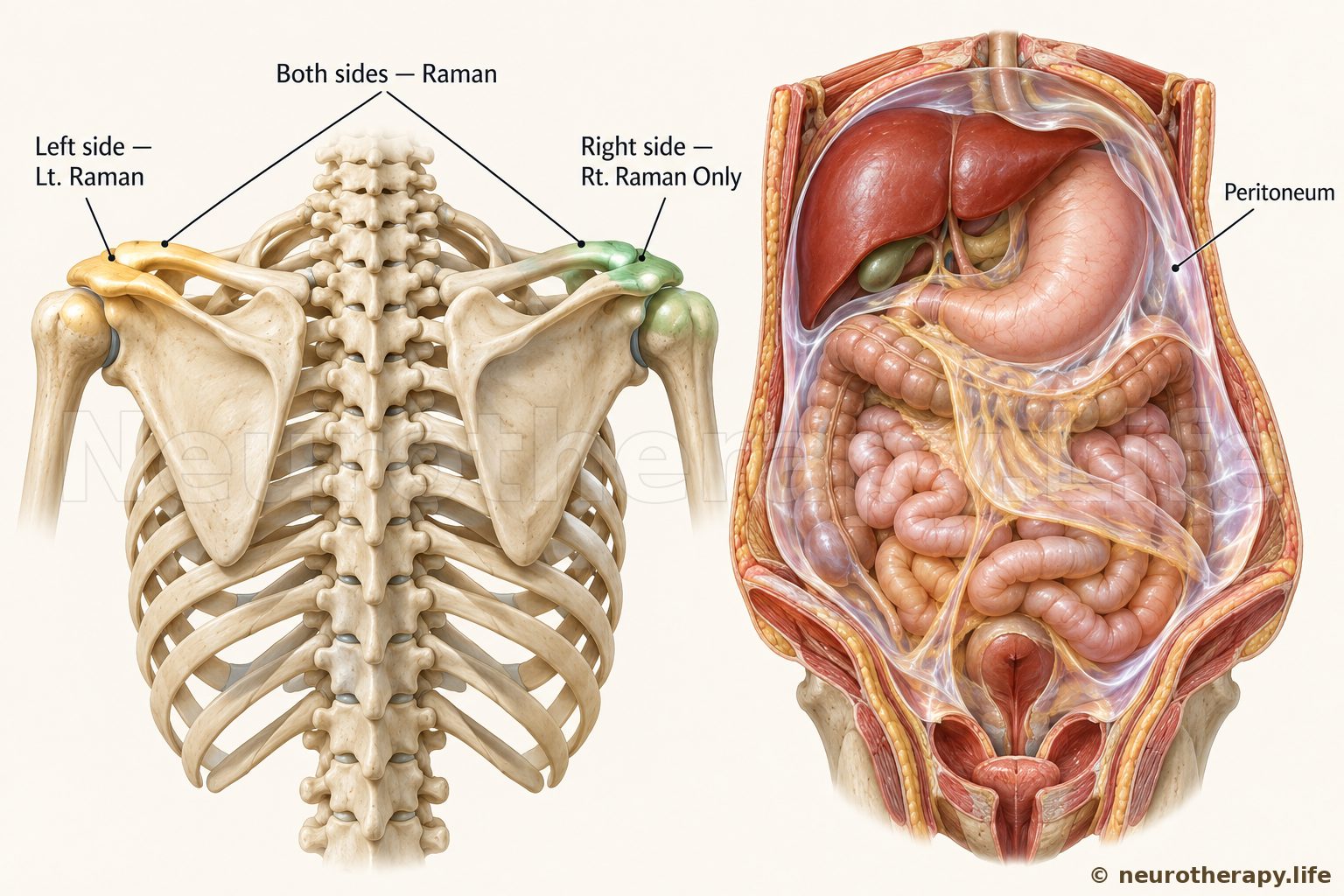
Raman is the Neurotherapy (LMNT) treatment of the peritoneum, the thin lining of the abdomen. It is written in three ways — both sides, right side alone, or left side alone — and the side is chosen by where the pain is and whether acid or alkali is raised. It is called a 'sure-shot' treatment for many of the body's pains.
Overview
What is the Raman treatment?
The peritoneum is a smooth, thin membrane that lines the inside of the abdomen and wraps around most of the organs there. It lets them glide against each other and helps protect them. Neurotherapy (LMNT) teaches that the Raman treatment rouses the peritoneum.
The teaching calls it a rāmbāṇ — a sure-shot — treatment that can end many of the body's pains. It is also named as useful in all problems of the uterus and the testes.
Raman is written in three ways. 'Raman' means both sides. 'Rt. Raman Only' means the right side alone. 'Lt. Raman' means the left side alone. In some treatments it is also joined after (4) Medulla clockwise with T1/T2, which widens its reach. It also forms part III of the Complement System.
Raman is given seated, from behind, on both sides or on one side — and is taught to rouse the peritoneum, the lining of the abdomen.
What it is for
What is each form of Raman used for?
Raman (both sides): for the peritoneum, for many of the body's pains, and for all problems of the uterus and the testes.
Rt. Raman Only: for right-sided pain — from the right shoulder to the fingers of the right hand, the right chest and the right forehead. These pains often come from raised alkali.
Lt. Raman: for left-sided pain, including pain in the ring finger of the left hand. These pains often come from raised acid.
After (4) Medulla clockwise with T1/T2: for pains of the neck, shoulders, arms and hands, both sides of the chest, hiccups and hiatus hernia.
All three forms work through the same point, Raman, given seated from behind over the shoulders. What changes is the side. The exact method is taught hands-on in the Neurotherapy (LMNT) course. This page lists the points of the formula and what each one contributes; it does not describe how any point is given. For the method, watch the demonstration video of each point on its own page and learn hands-on from a trained Neurotherapist. Please do not give a formula from a written description alone.
The back muscles are lifted upward with both hands over the shoulders, then released slowly, and the patient takes a few easy breaths. It rouses the peritoneum and reduces acid.
The upper chest level of the spine used with (4) Medulla clockwise in that combined form.
Position:Seated, with the therapist behind the patient.
The exact technique is taught hands-on in the Neurotherapy (LMNT) course. See the course →
How it works
How is the side chosen?
Raman reduces acid, so alkali rises. That is why it has a gate. Before it is given, the therapist checks the two kidney codes, Liv° and Mu°. It suits the patient with more pain at Mu° and less or none at Liv°.
The side follows the signs. Pain at Mu° or in the left ring finger points to Lt. Raman. Pain at Liv° or in the right ring finger points to Rt. Raman Only. Equal pain on both points to both sides.
The teaching once said Raman should not be given when alkali has increased. It now says some change has come in that thinking, without fixing a new line. So the kidney codes stay the gate, and the therapist writes down what is seen.
Its family
Which formulas use Raman?
Raman appears inside several larger Neurotherapy (LMNT) treatments.
Complement System — Raman is part III of this long treatment, for the peritoneum, so that all the organs work properly.
The gate: Raman reduces acid and raises alkali. Check Liv° and Mu° first. Given without the check to someone with pain at Liv° and none at Mu°, the pain can increase sharply. Raman
No pressure on the front or sides of the neck. New neck pain with an unusual headache, disturbed vision or numbness stops treatment and goes to a doctor. How to tell a patient to see a doctor
Chest pain that may come from the heart is a doctor's matter first. Raman in a heart treatment is given only alongside heart care. Angina (chest pain from the heart)
A testis that has not come down in a boy needs a doctor's check; any treatment is alongside that care.
Keep taking the medicines your doctor prescribed. Neurotherapy (LMNT) works alongside your medical care, never instead of it.
Guruji says
“Earlier it was thought that Raman treatment should not be given to those whose alkali has increased; but now some change has come in this thinking.”
— Dr. Lajpatrai Mehra
A teaching case
Teaching case: the woman who walked by swaying
A woman in her forties with osteoarthritis of the knee could walk only by swaying from side to side. The usual knee treatments brought no special benefit. She was then given a short course of Raman, which is not a knee treatment at all but works at a different level of the body. Her walk improved straight after the treatment, and within a few days she was well.
A composite case written to teach the reasoning — not one patient’s file.
Common questions
Why is it called 'the three ways it is written'?
Because on a treatment card Raman appears as Raman (both sides), Rt. Raman Only, or Lt. Raman. Each is a different treatment for a different picture.
My pain is in my knee. Why is the therapist working on my shoulders?
Raman is taught to work on the peritoneum, not on one joint. It is used when the pains of the body will not clear by the usual route.
Why does the therapist press my ring fingers first?
Pain in the left or right ring finger is one of the signs used to read whether acid or alkali is raised, and so which side of Raman suits you.
What should I feel during Raman?
A firm lift across the upper back and shoulders, then a slow release, followed by a few easy breaths. It should not hurt the neck.
Surprising facts
1The peritoneum is about the size of your skin
Spread flat, the peritoneum's surface area is roughly 1.5 to 2 square metres — close to that of the skin.
Source: Gray's Anatomy, 41st ed. — the peritoneum; surface area approximately equal to that of the skin.
2The peritoneum is used to clean the blood
Its large, thin surface lets water and waste pass across it so easily that doctors use it for peritoneal dialysis when the kidneys fail.
Source: Guyton & Hall, Textbook of Medical Physiology, 14th ed. — dialysis; peritoneal membrane.
3Pain can be felt far from its source
Irritation of the diaphragm can be felt as pain at the tip of the shoulder, because both share nerve roots from the neck. Doctors call this referred pain.
Source: Guyton & Hall, Textbook of Medical Physiology, 14th ed. — referred pain.
Watch
How to Give 4 Medulla, Raman & T1 T2 in Neurotherapy | LMNT Cervical, Shoulder pain & Numbness
This video shows the right way to give (4) Medulla, Raman and the T1–T2 point for neck and shoulder pain and numbness.
This page explains what a Neurotherapy (LMNT) treatment is for; it is not a self-treatment guide and does not diagnose. Neurotherapy (LMNT) works alongside your medical care — keep taking the medicines your doctor prescribed.
Ready to begin?
Send COURSE for course details, or your name, age and health issue for a consultation.