Hydrocele
A hydrocele is a painless swelling of the scrotum, caused by clear fluid collecting in the thin sac around a testis. It is common in newborn boys and less common in men.
- About 10 in every 100 newborn boys have a hydrocele
- Only about 1 in 100 adult men have one
- Most baby hydroceles go away on their own within the first one to two years
- Sudden severe pain in a testis can be twisting (torsion) — if surgery is done within 6 hours, most of the testis can usually be saved
Source: Cleveland Clinic; MedlinePlus (hydrocele; testicular torsion)
What is Hydrocele?
Each testis sits inside a thin covering sac in the scrotum. Normally this sac holds only a tiny film of fluid. In a hydrocele, clear fluid builds up in the sac, and one side of the scrotum (sometimes both) swells up.
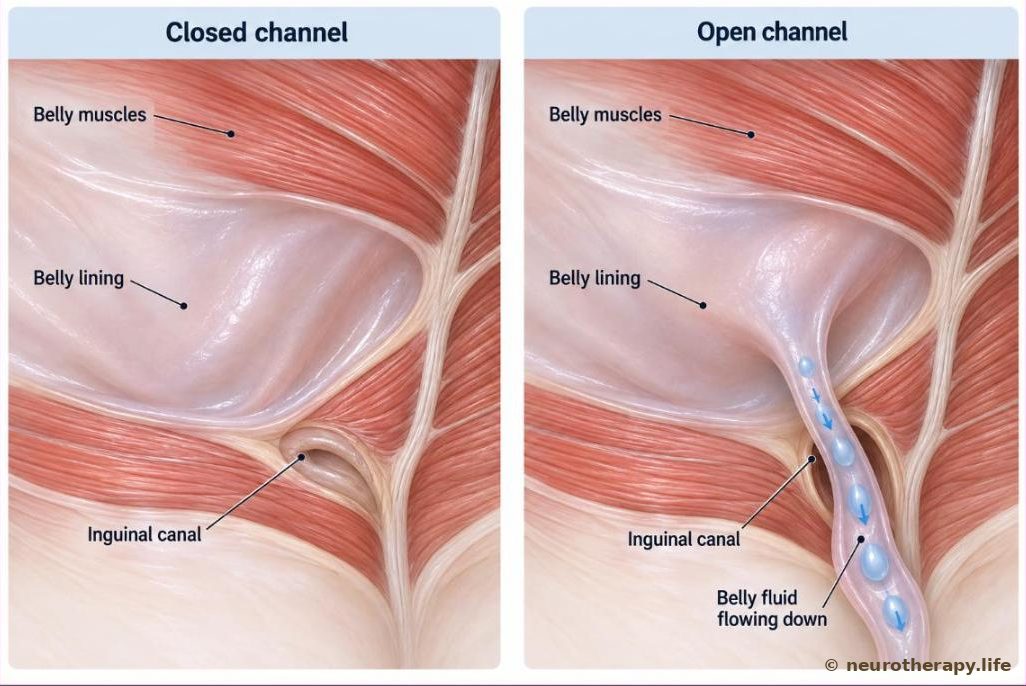
In babies, the testes come down from the belly before birth through a small channel. If the channel does not close, fluid from the belly can run down into the sac. In men, a hydrocele can follow an injury or an infection, or appear when the sac makes more fluid than it can soak back up.
What are the symptoms?
- A soft, painless swelling on one or both sides of the scrotum
- A feeling of heaviness or dragging, more after standing
- In some babies, a swelling that gets bigger during the day and smaller by morning
- Itching of the skin of the scrotum in some people
- In LMNT: a sharply tender point in the calf, a hand's breadth above the ankle
What causes it, and who is more likely to get it?
In babies
- The channel the testis came down through does not close
- Being born early (premature babies)
In men
- An injury to the scrotum
- Infection or inflammation of the testis or the tube behind it (epididymis)
- The sac makes fluid faster than it can soak it back
Things that can look like a hydrocele
- A hernia — a swelling that runs up into the groin or changes with straining
- Twisting of the testis (torsion) — sudden, severe pain
- A firm lump inside the testis itself — needs urgent checking
How is it found?
Every new swelling of the scrotum is first seen by a doctor, because a few other problems look similar and two of them are urgent. The doctor examines the area and usually confirms a hydrocele with a light or an ultrasound.
Physical examination
The doctor feels the swelling, checks whether it is tender, and checks the groin for a hernia.
Light test (transillumination)
A torch is held behind the swelling. Clear fluid lets the light glow through; a solid lump does not.
Ultrasound of the scrotum
The most common scan. It shows the fluid, checks the testis inside, and helps rule out a hernia or a lump.
A neurotherapist first asks, plainly and without embarrassment, about any swelling, heaviness or itching of the scrotum — and makes sure a doctor has seen it. Then the therapist presses gently in the calf, four to five inches above the ankle: in a person with this trouble, that point is usually very tender, and the side where it hurts most decides which leg is worked.
How Neurotherapy (LMNT) sees Hydrocele
In LMNT, a hydrocele is met in an unexpected place — the calf. Guruji's teaching says that people with swelling or itching of the scrotum have a great deal of pain in the calf muscle, four to five inches above the ankle joint. That tender spot is the Hydrocele point. The ovary points, Lt. Ov. and Rt. Ov., which in a man serve the testis of the same side, are given for the side of the swelling.
LMNT is equally clear about what the calf point does not do. Relief in the calf is real, but it is not information about the scrotum. A point whose use names a distant organ obliges the therapist to ask about that organ — and to send the person to a doctor either way.
Whether or not the patient gets immediate benefit from our treatment, let no harm reach him through our carelessness — attend to this.
Neurotherapy (LMNT) treatment for Hydrocele, step by step
Ask, and send to a doctor
The therapist asks about the swelling in the same calm voice as everything else: is it painful, and is it getting bigger quickly? Any new, painful or fast-growing swelling is seen by a doctor the same day. Sudden severe pain goes to the emergency department at once.
Find the point in the calf
The point is found by touch before it is treated — about a hand's breadth above the bony knob on the inside of the ankle, where the soft calf muscle narrows into the tendon. The person with this trouble will say at once that it hurts.
The Hydrocele point
The therapist's heel comes in from the side onto that painful spot — press and release, two to four times only. According to the pain, one leg or both are worked, together or separately.
The side of the swelling: Lt. Ov. or Rt. Ov.
In a man, Lt. Ov. serves the left testis and Rt. Ov. the right. LMNT teaching gives the one on the side of the hydrocele — unless one of its bars applies.
Keep the doctor's follow-up
Less pain in the calf does not mean the swelling has been checked. The person keeps the doctor's appointment and scans whether the leg hurts or not.
Points and formulas used
Hydrocele Point
A point in the calf, found by its tenderness, pressed with the heel from the side — for those with swelling or itching of the scrotum.
Open →Never do this
- Sudden severe pain in the scrotum or groin, often with vomiting — most often in a boy or a young man — may be twisting of the testis. It is measured in hours: go to the emergency department at once (call 108/112). Nothing is pressed or manipulated.
- Any new, painful or fast-growing swelling of the scrotum is seen by a doctor the same day. A firm lump felt inside the testis itself needs urgent checking. A swelling that comes and goes with standing or straining, or runs up into the groin, may be a hernia. Hernia
- Lt. Ov. and Rt. Ov. are not given in cancer, in the teenage years, or to children being treated to increase height — they can make the growth plates close early. Teenage years
- Children get half the adult dose and light treatment only, given by a trained therapist. A hydrocele in a baby is followed by the child's doctor.
- Cancer: if the person has cancer, (10) Pan, Thymus, Pit, Lu + Sh, Rt. Ov / Lt. Ov and (30) Medulla are never given — the therapist changes the plan.
- Keep taking the medicines your doctor prescribed. Neurotherapy (LMNT) works alongside your medical care, never instead of it.
From practice
The young man who came about his calf
A teaching case — a composite from practice, not one patient's file
22 years · student · pain in the right calf for about six weeks
- What was found
- His calves looked normal, but a light press a hand's breadth above the right inner ankle made him jump; the left was tender too, less so. Asked calmly whether anything else was swollen, he admitted that one side of his scrotum had been swollen for three months. He had told no one.
- What was done
- The Hydrocele point was given on the right leg, three times, and on later visits on both legs as the pain decided. He was sent to hospital that week with a note, and told plainly that the calf treatment had not looked at his swelling. The ultrasound showed a simple collection of fluid, and the surgeon let him choose to wait and be reviewed.
- What it teaches
- Relief in the calf is real, and it is not information about the scrotum. Ask about the embarrassing thing in the same voice as everything else — and make the referral either way.
From Ayurveda and the kitchen
Test yourself
What research says
- Strong evidence
About 80 in 100 full-term baby boys are born with the channel from the belly still open; in most it closes by age two. In men, a hydrocele usually comes from an imbalance — the sac makes more fluid than it soaks back.
No clinical trial of Neurotherapy (LMNT) in hydrocele has been published yet. Improvements reported by neurotherapists are clinical observations.
For you
Parents of a baby boy
A soft, painless swelling in a newborn often settles by itself. Show it to the child's doctor, and go at once if it becomes painful, red or hard, or the baby vomits.
Boys and young men
Do not let shyness decide. Any swelling or lump in the scrotum deserves a doctor's look — and sudden pain there is an emergency.
Men after an injury or infection
A hydrocele can follow a blow or an infection of the testis. Get the cause checked and treated, not just the swelling.
This page explains; it does not diagnose. Neurotherapy (LMNT) works alongside your medical care — keep taking the medicines your doctor prescribed, and see a doctor for any new or severe symptom.