The reproductive system is the one body system you do not need to stay alive — yet without it there would be no next generation. Its organs make eggs or sperm, make the sex hormones that shape puberty, the monthly cycle and much of adult health, and in women carry a pregnancy for about nine months.
Overview
What is the reproductive system?
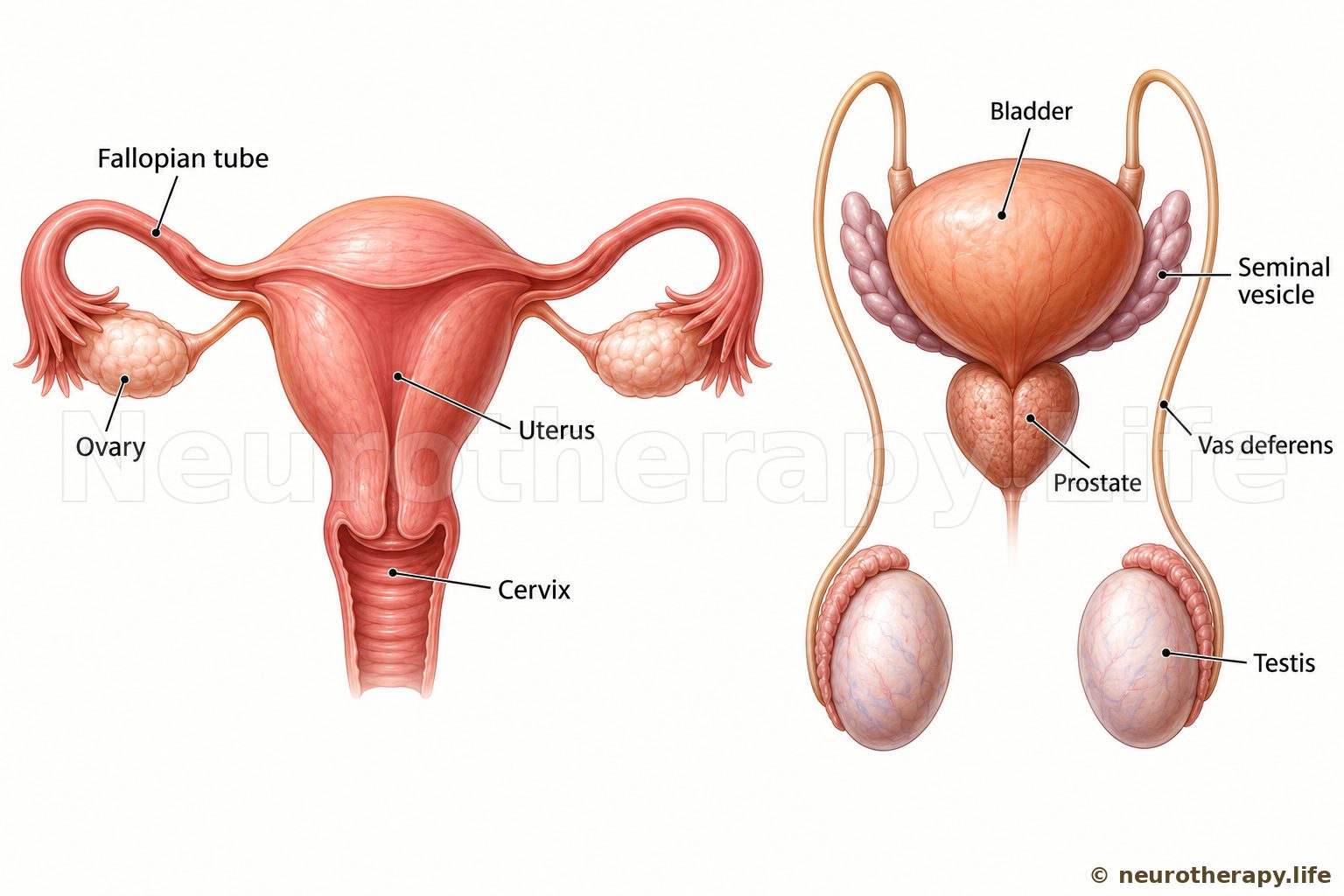
The reproductive system is the group of organs that makes a new life possible. In a woman, its main inner organs are the two ovaries, the two fallopian tubes, the uterus (womb) and the cervix, its neck. In a man, they are the two testes, the tubes that carry sperm, the seminal vesicles and the prostate gland.
These organs are also hormone glands. The ovaries make oestrogen and progesterone; the testes make testosterone. A pea-sized gland under the brain, the pituitary, tells them how much to make — so the reproductive system and the glands-and-hormones system work as one team.
Most of these organs lie low in the belly, inside the bowl of the hip bones called the pelvis. Their troubles are often felt as pain below the navel or low in the back — and many people feel shy to speak about them. On this page the words for the body are the ordinary, correct words, said plainly, because shyness is how important signs get missed.
The inner reproductive organs of a woman (left) and a man (right). Many of them are also hormone glands.
Function
What does the reproductive system do?
Its main job is to make a baby possible: to make an egg or sperm, to bring them together, and — in a woman — to shelter and feed the growing baby until birth. Along the way it makes hormones that affect almost the whole body.
Makes the sex cells — eggs in the ovaries, sperm in the testes.
Makes the sex hormones — oestrogen and progesterone in women, testosterone in men — which bring on puberty and keep bones, muscles, skin and mood in balance.
Runs the monthly cycle, in which the ovary releases an egg and the uterus prepares a fresh lining.
Carries sperm from the testes through a long chain of tubes, mixed with fluid from the seminal vesicles and the prostate.
Shelters, feeds and finally delivers a baby — the uterus grows many times its size in pregnancy and then shrinks back.
How does the reproductive system work with other organs?
Pituitary gland — The pituitary sends two messenger hormones, FSH and LH, that switch the ovaries and testes on and set their pace.
Glands and hormones — The ovaries and testes are themselves hormone glands, so this system overlaps with glands and hormones.
Thyroid — A thyroid that works too slowly or too fast can upset the monthly cycle and fertility.
Bladder — The bladder sits just in front of the uterus, and just above the prostate — so these organs often affect passing urine.
Kidneys and urinary system — In men, urine and semen leave through the same tube, the urethra, which runs straight through the prostate.
Intestines — The last loops of the large intestine lie right beside the uterus, ovaries and prostate; a loaded bowel can press on them and cause pain low in the belly.
Blood — Heavy periods drain the body's iron; a pregnant woman's blood volume rises by about half.
Three groups: the woman's organs, the man's organs, and the control centre in the brain that runs both.
A woman's inner organs
Ovaries — Two almond-sized glands, one on each side of the uterus. They store the eggs and make oestrogen and progesterone.
Fallopian tubes — Two thin tubes, about 10 cm long, whose fringed ends catch the egg and carry it towards the uterus. This is usually where egg and sperm meet.
Uterus (womb) — A hollow, pear-shaped muscle whose lining thickens every month. If there is no pregnancy, the lining is shed as the period.
Cervix — The narrow lower neck of the uterus, opening into the birth canal (vagina). It stays nearly closed in pregnancy and opens in labour.
A man's inner organs
Testes — Two oval glands that hang in a skin pouch (the scrotum), outside the belly, where it is a little cooler. They make sperm and testosterone.
Epididymis — A tightly coiled tube on the back of each testis, where young sperm are stored and mature.
Vas deferens — A firm tube that carries sperm up from each testis, into the pelvis and behind the bladder.
Seminal vesicles — Two small pouches behind the bladder that add most of the fluid in semen.
Prostate gland — A walnut-sized gland under the bladder, wrapped around the urethra. It adds a thin, milky fluid to semen.
The control centre
Neither the ovaries nor the testes decide on their own how much to make. A chain of command in the brain does.
Hypothalamus — A small area deep in the brain that sends pulses of a releasing hormone to the pituitary.
Pituitary gland — Answers with FSH and LH, which ripen eggs, trigger the release of an egg, and drive sperm and testosterone production.
Feedback — The sex hormones travel back to the brain and tell it to ease off — like a thermostat that switches the heater off when the room is warm.
The journey
Before birthThe first months in the womb
For the first weeks, a baby's sex glands look the same in boys and girls. Then they become ovaries or testes. A baby girl's ovaries hold their largest number of egg cells — millions — at about five months of pregnancy.
ChildhoodBirth to about 8–9 years
The organs are small and quiet. The testes should have come down into the scrotum by birth or within the first months.
PubertyUsually 8–13 in girls, 9–14 in boys
The pituitary wakes the ovaries and testes. Periods begin, sperm production starts, and height shoots up — until the growth plates at the ends of the long bones close.
The fertile yearsRoughly the late teens to the 40s
A woman usually releases one egg a month; a man makes fresh sperm every day. A pregnancy lasts about 40 weeks counted from the last period.
Menopause and later lifeUsually between 45 and 55 in women
The ovaries run out of eggs, periods stop and oestrogen falls, which speeds bone thinning. In men, testosterone falls slowly over many years, and the prostate often grows.
Where is the reproductive system located?
Most of it sits in the pelvis — the bony bowl formed by the hip bones at the bottom of the trunk. In a woman, the uterus sits in the middle of the pelvis with the bladder in front of it and the last part of the bowel (the rectum) behind it. The ovaries lie on the side walls of the pelvis, one on each side.
In a man, the prostate sits just below the bladder and in front of the rectum. The testes are the exception: they start life inside the belly near the kidneys, travel down before birth, and hang outside the body in the scrotum, where they stay about 2–3 °C cooler.
Because these organs lie so low, their trouble is often felt below the navel, in the groin, or low in the back over the flat bone at the base of the spine (the sacrum). LMNT's back-pain chart marks the same place: pain at the lower lumbar and upper sacral level is linked with the uterus, the prostate and the urinary tract.
The uterus is a firm, pinkish, upside-down pear. The ovaries are pale, greyish-white and almond-shaped; before the menopause their surface looks slightly bumpy from the small egg sacs inside, and after it they become smaller and smoother.
The testes are smooth, firm ovals wrapped in a tough whitish coat, each with a soft coiled tube (the epididymis) along its back. The prostate is a rubbery, rounded gland shaped a little like a walnut or a chestnut.
How big are the reproductive organs?
In an adult woman who is not pregnant, the uterus is about 7.5 cm long, 5 cm wide and 2.5 cm thick — about the size of a small pear. Each ovary is about 3 cm long, the size of an almond. Each fallopian tube is about 10 cm long.
In an adult man, each testis is about 4–5 cm long. The prostate is about the size of a walnut and weighs about 20 grams, though it often grows larger after the age of 50.
Conditions and disorders
What conditions and disorders affect the reproductive system?
Problems can affect the monthly cycle, the uterus and ovaries, fertility, pregnancy, the testes and the prostate. Some are very common and harmless; a few are serious and time-sensitive, so new symptoms here always deserve a proper check.
Low height in children (short stature)Sex hormones close the growth plates; this is why the ovary points are not given to children being treated for height.
OsteoporosisAfter the menopause, falling oestrogen speeds up bone thinning.
Cancer care: Neurotherapy (LMNT) supportCancers of the cervix, uterus, ovary, testis and prostate — each needs specialist care; LMNT changes its plan completely.
Signs that travel
AnaemiaHeavy periods are the commonest cause of iron shortage in women of childbearing age.
HypothyroidismA slow thyroid can bring early or heavier periods and make it harder to conceive.
Urinary problemsA prolapse or a growing prostate often shows first as trouble passing urine.
Low back painTrouble in the womb or prostate is often felt low in the back, over the sacrum.
What are common signs of a reproductive problem?
Periods that are very heavy, very painful, very irregular, or that stop without pregnancy
Any bleeding after the menopause, between periods, or after intercourse
Discharge that is coloured, bad-smelling, itchy or blood-stained
Pain below the navel, in the groin, or low in the back over the sacrum
A lump, swelling or sudden pain in a testis or the scrotum
A weak or stop-start urine stream, straining, or waking often at night to pass urine
Not conceiving after a year of trying
What tests check the reproductive system?
Pelvic ultrasound (sonography) — Sound waves show the uterus, ovaries, fibroids, cysts and a prolapse without any radiation.
Hormone blood tests — FSH, LH, oestrogen, progesterone, testosterone, prolactin and thyroid (TSH), usually timed to a day of the cycle.
Pap smear and HPV test — A few cells from the cervix are checked for early changes that could, over years, turn into cancer.
Semen analysis — Counts the sperm and checks how well they move and how they are shaped — a key test when a couple cannot conceive.
PSA blood test — Measures a protein made by the prostate; a raised level needs a doctor to work out why.
Scrotal ultrasound — Shows a swelling or lump in the scrotum and, with Doppler, whether blood is still reaching the testis.
Haemoglobin — A simple blood count that shows whether heavy periods have drained the body's iron.
How are reproductive conditions treated?
Lifestyle changes — A healthy weight, regular activity, no tobacco and less alcohol help periods, fertility, and prostate symptoms alike.
Medicines — For example iron, pain relief for period cramps, hormone treatments, antibiotics for infection, and medicines that ease prostate symptoms — prescribed and adjusted by a doctor.
Fertility treatment — From medicines that help release an egg to IUI and IVF, chosen after both partners are tested.
Pelvic floor exercises and physiotherapy — Strengthening the muscles at the base of the pelvis helps a mild prolapse and leaking urine in women, and continence after prostate surgery in men.
Surgery — Such as removing fibroids or the uterus, prolapse repair, prostate operations, hernia or hydrocele repair, and bringing down an undescended testis.
Screening and vaccination — Cervical screening and the HPV vaccine prevent most cervical cancer; the mumps vaccine protects boys' testes.
Neurotherapy (LMNT)
LMNT never presses on the lower belly to reach these organs. The points for the pelvic organs — WD, Rt. Ov. and Lt. Ov. — are named after places below the navel where pain is found, but they are given on the forearms, from elbow to wrist, which carries none of the risk of pressure on the pelvis. The names are addresses, not descriptions: Rt. Ov. means 'right ovary or right testis', and WD covers 'the uterus or the prostate' — one point, either sex. What the therapist reads is pain below the navel and low in the back. Around these points stands a set of bars that is stricter here than anywhere else: the four days of the period, pregnancy, the teenage years, a wish for a child, and cancer.
Points
WD — The midline point below the navel, for the uterus and the prostate. Given on both forearms, it is used to increase blood flow in the uterus, and in the prostate and genital organs in men; also in prolapse, control of urine, menstrual pain and infertility. Not given in cancer or in the teenage years.
Rt. Ov. — Right ovary or right testis — for pain low on the right below the navel. Given on the left forearm, because in LMNT's map the arm on one side answers the belly on the other.
Lt. Ov. — Left ovary or left testis — for pain low on the left, given on the right forearm. Neither ovary point is given in cancer, in the teenage years, or to a child being treated for height.
P point — The prolapse point, for a womb that has moved down — given only when sonography shows the prolapse, and always followed at once by (6) WD.
Triangle for Piles — Given on the sacrum; the teaching says it strengthens the pelvic muscles and tightens the sphincters of the bladder, uterus and back passage — used for prolapse and very heavy menstrual flow.
Raman — The treatment of the peritoneum, the thin lining of the belly. The teaching calls it useful in all problems of the uterus and the testes.
Ton 'P' — A treatment of the parotid glands in the cheek. Because mumps, a parotid illness, can harm the testes, the teaching thinks Ton 'P' and Ton 'T' may have some relation with fertility — so they are not given to young people or to a woman who wants a child.
Hydrocele Point — For swelling or itching of the scrotum, found as a very tender spot in the calf above the ankle — given with the heel, and always alongside a doctor's check of the swelling.
(8) Pan (6) WD (8) Ch. Only (20) Round Arrow. Over sixty years the teaching found pain below the navel in almost all diseases of the genital organs, and names this formula for all problems of the uterus and the prostate, white discharge and low back pain.
“The patient is a form of God. If your spectacles are the right ones, then a therapist — whether a woman or a man — can treat any patient.”
— Dr. Lajpatrai Mehra
“The research is still to be done.”
— Dr. Lajpatrai Mehra
“This matter is to be publicised as widely as possible: that the cord should not be cut until the child itself has cried properly for some time.”
— Dr. Lajpatrai Mehra
Never do this
Emergency — call 108/112 or go to hospital at once: sudden severe pain in a testis or the scrotum, often with vomiting (the testis may have twisted — it can be saved only within hours); sudden severe one-sided pain low in the belly with faintness, especially if a woman may be pregnant; heavy bleeding with dizziness or fainting. How to tell a patient to see a doctor
See a doctor — and keep treating alongside — for any bleeding after the menopause, bleeding between periods or after intercourse, a cycle that has recently changed, a lump in a testis, or difficulty passing urine. Warning signs that stop a Neurotherapy (LMNT) session at once
The four days: no treatment for any other problem during the period. A woman does come for flow that is very heavy, will not stop or is very scanty, or for pain and clots. No Heparin formula while the flow is heavy, and no Ku during the period. Neurotherapy (LMNT) during periods: the four-day pause and its exceptions
In the teenage years: Lt. Ov., Rt. Ov., WD, Ton 'P' and Ton 'T' are not given. Sex hormones close the growth plates early, and once closed, height does not increase. Teenage years (care for teenagers)
Ton 'P' is not given to any woman who wants a child, now or later. It is not proven to prevent pregnancy either, so it is never to be called a contraceptive. Ton 'P'
No deep or sustained pressure on the lower belly in pregnancy or possible pregnancy, with a coil in place, with a known cyst or lump in the pelvis, with a tender pelvis, after recent surgery there, or with infection there.
Consent and dignity come first: treatment in these regions is explained beforehand, the patient stays covered, and a chaperone is present where needed. Consent, dignity and a chaperone during treatment
Cancer: if the person has cancer, (10) Pan, Thymus, Pit, Lu + Sh, Rt. Ov / Lt. Ov and (30) Medulla are never given — the therapist changes the plan. WD is not given in cancer either. Cancer care: Neurotherapy (LMNT) support
Keep taking the medicines your doctor prescribed — in pregnancy, take nothing new without asking, and never stop a medicine you were given without asking the same doctor. Neurotherapy (LMNT) works alongside your medical care, never instead of it.
Care
How can I keep my reproductive system healthy?
Most of what protects these organs is simple, regular and cheap — and some of it is about speaking up early.
Know your normal
Keep a simple note of when each period starts and how many days it runs. A change in your own pattern is worth more than any average.
Check, and get checked
Women: cervical screening as your doctor advises. Men: feel each testis once a month after a warm bath, and report any new lump.
Vaccinate
The HPV vaccine, given ideally to girls aged 9–14, prevents most cervical cancer. The mumps (MMR) vaccine protects boys from mumps, which can inflame the testes.
Iron and water in heavy periods
Heavy periods drain iron: ask for a haemoglobin test, eat dal, greens and millets with something sour such as lemon or āmlā, which helps iron to be absorbed. LMNT's teaching also asks for at least ¾ litre of lukewarm — never hot — milk a day during heavy flow.
Folic acid before pregnancy
The WHO advises 400 micrograms of folic acid a day from before conception until 12 weeks of pregnancy, to protect the baby's spine and brain. Ask your doctor.
Sit and sleep straight
Guruji's daily rule: do not sit or sleep with one leg crossed over the other, because it puts a one-sided pull on the organs below the navel; sleep with straight legs. Until the habit goes, change legs often. This is a rule for the future — it does not mean an old problem was caused by how you sat.
Common questions
At what age do periods usually start and stop?
Most girls have their first period at around 12, though a little earlier or later is common. Periods usually stop for good between 45 and 55. A girl who has had no period by 15, or who shows signs of puberty before 8, should see a doctor.
How long is a normal cycle?
Counting from the first day of one period to the first day of the next, adult cycles usually last 21 to 35 days, and bleeding lasts 2 to 7 days. The famous '28 days' is only an average.
Why are the testes outside the body?
Because making sperm works best a few degrees below body temperature. Hanging in the scrotum keeps them about 2–3 °C cooler, and small muscles pull them closer to the body in the cold.
Is infertility always the woman's problem?
No. The cause can lie with the man, the woman, both, or be unexplained. This is why doctors test both partners — a semen analysis is simple and is usually one of the first tests.
Can I have Neurotherapy (LMNT) during my period?
Not for other problems — for the four days of the period, the course simply pauses. But you should come if the flow is very heavy, will not stop, is very scanty, or comes with pain or clots: those are treated during the period itself.
Is Neurotherapy (LMNT) safe in pregnancy?
Some of it is and some of it is not. A trained therapist who knows you are pregnant leaves out Thymus, Thymus + Chest, Ton 'P' and Ton 'T', never presses on your belly, and gives nothing from which the child may have trouble. Your doctor or midwife stays in charge of the pregnancy.
What should I ask my doctor or therapist?
Is my cycle, or my urine flow, normal for my age — and what change should make me come back?
What does my ultrasound actually show, and does it need follow-up?
Should both of us be tested, since we have not conceived?
Which of my medicines are safe if I become pregnant, and which must never be stopped?
Am I due for cervical screening, or a PSA discussion?
(To the therapist) Which points are blocked for me — because of my age, a pregnancy, a wish for a child, or my history — and what is given instead?
Surprising facts
1A girl is born with all the eggs she will ever have
Egg cells are not made after birth. A baby girl is born with about 1–2 million; by puberty about 300,000–400,000 are left; and over a whole lifetime only about 400–500 are ever released. The rest simply fade away, month by month.
The adult testes can make up to about 120 million sperm a day — more than a thousand every second, day and night. Yet each single sperm takes about 74 days to be made from start to finish.
Source: Guyton & Hall, Medical Physiology — male reproductive functions (up to 120 million sperm a day; spermatogenesis about 74 days); Heller CG, Clermont Y, Science 1963.
3Boy or girl, it starts the same
For the first six or seven weeks in the womb, a baby's sex glands look exactly the same in boys and girls. A single gene on the Y chromosome then tips them towards becoming testes; without it they become ovaries. That shared beginning is why the ovary and the testis have the same blood supply from near the kidneys — and why LMNT's Rt. Ov. and Lt. Ov. points serve either sex.
Source: Langman's Medical Embryology — the indifferent gonad and the SRY gene; Gray's Anatomy — gonadal arteries from the abdominal aorta. LMNT: sec. 6.3-11 ('one point, either sex').
4The testes live in a cooler room
Sperm are made best at about 2–3 °C below body temperature. So the testes hang outside the body, and the veins around each one form a tangle that cools the incoming blood like a radiator. In the cold, small muscles lift them closer to the body for warmth.
Source: Guyton & Hall, Medical Physiology — effect of temperature on spermatogenesis; Gray's Anatomy — pampiniform plexus and cremaster muscle.
5The womb grows about 15 times heavier in pregnancy
A non-pregnant uterus weighs about 70 grams and holds about 10 millilitres. By the end of pregnancy it weighs about 1,100 grams and holds about 5 litres — mostly by stretching and enlarging the muscle cells it already has. Within about six weeks after birth, it shrinks almost all the way back.
Source: Williams Obstetrics — uterine growth in pregnancy (about 70 g to about 1,100 g; volume about 10 mL to about 5 L) and puerperal involution.
6The egg is the largest cell in the human body
A human egg is about 0.1 mm across — roughly the thickness of a hair, and just about visible to the naked eye. A sperm's head is about twenty times narrower. The smallest cell and the largest cell have to meet for a new life to begin.
Source: Standard human histology and embryology (oocyte diameter about 100–120 µm; sperm head about 5 µm); Langman's Medical Embryology.
7Both sexes make both hormones
Women's ovaries and adrenal glands make small amounts of testosterone, and men's bodies turn some testosterone into oestrogen, which men need for strong bones. The difference between the sexes is in the balance, not in having one hormone and lacking the other.
Source: Guyton & Hall, Medical Physiology — ovarian and adrenal androgens; aromatisation of testosterone to oestradiol in men and its role in male bone health.
8About 1 in 6 people face infertility
A WHO-backed analysis of studies from around the world found that about one in six adults experiences infertility at some point in life — in rich and poor countries alike. It is common, it is nobody's fault, and it is a medical question for both partners.
Source: Cox CM et al., Human Reproduction Open 2022; WHO, 'Infertility prevalence estimates 1990–2021' (2023).
The reproductive system in numbers
~120 millionsperm the adult testes can make in a day
~74 daysto make one sperm, start to finish
1egg usually released in each cycle
21–35 daysthe usual length of an adult cycle
~40 weeksof pregnancy, counted from the last period
2–3 °Ccooler in the scrotum than inside the body
Yoga
Baddha Koṇāsana — the butterfly Baddha Koṇāsana
Benefits
Gently opens the hips and inner thighs, and eases stiffness around the pelvis.
Encourages an upright, relaxed sitting posture — the opposite of sitting with one leg crossed over the other.
Easy to do daily, and many women find it comfortable during period discomfort.
How to do it
Sit on a folded blanket with the legs straight.
Bend the knees and bring the soles of the feet together, heels as close to the body as is comfortable.
Hold the feet, sit tall, and let the knees sink slowly towards the floor — never push them down.
Breathe slowly for 1–2 minutes, then straighten the legs.
Take care
Put cushions under the knees if the hips are stiff. Skip it with a groin or knee injury, or a groin hernia. In pregnancy, do it only as your doctor and a trained teacher advise.
Setu Bandhāsana — the bridge Setu Bandhāsana
Benefits
Works the buttock and pelvic floor muscles that hold the pelvic organs up.
Strengthens the low back gently without load on the spine.
How to do it
Lie on your back, knees bent, feet flat and hip-width apart, arms by your sides.
Breathing out, lift the hips slowly until the body is a straight slope from knees to shoulders.
Hold for 3–5 easy breaths, without holding the breath.
Roll down slowly, one part of the back at a time. Repeat 3–5 times.
Take care
Avoid it with neck pain or a recent neck, back or belly operation. Skip it during the period if lifting the hips feels uncomfortable; in the later months of pregnancy, lying flat on the back is not advised.
Calms the stress response, which affects both the monthly cycle and male hormones.
Simple enough to do on a chair, in any season of life.
How to do it
Sit comfortably with a straight back, on the floor or a chair.
Close the right nostril with the thumb and breathe in slowly through the left.
Close the left nostril, open the right, and breathe out slowly through the right.
Breathe in through the right, switch, and breathe out through the left. That is one round; do 5–10 minutes.
Take care
Never force or hold the breath. People with heart disease or high blood pressure, and pregnant women, should avoid breath-holding and fast breathing practices unless their doctor agrees.
Watch
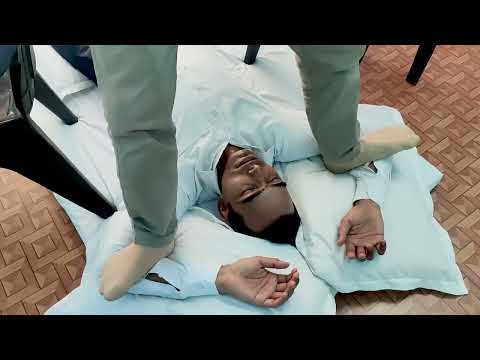
NEW GENES FORMULA - LMNT Neurotherapy
A step-by-step demonstration, in Hindi, of the New Genes formula: (8) Pan at the thigh–hip crease, (6) WD on both forearms, (8) Ch. Only and the Round Arrow, with the patient's position and how each count is kept.
TREATMENT FOR PAIN DUE TO LFT OV - LMNT Neurotherapy
A demonstration, in Hindi, for period pain felt on the left side: (30) Medulla on the nape, then (6) Lt. Ov. on the forearm, and Thymus + Chest.
(30) Medulla is not given to heart patients. Thymus + Chest is not given in pregnancy, diabetes, heart, kidney or autoimmune disease. Ovary points are not given to teenagers or in cancer.
Test yourself
Research
Strong evidence
A systematic review of 133 studies from around the world, used by the WHO, found that about 17.5% of adults — roughly one in six — experience infertility during their lives, with similar rates in rich and poorer countries.
Pooling data from thousands of men, researchers found that sperm counts in North America, Europe, Australia and New Zealand roughly halved between 1973 and 2011 — a reason to take men's reproductive health as seriously as women's.
Combining egg counts from many studies into one model, this paper showed that by age 30 a typical woman has only about 12% of her peak egg supply left, and by 40 about 3%.
This page explains how the body works; it does not diagnose. Neurotherapy (LMNT) works alongside your medical care — keep taking the medicines your doctor prescribed, and see a doctor for any new or severe symptom.
Ready to begin?
Send COURSE for course details, or your name, age and health issue for a consultation.