Also called: Angiotensin #2 formula, Angiotensin II formula, Angiotensin 2
Angiotensin No. 2 is the Neurotherapy (LMNT) formula for blood pressure that has fallen suddenly after about half a litre of blood has been lost — through an accident, a miscarriage, an operation or very heavy periods. It works through the liver, the left kidney and the top of the lungs, the three organs of the body's own pressure-raising chain.
Overview
What is the Angiotensin No. 2 formula?
When the body loses blood, it has its own way of holding the pressure up. It makes a hormone called angiotensin II (angiotensin No. 2). This hormone narrows the blood vessels and tells the kidneys to hold on to salt and water, so the pressure climbs back to normal.
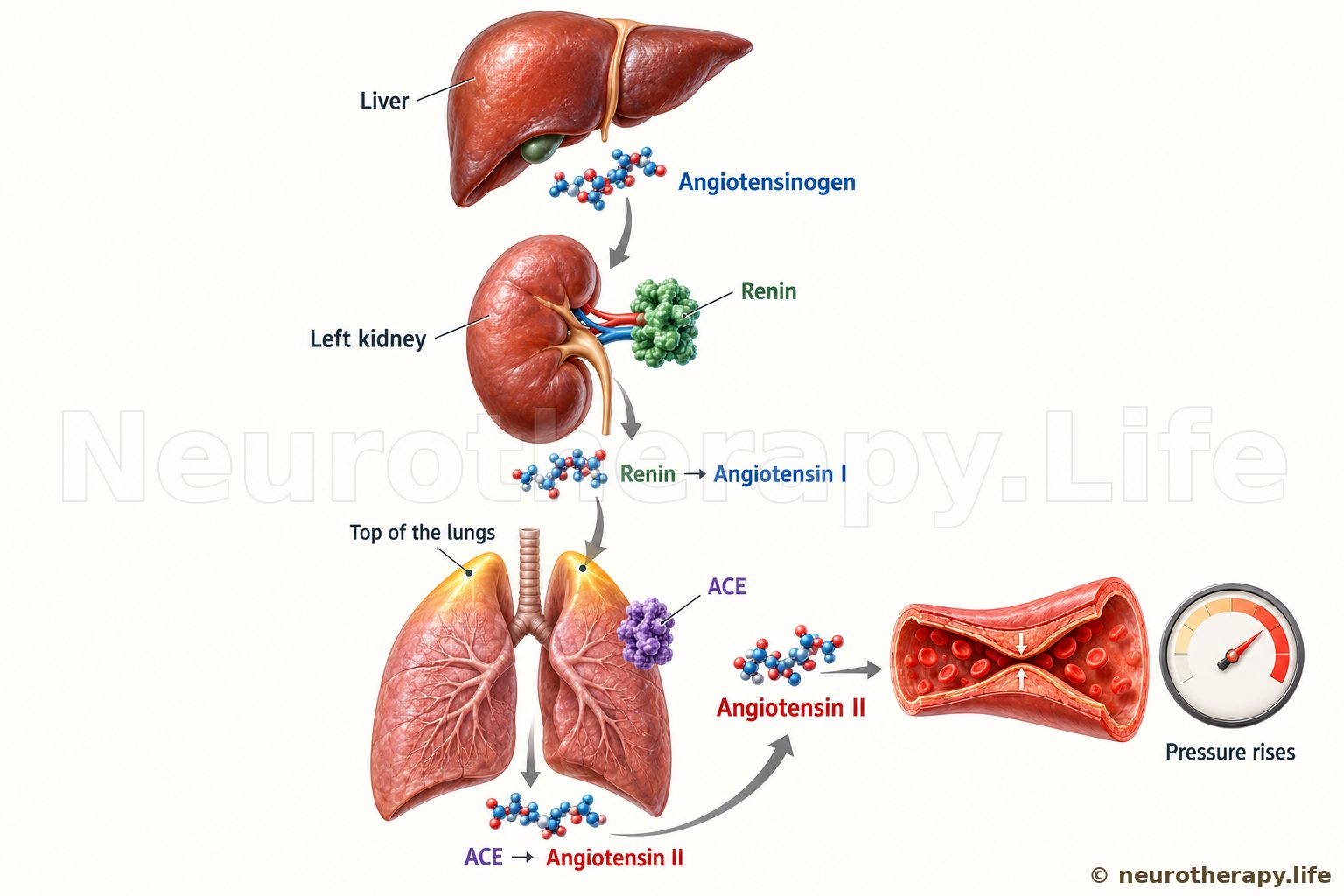
Making that hormone takes three organs. The liver makes the starting protein, angiotensinogen. The kidney releases renin, which turns it into angiotensin I. The lungs make the enzyme ACE, which turns angiotensin I into angiotensin II. Guruji asked a simple question: if we rouse these three organs, will the body make angiotensin II of itself? This formula is his answer, and it is named after the hormone.
It is recorded that right after this treatment, the shivering of women who had lost blood stopped and their pressure began to rise.
The body's pressure-raising chain: liver, kidney and lungs. Angiotensin No. 2 is aimed at one link with each of its points.
What it is for
What is it used for?
Blood pressure that has fallen suddenly after about half a litre of blood has been lost — accident, miscarriage, operation, very heavy periods or a blood donation — once the bleeding has been stopped.
Women who, after a period, get dizziness, trembling of the lips or hands and clenching of the teeth.
Double pneumonia, where the tissues are short of blood flow and oxygen — alongside hospital care.
Points it works through
Which points does it work through?
(7) Liv (7) Mu° (6) Lu+Sh
Angiotensin No. 2 works through three points, one for each organ of the chain. They are listed here as a set. The exact method is taught hands-on in the Neurotherapy (LMNT) course. This page lists the points of the formula and what each one contributes; it does not describe how any point is given. For the method, watch the demonstration video of each point on its own page and learn hands-on from a trained Neurotherapist. Please do not give a formula from a written description alone.
(7) Liv, the liver point on the left arm and thigh. It rouses the liver to make angiotensinogen, and the liver can also squeeze stored blood back into circulation.
Mu°, the left kidney point. It rouses the kidney to release renin. Only the left kidney is treated, because in LMNT teaching it is the left kidney that filters acid.
Lu + Sh, the lung-and-shoulder point below the collar bones. ACE is made mainly in the lungs, and Lu + Sh is the one treatment said to reach their topmost tip.
Position:Lying on the back (supine) throughout.
The exact technique is taught hands-on in the Neurotherapy (LMNT) course. See the course →
How it works
How does it work, and why can it not overshoot?
A fair worry is this: the liver makes hundreds of things — if we rouse it, will it make all of them? LMNT teaching answers with the body's negative feedback system. Every organ knows what the body is short of at that moment. A roused liver makes what is needed — here, angiotensinogen — and not what is already in good supply.
The same feedback keeps the pressure from rising too far. The signal that makes angiotensin II is a low volume of blood. As the body rebuilds its blood day by day, the vessels open again and the hormone falls back. Once the volume is right, the pressure settles and does not keep climbing.
Why not the Vasopressin formula? Both hormones raise pressure, but vasopressin holds back water only. Angiotensin II, with aldosterone, holds back salt and water. A patient who has lost blood has lost salt, water and cells together — so for a sudden fall after blood loss, the Vasopressin formula is not given. Vasopressin is for pressure that has been low for years.
Its family
Which formulas are related?
Angiotensin No. 2 is one of a pair of pressure-raising formulas, and it opens a larger treatment.
Vasopressin formula — Its partner: for pressure that has been low for many years, not for a sudden fall after blood loss.
ADK — ADK opens with Angiotensin No. 2, for patients who had pneumonia in childhood.
Kidney Clear — Another formula built on the kidney points, for a different set of findings.
What it is used for
Which conditions is it used for?
The story chooses this formula, not the number on the cuff: a pressure that was normal, then fell after blood was lost.
After blood loss
Low blood pressureA sudden fall after blood loss — not low pressure of many years
If bleeding is still going on, or the person is cold, pale, confused or fainting, this is an emergency: call 108/112 and go to hospital first. This formula is for after the bleeding has been stopped. How to tell a patient to see a doctor
Lu + Sh raises blood pressure, so this formula is not given in high blood pressure or in heart disease. Lu + Sh
Mu° is not stimulated in kidney failure or kidney cancer, and not in a patient whose only pain is at Liv°. Mu°
Liv is not given if there is cancer in the liver. Liv
For a sudden fall after blood loss, the Vasopressin formula is not the right formula. Vasopressin formula
Heavy periods for months or years need a haemoglobin test and a gynaecologist's opinion. The formula answers the loss; the cause of the loss needs its own treatment. Period problems (irregular, heavy or painful)
No treatment is given without first examining that day's pain points — not even 'the same as yesterday'.
Keep taking the medicines your doctor prescribed. Neurotherapy (LMNT) works alongside your medical care, never instead of it.
A teaching case
Teaching case: giddy after every period
A schoolteacher came with 'weakness' and dizziness that always came just after her periods, which had been very heavy for years. Her story — normal pressure, falling after blood loss each month — pointed to Angiotensin No. 2, and it helped. When she stopped coming, the dizziness returned, because the monthly loss was still happening. A scan she was sent for found a fibroid; her gynaecologist treated that while Neurotherapy (LMNT) continued alongside.
A composite case written to teach the reasoning — not one patient’s file.
Common questions
My blood pressure is always low. Is this formula for me?
Usually not. Pressure that has been low for years, with quick tiredness, points to the Vasopressin formula. Angiotensin No. 2 is for a pressure that was normal and fell after blood was lost. Your therapist decides after examining you.
Will it push my pressure too high?
The signal for angiotensin II is low blood volume. As your blood is rebuilt, the signal fades, and the pressure settles. That is the reasoning given — and it is also why the formula is not given to people who already have high pressure.
Why only the left kidney?
In LMNT teaching the two kidneys do not work alike, and the left kidney filters acid. So only the left kidney point, Mu°, is used.
I feel dizzy after every period. What else should I do?
Get your haemoglobin checked, and if your periods are very heavy, see a gynaecologist. The formula helps the body answer the loss, but the cause of the heavy flow needs its own care.
Surprising facts
1The kidney is a pressure gauge that acts on its own reading
Special cells in the wall of the small artery entering each filter unit of the kidney sense stretch. When pressure falls, the wall slackens, and these cells release renin — a mechanical reading turned straight into a chemical order.
Source: Guyton & Hall, Textbook of Medical Physiology, 14th ed. — juxtaglomerular cells and renin release.
2The lungs are also a chemical works
ACE, the enzyme that switches angiotensin I into its active form, sits in great quantity on the lining of the lung's tiny vessels. Blood leaves the kidney carrying an unfinished message, and comes out of the lungs with that message switched on.
An adult carries roughly seven per cent of body weight as blood — about five litres in a 70 kg person. Losing half a litre quickly is enough to make many people dizzy when they stand or work.
Source: Guyton & Hall, Textbook of Medical Physiology, 14th ed. — blood volume.
Watch
LOW BP DUE TO HEADY BLEEDING DURING PERIODS
A demonstration of the Angiotensin No. 2 formula — (7) Liv, (7) Mu° and (6) Lu + Sh — for low blood pressure that comes on suddenly after very heavy bleeding in a period.
The video suggests using the formula at the moment of fainting. In LMNT teaching, a person who is still bleeding, cold, pale or fainting is taken to hospital first; this formula is for after the bleeding has been stopped. Lu + Sh is not given in cancer.
Test yourself
Research
Strong evidence
This physiology review describes the renin–angiotensin chain: angiotensinogen is made mainly by the liver, renin comes from special cells in the kidney's small arteries, and ACE is found mainly on the vessel lining of the lungs. Angiotensin II then narrows vessels and helps the kidneys hold salt and water.
This page explains what a Neurotherapy (LMNT) treatment is for; it is not a self-treatment guide and does not diagnose. Neurotherapy (LMNT) works alongside your medical care — keep taking the medicines your doctor prescribed.
Ready to begin?
Send COURSE for course details, or your name, age and health issue for a consultation.