Also called: 2 Para, Two Para, Vasopressin formula, 2 पैरा
(2) Para is the form of the Para point that, in Neurotherapy (LMNT) teaching, rouses the posterior pituitary to release vasopressin, a hormone that holds water in the body. Given on the right arm, it is used for low blood pressure of many years and for diabetes insipidus — and never in high blood pressure.
Overview
What is (2) Para?
Para is the parathyroid point, given on the right arm. Its larger form, (4) Para, works on calcium. (2) Para, given at the very same place, was found to do something quite different.
It was found by chance. A man had come for years with a blood pressure that stayed low whatever was done. Guruji was giving him the parathyroid step of a calcium formula, and partway through it the man said he felt extremely well. His blood pressure had risen. The next day the same step brought it to normal, and days later it was still normal.
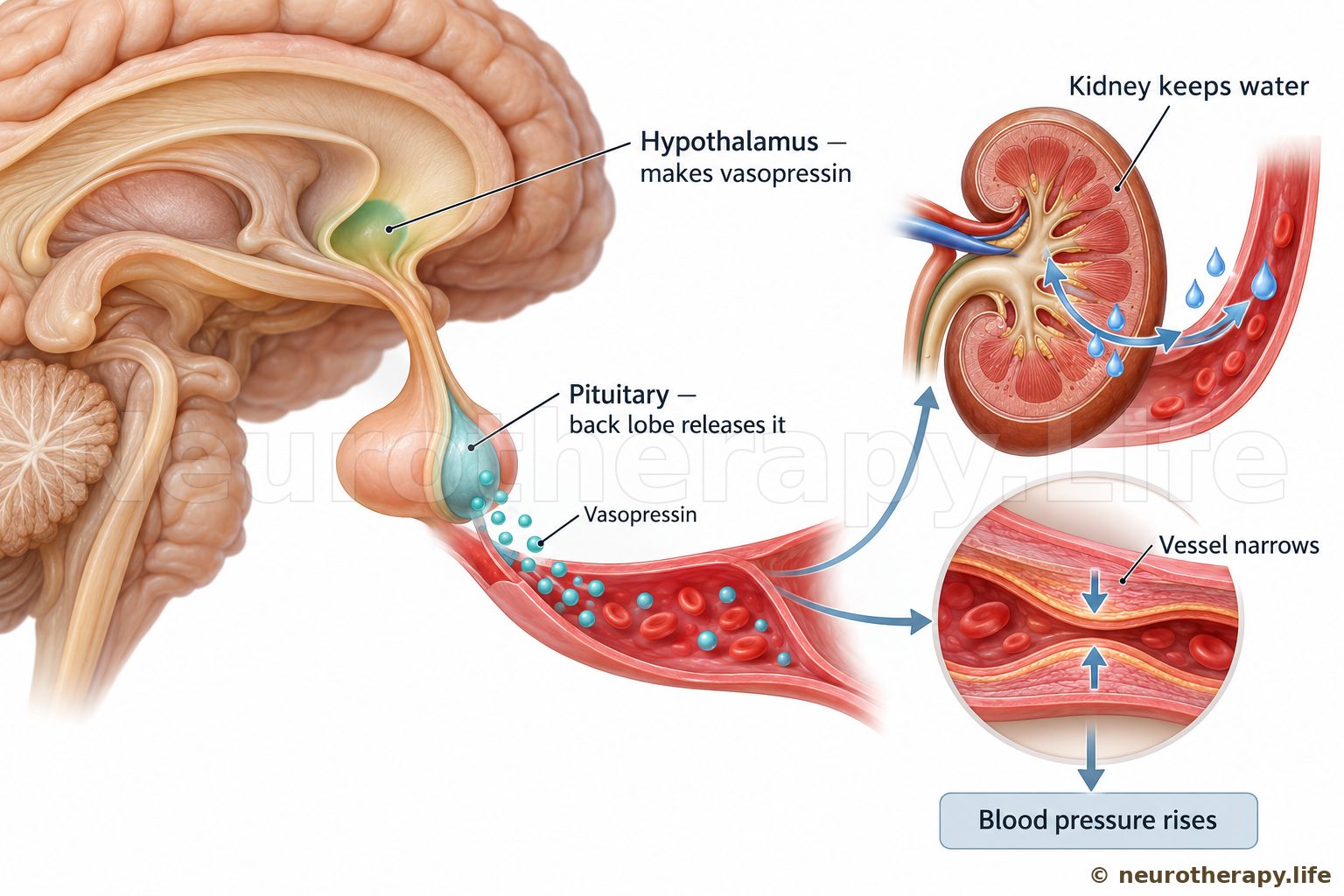
Guruji then read about the hormones that narrow blood vessels and concluded that this step was provoking vasopressin. Vasopressin is made in the hypothalamus, stored in the back part of the pituitary gland, and makes the kidneys hold water — so the blood volume, and the pressure, rise.
Given on its own, (2) Para is the whole of the Vasopressin formula — the shortest formula in the therapy.
Vasopressin holds water and narrows the vessels — the hormone (2) Para is held to provoke.
Where it is given
Where is (2) Para given?
PositionLying on the back
Body areaRight arm only — near the elbow bone and near the shoulder
You lie flat on your back, usually with no pillow under the head unless you need one. The therapist works from the head end. (2) Para is given on the right arm only — first near the elbow bone, then near the shoulder. The left arm is not treated.
The parathyroid glands themselves are four tiny glands, each about the size of a grain of rice, at the back of the thyroid in the neck. Nothing touches the neck in Para. As with all Neurotherapy (LMNT) points, the point is named for what it is meant to rouse, not for the place where it is given.
How it is given
How is (2) Para given?
How this point is given — the tool, the pressure, the count and the exact movement — is deliberately not described here. Watch the demonstration video on this page, and learn the method hands-on from a trained Neurotherapist before giving it. Please do not give any point from a written description alone: a point given in the wrong place or the wrong way can do harm.
The number written before a point's name is not a strength setting. Each numbered form is a separate named treatment with its own method and timing, taught hands-on in the course.
SideRight arm only
PlacesNear the elbow, then near the shoulder
The number before itChooses the treatment — (2) and (4) Para act on different glands
The exact technique is taught hands-on in the Neurotherapy (LMNT) course. See the course →
What it does
What does (2) Para do in the body?
In Neurotherapy (LMNT) teaching, (2) Para provokes vasopressin. Body science confirms what vasopressin does; the link from a press on the arm to the pituitary is the therapy's own inference, drawn from the readings taken on patient after patient.
Helps the kidneys hold water instead of letting it go out in the urine.
Used for low blood pressure of many years — a pressure always below normal, in someone who tires very quickly. Patients have reported the pressure rising and the giddiness going.
Used in diabetes insipidus, a rare illness in which too little vasopressin is made, so the person drinks and passes very large amounts of water.
Opens one of the Multivitamin formulas, for low blood pressure with weakness in the body.
Organs it reaches
Pituitary gland — Its back lobe stores and releases vasopressin.
Para is given at one site, and the number before it decides which gland is being asked: two for vasopressin, four for parathyroid hormone. Read the number before you read the point.
Para — The parent Para point — named for the parathyroid, given on the right arm.
(4) Para — Parathyroid hormone and blood calcium — calcium cramps, heavy periods. In osteoporosis only inside the full 1,25 DCC formula.
Pit — Pit — the pituitary point, its neighbour among the glands of the head and throat.
Thrd — Thrd — the thyroid point; thyroid and parathyroid share the calcium balance.
What it is used for
What is (2) Para used for?
(2) Para is chosen from the history of the low pressure — how long, and why — after the blocked list has been checked.
Blood pressure
Low blood pressureLow pressure of many years, always below normal, with quick tiredness.
High blood pressure: (2) Para is not given — vasopressin narrows the vessels and raises the pressure. High blood pressure
Low blood pressure that came on suddenly after blood loss (accident, miscarriage, operation, very heavy periods) is not treated with (2) Para — the Angiotensin No. 2 formula is the one written for it. Active bleeding is a hospital matter. Angiotensin No. 2
(2) Para is not (4) Para. Its bar is high blood pressure; (4) Para's bar is osteoporosis. Each number carries its own rule. (4) Para
Fainting, chest pain, a very fast or slow pulse, or confusion with low pressure is an emergency: call 108/112. How to tell a patient to see a doctor
Diabetes insipidus is a medical condition that needs a doctor's diagnosis and care; Neurotherapy (LMNT) works alongside it. Never stop or change medicines on your own. Diabetes insipidus
A teaching case
Teaching case: the pressure that would not come up
A teaching case from the story of how (2) Para was found: a man had a low pressure for years and was always worn out by the afternoon. During a calcium formula, partway through the parathyroid point, he said he felt extremely well — and the cuff showed his pressure had risen. The same step the next day brought it to normal, and it stayed normal when checked days later.
A composite case written to teach the reasoning — not one patient’s file.
Common questions
My pressure has been low for years. Is (2) Para for me?
That is exactly the patient it was written for — a pressure always below normal, with tiredness. The therapist will still check your card and your history first.
My pressure dropped after heavy bleeding. Why am I not given (2) Para?
Because you lost blood — salt, water and cells together — and vasopressin holds back water only. The Angiotensin No. 2 formula, which holds salt and water, is written for you. If the bleeding is still going on, go to hospital first.
Can I check whether it works?
Yes. The teaching records the pressure rising within about an hour. A reading before and after the session, with the same cuff, shows you and your therapist what is happening.
Surprising facts
1Made in the brain, stored below it
Vasopressin is made by nerve cells in the hypothalamus and travels down their fibres to the back of the pituitary, where it waits to be released.
Source: Cuzzo B et al., Physiology, Vasopressin, StatPearls (NCBI Bookshelf NBK526069).
2It has two names
Vasopressin is also called antidiuretic hormone (ADH) — 'anti-diuretic' simply means 'against passing urine'.
Source: Guyton & Hall, Textbook of Medical Physiology.
3Why alcohol sends you to the toilet
Alcohol holds back the release of vasopressin, so the kidneys let more water go — one reason drinking leaves people dehydrated.
Source: Standard physiology of ethanol-induced diuresis (ADH suppression), e.g. Guyton & Hall.
Watch
(2) Para vs (4) Para — One Point, Two Powerful Actions | LMNT Neurotherapy Explained
This video explains the Para point and how (2) Para differs from (4) Para, in relation to low calcium, bone pain and blood pressure.
Test yourself
Research
Strong evidence
A physiology review: vasopressin is made in the hypothalamus and released from the posterior pituitary; it makes the kidneys hold water and, at higher levels, narrows blood vessels. A failure of its release causes central diabetes insipidus.
This page explains what a Neurotherapy (LMNT) treatment is for; it is not a self-treatment guide and does not diagnose. Neurotherapy (LMNT) works alongside your medical care — keep taking the medicines your doctor prescribed.
Ready to begin?
Send COURSE for course details, or your name, age and health issue for a consultation.