(4) Para is the form of the Para point aimed at parathyroid hormone (PTH), which keeps calcium in the blood steady. Given on the right arm, it is used for cramps from calcium shortage and very heavy periods — and in osteoporosis it is never given alone, only inside the full 1,25 DCC formula.
Overview
What is (4) Para?
Para is the parathyroid point. The parathyroids are four tiny glands behind the thyroid that make parathyroid hormone, or PTH. When blood calcium falls, PTH borrows calcium from the bones, makes the kidneys hold on to calcium, and switches on the last step in making active vitamin D.
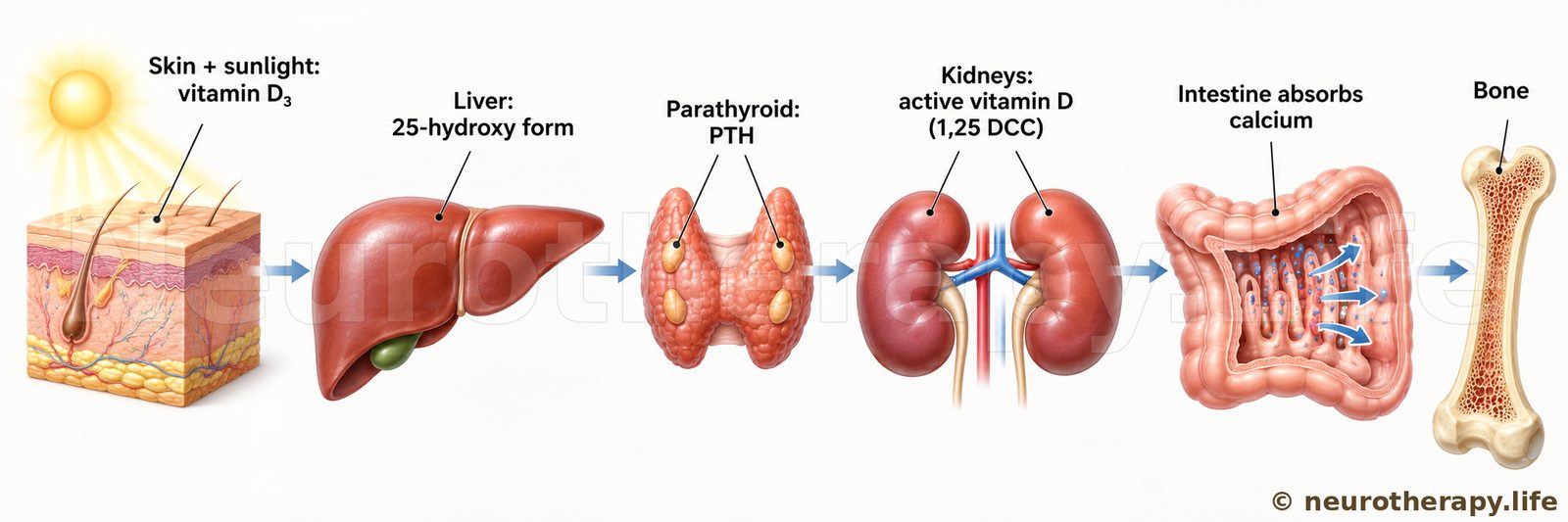
(4) Para is the form aimed at PTH. Its home is the 1,25 DCC formula, named after the active form of vitamin D (1,25-dihydroxycholecalciferol). That formula asks the organs that make vitamin D in the order the body uses them — the liver, then the parathyroid, then both kidneys — and (4) Para is the parathyroid step.
The same point given by itself does something different: it lifts calcium out of the bone into the blood. That is useful where bone has grown where it should not — and it is exactly why it is never given alone to someone whose bones are already thin.
Active vitamin D is made in stages — and the parathyroid step, which (4) Para is aimed at, cannot be skipped.
Where it is given
Where is (4) Para given?
PositionLying on the back
Body areaRight arm only — near the elbow bone and near the shoulder
You lie flat on your back, usually with no pillow under the head unless you need one. The therapist works from the head end. (4) Para is given on the right arm only — first near the elbow bone, then near the shoulder. The left arm is not treated.
The parathyroid glands themselves are four tiny glands, each about the size of a grain of rice, at the back of the thyroid in the neck. Nothing touches the neck in Para. As with all Neurotherapy (LMNT) points, the point is named for what it is meant to rouse, not for the place where it is given.
How it is given
How is (4) Para given?
How this point is given — the tool, the pressure, the count and the exact movement — is deliberately not described here. Watch the demonstration video on this page, and learn the method hands-on from a trained Neurotherapist before giving it. Please do not give any point from a written description alone: a point given in the wrong place or the wrong way can do harm.
The number written before a point's name is not a strength setting. Each numbered form is a separate named treatment with its own method and timing, taught hands-on in the course.
SideRight arm only
PlacesNear the elbow, then near the shoulder
The number before itChooses the treatment — (2) and (4) Para act on different glands
The exact technique is taught hands-on in the Neurotherapy (LMNT) course. See the course →
What it does
What does (4) Para do in the body?
In Neurotherapy (LMNT) teaching, (4) Para rouses the parathyroid glands to make PTH. Body science confirms what PTH does; how a press on the arm reaches the glands is the therapy's own explanation, offered from clinical experience.
Inside the 1,25 DCC formula: to keep the amount of calcium in the blood steady.
For people who get cramps from calcium shortage, by day or at night.
For women with very heavy menstrual flow.
Given alone: lifts calcium from the bone into the blood, so it is used where bone has grown in an unwanted place.
For a breastfeeding mother whose milk has recently stopped, it is held to rouse oxytocin so the milk begins to come again.
Kidneys — PTH makes them keep calcium and finish making active vitamin D.
Liver — The step before Para in the 1,25 DCC formula.
Muscles — Muscles cramp when blood calcium runs low.
Blood — Calcium in the blood is what PTH keeps in range.
Its family
What are the forms and neighbours of Para?
Para is given at one site, and the number before it decides which gland is being asked: two for vasopressin, four for parathyroid hormone. Read the number before you read the point.
Para — The parent Para point — named for the parathyroid, given on the right arm.
(2) Para — Vasopressin, through the posterior pituitary — long-standing low blood pressure, diabetes insipidus. Not in high BP.
Pit — Pit — the pituitary point, its neighbour among the glands of the head and throat.
Thrd — Thrd — the thyroid point; thyroid and parathyroid share the calcium balance.
What it is used for
What is (4) Para used for?
(4) Para is chosen from the patient's findings — and whether it is given alone or inside a formula is part of the choice.
Calcium shortage
Muscle crampsCramps from calcium shortage, day or night; also inside J. Heparin.
OsteoporosisOnly inside the full 1,25 DCC formula, by hand.
HypothyroidismThe 1,25 DCC formula is used where low calcium is held to slow the thyroid.
Osteoporosis (thin bones): (4) Para is never given alone — given by itself it lifts calcium out of the bone. It is given only inside the full 1,25 DCC formula, and these patients are treated with the hand only. Osteoporosis
The bar is on the word 'alone', not on the point: in osteoporosis (4) Para is still given — but only with the rest of the 1,25 DCC formula. 1,25 DCC (ordinary form)
Inside J. Heparin or Multi Heparin: no Heparin treatment while blood is flowing or a wound is open. J. Heparin (joints)
Very heavy periods need a doctor's check (blood count, ultrasound) — a fibroid or anaemia may lie behind them. How to tell a patient to see a doctor
(4) Para is not (2) Para: high blood pressure is (2) Para's bar, osteoporosis-alone is (4) Para's. (2) Para
Common questions
I have osteoporosis. Is (4) Para dangerous for me?
Not inside the full 1,25 DCC formula, which is how it is given to you. Alone it would draw calcium out of the bone, so it is never given alone in thin bones.
Why should I sit in the sun during this course?
Because the first step of vitamin D happens in the skin, in sunlight. The teaching asks patients on the 1,25 DCC formula to stay in the sun for at least half an hour daily.
I get leg cramps at night. Will (4) Para help?
Cramps from calcium shortage are one of its named uses, and J. Heparin, which opens with (4) Para, is written for night cramps. The therapist first finds out why your cramps come.
Surprising facts
1No PTH, no active vitamin D
PTH switches on the kidney enzyme that turns stored vitamin D into its active form — the reason the parathyroid step sits between the liver and the kidneys.
Source: Khan M et al., Physiology, Parathyroid Hormone, StatPearls (NCBI Bookshelf NBK499940).
2Rhythm changes the result
PTH present all the time thins bone, but the same hormone in short daily pulses thickens it — modern medicine uses this to treat severe osteoporosis.
Source: Neer RM et al., Effect of parathyroid hormone (1-34) on fractures and bone mineral density in postmenopausal women with osteoporosis, N Engl J Med 2001;344:1434–41.
3Calcium runs the heartbeat
Every heartbeat and every muscle twitch depends on calcium moving in and out of cells, which is why the body guards blood calcium within a very narrow range.
Source: Guyton & Hall, Textbook of Medical Physiology (calcium in excitation–contraction coupling).
Watch
(2) Para vs (4) Para — One Point, Two Powerful Actions | LMNT Neurotherapy Explained
This video explains the Para point and how (2) Para differs from (4) Para, in relation to low calcium, bone pain and blood pressure.
Test yourself
Research
Strong evidence
A physiology review: parathyroid hormone raises blood calcium by releasing calcium from bone, by making the kidneys hold calcium back, and by switching on the kidney step that makes active vitamin D (1,25-dihydroxycholecalciferol).
This page explains what a Neurotherapy (LMNT) treatment is for; it is not a self-treatment guide and does not diagnose. Neurotherapy (LMNT) works alongside your medical care — keep taking the medicines your doctor prescribed.
Ready to begin?
Send COURSE for course details, or your name, age and health issue for a consultation.