Also called: Multivitamin 3, Third Multivitamin formula
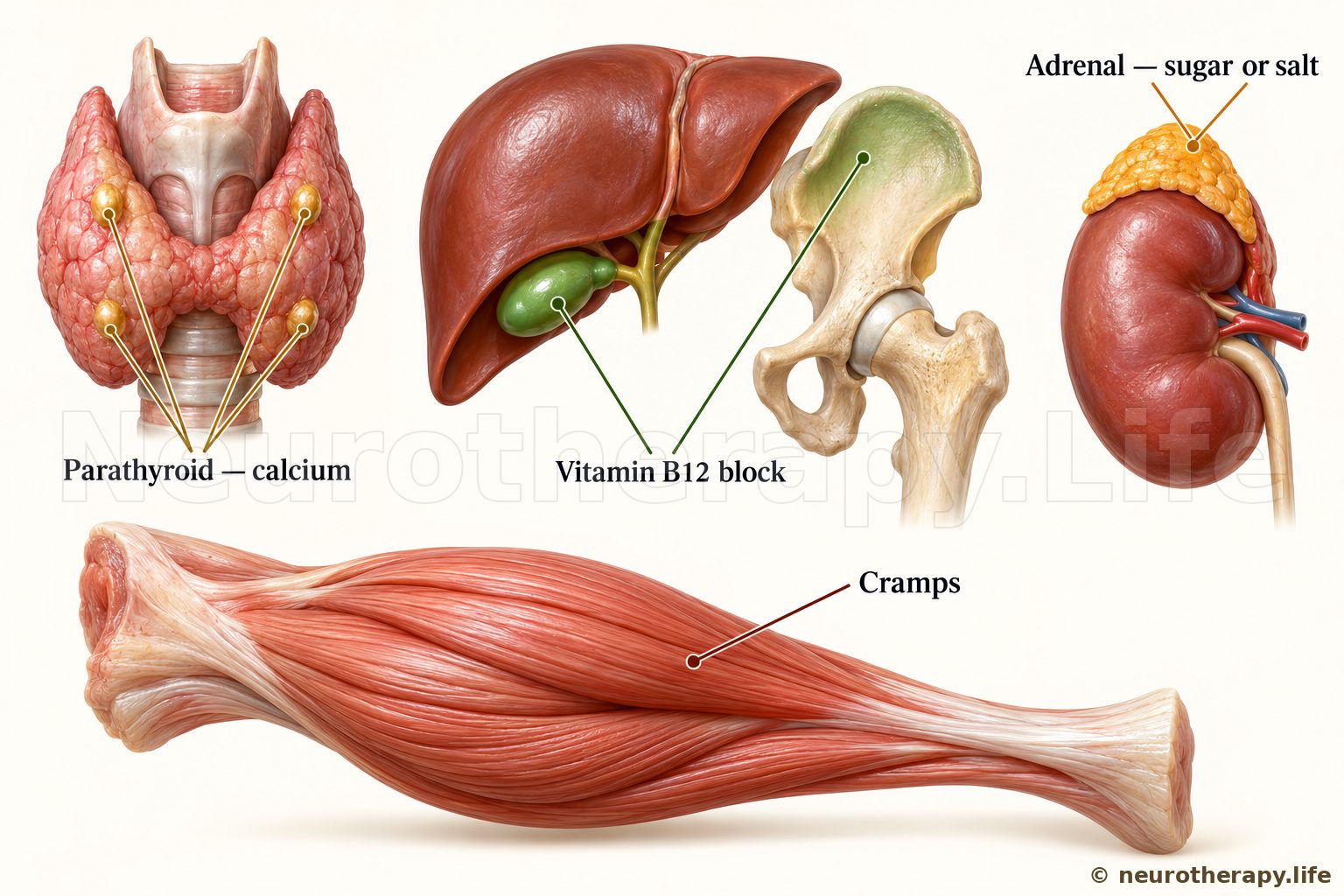
Multivitamin formula 3 is the Neurotherapy (LMNT) formula for a shortage of calcium together with sugar or sodium — seen in diabetes and kidney patients and in people who cramp by day and at night. It opens with the parathyroid point for calcium, keeps the vitamin B12 block in the middle, and closes with the adrenal point chosen for sugar or for salt.
Overview
What is Multivitamin formula 3?
One day Guruji was discussing formulas with a few therapists when one of them asked why there should not be a treatment that gives everybody energy. Just then a bottle of multivitamin tablets came into Guruji's hand. Treatments to raise calcium, sodium and so on already existed separately; joining them gave four Multivitamin formulas.
All four share one design. The middle is always the vitamin B12 block — the gall bladder, liver and left hip points. Only the opening point and the closing point change, chosen by the shortage in front of the therapist: sugar, sodium, calcium or B12.
Formula 3 is the one for calcium. It opens with (4) Para, the parathyroid point linked with parathormone (PTH), the hormone that raises calcium in the blood. It is the only one of the four whose closing point is a choice: (6) Adr when sugar is short, (2) Adr when salt is short.
They are called Multivitamin formulas because, when a person feels weak, doctors often suggest multivitamin tablets. Nothing is swallowed: the formulas work through points on the body.
Formula 3 opens for calcium, keeps the B12 block in the middle, and closes for sugar or for salt.
What it is for
What is Multivitamin formula 3 used for?
For a shortage of calcium together with sugar or sodium — as found in diabetes and kidney patients.
For people who get cramps during the day and also at night while lying asleep.
For people with paralysis — but only if they do not have high blood pressure.
To support the nerves through the vitamin B12 block in the middle.
Points it works through
Which points does Multivitamin formula 3 work through?
(4) Para (3) Gal (7) Liv (8) Lt. Parkhoo (6) Adr or (2) Adr
Formula 3 works through these points, listed here as a set with what each contributes. Only one of the two adrenal forms is given to any patient. The exact method is taught hands-on in the Neurotherapy (LMNT) course. This page lists the points of the formula and what each one contributes; it does not describe how any point is given. For the method, watch the demonstration video of each point on its own page and learn hands-on from a trained Neurotherapist. Please do not give a formula from a written description alone.
The closing point when salt is short: the adrenal point for aldosterone, which tells the kidneys to hold on to sodium.
Position:Lying on the back for the opening point and for the gall bladder and liver points; on the side for the hip points; and face down for the adrenal point.
The exact technique is taught hands-on in the Neurotherapy (LMNT) course. See the course →
How it works
How is formula 3 chosen and completed?
'Weakness' is the commonest word a therapist hears, and on its own it means nothing. These formulas do not treat weakness; they treat four named shortages, and each has a sign that takes about a minute to look for.
Dizziness after a little exercise points to sugar. Cramps as evening comes on, in someone who sweats all day, point to sodium. Cramps by day and at night in bed point to calcium. Dark skin over the knuckles, feet that stay 'asleep' after sitting cross-legged, and a tender left waist point to B12.
Cramps that come by day and also at night in bed point to calcium, and that is formula 3's sign. The second question is which other shortage sits beside it. If it is sugar, the formula closes with (6) Adr. If it is salt, it closes with (2) Adr — unless the patient has high blood pressure, when (2) Adr is not given.
(4) Para is not given on its own to people with osteoporosis; they need the full 1,25 DCC formula instead. Inside formula 3, (4) Para is one part of a longer whole.
Its family
Which formulas are related?
The four Multivitamin formulas share the B12 middle and differ only at the two ends.
Multivitamin formula 1 — For a shortage of sugar and sodium — tiredness, children with fits from that shortage, sportsmen cramping in the evening.
Multivitamin formula 2 — For very low sugar — dizziness after only a little exercise. Not for heart or high blood pressure patients.
Multivitamin formula 4 — For long-standing low blood pressure with weakness in the body.
For paralysis, only if the patient does not have high blood pressure. Paralysis and stroke
Do not close with (2) Adr in a high blood pressure patient. (2) Adr
(6) Adr lowers immunity, so it is not given in septicaemia, HIV/AIDS or cancer. It lowers acid and raises alkali, so it is not given in high blood pressure. (6) Adr
(4) Para is not given on its own in osteoporosis — the full 1,25 DCC formula is given instead. (4) Para
Gal is not given in leukaemia (blood cancer) or other diseases with a raised white cell count, in asthma, or to people passing very little urine. Liv is not given in liver cancer. Gal
Night cramps can also come from medicines, nerve problems or poor circulation. Cramps with swelling, a hot red calf or weakness that spreads need a doctor first. How to tell a patient to see a doctor
No treatment is given without first examining that day's pain points — not even 'the same as yesterday'.
Keep taking the medicines your doctor prescribed. Neurotherapy (LMNT) works alongside your medical care, never instead of it.
Common questions
Does this formula give me vitamins?
No. Nothing is taken in. The name comes from the shortages the formulas are aimed at — the same ones doctors often meet with multivitamin tablets. If your doctor has prescribed a supplement, keep taking it.
I have kidney disease. Can this formula replace my treatment?
No. Kidney disease changes how the body handles calcium, salt and water, and it needs a doctor's care and regular tests. Formula 3 is given alongside that care, never instead of it.
Why can the last point change?
Because calcium rarely runs short alone. If sugar is also short, the adrenal point for cortisol is chosen; if salt is short, the adrenal point for aldosterone — unless blood pressure is high.
How does the therapist know which of the four I need?
By looking for the sign of each shortage — when the tiredness comes, whether there are cramps and at what time, whether you get dizzy after effort, and how your blood pressure runs — and by examining that day's pain points.
Surprising facts
1Calcium keeps your nerves quiet
When blood calcium falls, nerves become over-excitable and fire on their own. That is why a low calcium can show itself as cramps, twitching and tingling.
Source: Guyton & Hall, Textbook of Medical Physiology, 14th ed. — hypocalcaemia and neuromuscular excitability (tetany).
2Four tiny glands guard your calcium
The parathyroid glands, each about the size of a grain of rice, sit behind the thyroid. Within minutes of a fall in blood calcium they release PTH to pull it back up.
Source: Guyton & Hall, Textbook of Medical Physiology, 14th ed. — parathyroid hormone and calcium regulation.
3The kidney finishes vitamin D
The active form of vitamin D, 1,25-dihydroxycholecalciferol, is made in the kidney. It is one reason calcium trouble is common in kidney disease.
Source: Guyton & Hall, Textbook of Medical Physiology, 14th ed. — renal activation of vitamin D.
Watch
(2) Para vs (4) Para — One Point, Two Powerful Actions | LMNT Neurotherapy Explained
This video explains the Para point and how (2) Para differs from (4) Para, in relation to low calcium, bone pain and blood pressure.
Get Rid of Muscle Cramps: Simple Causes and Effective Prevention मांसपेशियों की ऐंठन से पाएं छुटकारा
A short talk on the common causes of muscle cramps and simple ways to prevent them.
Vitamin B12 Treatment in Neurotherapy | LMNT Formula for Anaemia, RBC & Nerve Health
Shows the Vitamin B12 treatment: (3) Gal and (7) Liv on the thigh and forearm, then (8) Left Parkhoo at the left hip with the patient lying on their side. It is given to support the body's absorption of vitamin B12.
Test yourself
Research
Strong evidence
This review of sweat testing in athletes shows that how much salt people lose in sweat varies widely from person to person, with heat, effort and how used to the heat they are — which is why one hard-working person cramps and another does not.
This page explains what a Neurotherapy (LMNT) treatment is for; it is not a self-treatment guide and does not diagnose. Neurotherapy (LMNT) works alongside your medical care — keep taking the medicines your doctor prescribed.
Ready to begin?
Send COURSE for course details, or your name, age and health issue for a consultation.