Parkhoo: the right and left points at the edge of the thigh bone
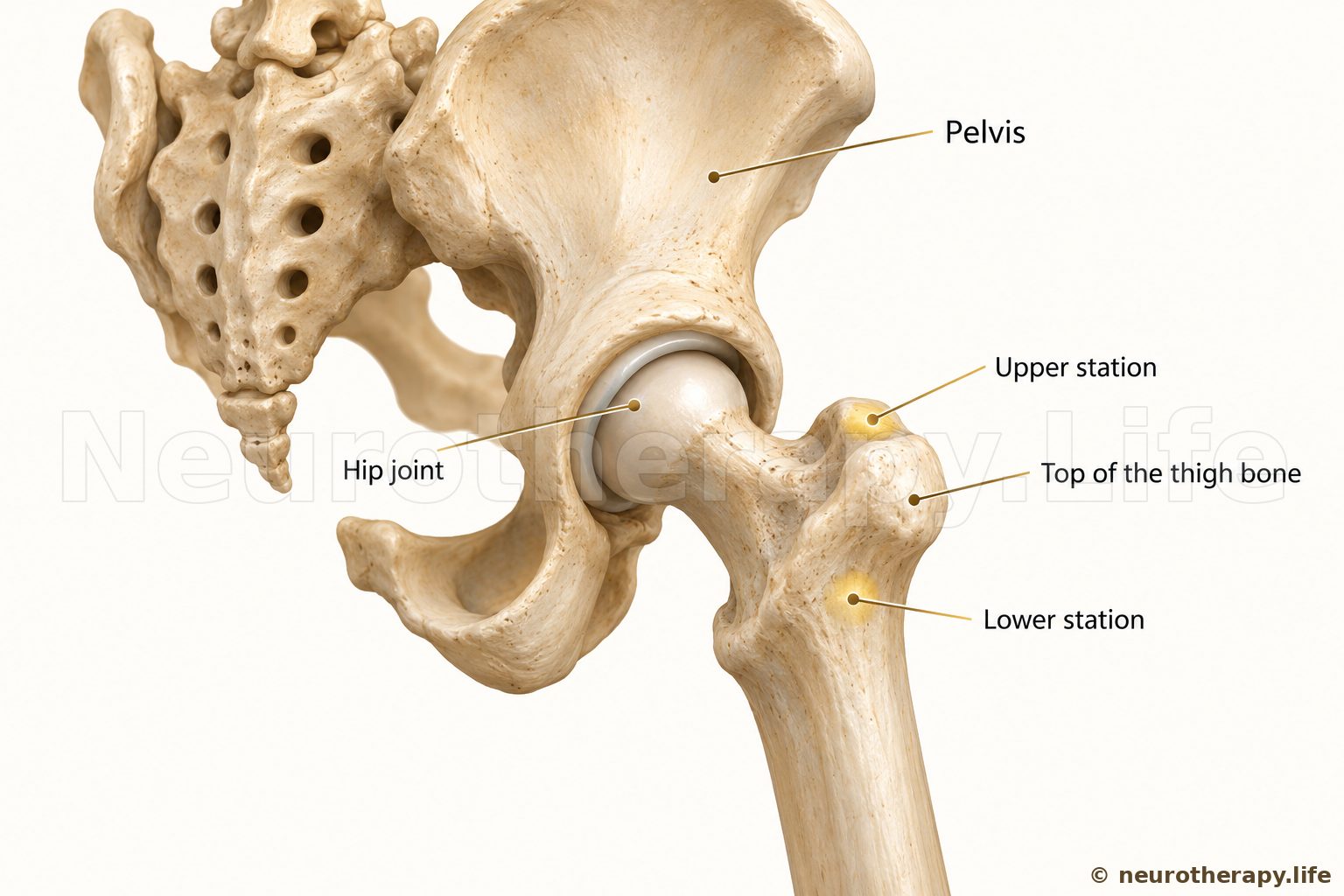
Rt. Parkhoo and Lt. Parkhoo are side-lying Neurotherapy (LMNT) points at the upper hip, where the top of the thigh bone stands out. Each has two places, one above and one below, worked in turn, and both appear inside several formulas, including the UDF treatments for undigested food.
Overview
Parkhoo is given at the hip that faces the ceiling, so the side the patient lies on is the side not being treated. For Rt. Parkhoo the patient lies on the left side; for Lt. Parkhoo, on the right. The chest is turned in, both knees are drawn close to the chest, and pillows fill the space between the knees so the upper knee stays at waist level. A pillow supports the head.
Drawing the knees up rolls the pelvis and makes the top corner of the thigh bone stand out under the skin. The two Parkhoo places lie at its edge, one above and one below, and they are pressed and released in turn, with the foot or the hand. If the upper knee sinks, the pelvis rolls forward and both places slip away from the hand, which is why the pillow between the knees belongs to the technique itself, and compulsory in very thin thighs.
No separate purpose is stated for Parkhoo at the point itself; its work is set by the formula it is written in, such as the UDF treatments and the genes and vitamin formulas. Beneath the two places lie tendons, small fluid cushions and bone, the commonest site of pain at the side of the hip. The exact method is taught hands-on in the course.
Key points
- The hip treated faces the ceiling: Rt. Parkhoo lying on the left side, Lt. Parkhoo on the right.
- Knees close to the chest, pillows between the knees, upper knee at waist level.
- Two places at the edge of the thigh bone, one above and one below, worked in turn.
- Its purpose comes from the formula it is written in.
Go deeper
Rt. Parkhoo
Rt. Parkhoo in full
Lt. Parkhoo
Lt. Parkhoo in full
General UDF formula
The General UDF formula, which uses both Parkhoo points
Black treatment
The Black treatment, which uses Lt. Parkhoo
Right and Left Vitamin Formation: side-lying points for pain at the side of the hip
Right and Left Vitamin Formation, for pain at the side of the hip
Lying on the side: the pillow rules that come before every side-lying point
The pillow rules for side-lying points
Joints
How the hip and other joints work
On the Side: Treatments Given Lying on One Side
The full guide to the side-lying treatments
Read the full guide
This topic is part of: On the Side: Treatments Given Lying on One Side
Safety: when it is held back
- In anyone thin, elderly, on long-term steroid tablets or on blood thinners, the hand is used instead of the foot. Frail and elderly patients (gentle care)
- An older patient with hip pain is always asked, kindly and plainly, whether they have had a fall. A fall with lasting hip pain needs an X-ray first. Osteoporosis
- When Parkhoo hurts more than it should, the position is rebuilt first, before the point is changed. Lying on the side: the pillow rules that come before every side-lying point
- The exact method is taught hands-on in the course, under a trained therapist. Please do not try it on yourself or others from this page.
Watch

Shows the Vitamin B12 treatment: (3) Gal and (7) Liv on the thigh and forearm, then (8) Left Parkhoo at the left hip with the patient lying on their side. It is given to support the body's absorption of vitamin B12.
This page explains what a Neurotherapy (LMNT) treatment is for; it is not a self-treatment guide and does not diagnose. Neurotherapy (LMNT) works alongside your medical care — keep taking the medicines your doctor prescribed.