How a Formula Is Built: Points, Order and Rests
A Neurotherapy (LMNT) formula is not a list of good points. It is a set of points given in a fixed order, with its own rests and its own name — and changing the order or dropping a rest gives a different formula, not a weaker one.
Overview
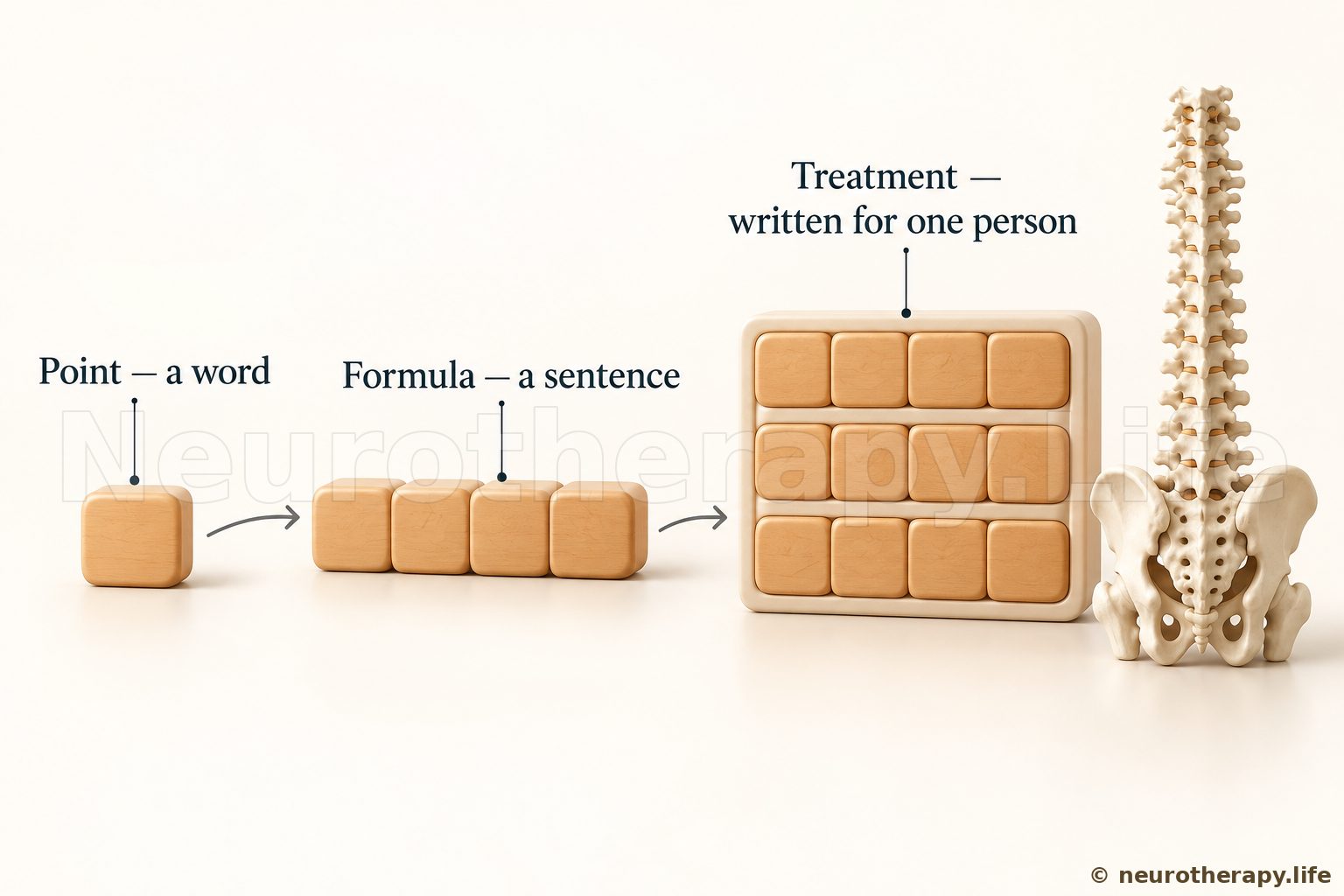
A Neurotherapy (LMNT) formula is not a list of good points. It is a set of points given in a fixed order, with its own rests and its own name — and changing the order or dropping a rest gives a different formula, not a weaker one.
Five right points, in the wrong order
A teaching case, built from a mistake made in many centres: a newly trained student gave a patient with gas and heaviness after meals the Normal formula. He knew every point well, but because the patient's other arm was nearer, he swapped the places of two pairs. The patient felt light that day — and came back days later constipated for the first time in his adult life.
His teacher asked only one question: in what order did you give it? He had not given a sloppy Normal formula. He had given Ulta Normal — a formula built on purpose for loose motions by reversing those very pairs — to a man whose bowels had been working perfectly well.
Point, formula, treatment — three sizes
A treatment point is the code name of a technique — Pan, Gal, L5–S1 Ghisai. It names what is done, not a place or an organ. A formula is a particular set of points, given in order, that together address one group of symptoms — the Acid Treatment Formula, for example. A treatment is a set of formulas chosen for one disease in one person.
Why can the third never be printed in advance? The body corrects small faults by itself — this self-balancing is called homeostasis. When symptoms of a disease appear, several organs are working below normal, each to its own degree. So a series of formulas is used, each correcting a group of organs, until the root is reached — and two people with the same disease may need different treatments.
The engine underneath: press a limb, change the belly
The discovery every formula stands on is that pressure at chosen places on the limbs, given in a set way, removes pain at chosen places around the navel. The reasoning offered is simple: the heart and arteries are one pumping system, so holding back flow in one part for a moment sends more blood to another part. More blood to an area of the abdomen eases its pain, and the organs there work better.
There are two routes. Indirect work loads a limb and looks for the effect in the abdomen — the pancreas, stomach, liver, gall bladder, intestines, spleen, kidneys and more. Direct work is used for some glands whose place is known from anatomy, such as the thymus, thyroid and adrenal, with a gentle wiping action for some and short, quick actions for others. Everything is measured from the navel, because each organ sits at its own distance from it. The exact method is taught hands-on in the course.
Order is part of the formula
Can any point be given in any order? The therapy's own answer is no. A few general rules govern every formula, and all of them are rules of balance. The proof is a pair of formulas made of the same points: Normal keeps the gut's natural wave moving, while Ulta Normal, with two pairs reversed, slows the bowel — which is why it was kept for loose motions.
- Opposite partners follow each other: a point on one side of the navel is answered by its partner on the other side, and work above the navel is balanced by work below it.
- Where both are needed, the point that lowers alkali comes before the point that lowers acid.
- Many formulas close with a balancing pair — Ch. Only with Round Arrow — so the patient is not left tilted towards acid or alkali.
- Going against the natural direction of the gut is allowed only for a limited time, for a particular problem — and is marked on the card.
When order and comfort pull against each other
Sometimes the best order would mean turning the patient face up, face down and face up again. That is hard for the elderly and for people with back pain or heart trouble. In one such formula the source allows a compromise: two glands are given the other way round to save the extra turn. It says honestly that this does no harm, but the patient may need the treatment for a day or two longer.
The lesson is to write such a choice on the card. A compromise that is written down is a clinical decision; one that is not written looks exactly like an error.
The rests are part of the treatment
A new student says a formula is made of points. A therapist of ten years says it is made of points and gaps. A rest looks like nothing happening, so it is the first thing a hurried person drops — but the rest is when the body answers. If the next press comes too soon, it interrupts the first instead of adding to it. Each formula carries its own rests, and they are kept by the clock, not guessed.
The timing can also change the whole character of a formula. The Fast Treatment uses the same ground as the Normal formula, but as a light, quick sweep over many close places instead of held presses — and it is written differently on the card for exactly that reason.
How formulas get their names
Every formula is named in one of four ways. Some name the condition they correct — the Acid Treatment Formula, the Genes formulas, the Black treatment. Some name the organ they work on — Vater, the Medulla treatments. Some name a chemical whose effect they are held to resemble — Heparin, 1,25 DCC, B₁₂. And some carry the name of a student or patient who helped in the research — Maunish, Raman, Anil Sharma.
The chemical names need one honest sentence every time: nothing is given — no medicine, no injection, no instrument. The source itself says these names come from experience and patient feedback across many people, not from laboratory tests, which were too costly or not shared. A chemical name is a hypothesis written on a label.
Key points
- A point is a word, a formula is a sentence, and a treatment is written for one person.
- Order is part of the formula: the same points in a different order can do the opposite thing.
- The rules of order are rules of balance — side against side, above against below, alkali before acid, and a balancing close.
- Rests are part of the treatment and are kept by the clock.
- Any compromise for the patient's comfort is written on the card with its cost.
- A formula named after a chemical gives no chemical; the name describes an effect the body is hoped to produce.
Topics in this guide
Go deeper
Normal Treatment Formula
The first formula ever made
Ulta Normal
The same points reversed, for loose motions
LSTF
The formula where order and comfort meet halfway
Fast Treatment Formula
Same ground, a different timing
Complement System
A long formula with parts that can be lifted out
The Shorthand: How Neurotherapy (LMNT) Treatments Are Written and Read
How formulas are written on a card
Each Point in Use: What It Is For, and When It Is Held Back
What each point is for, and when it is held back
Setting the Stomach: The Digestive Formulas of Neurotherapy (LMNT)
The digestive formulas that open most treatments
Safety: when it is held back
- Never stop or change your medicines because you are taking Neurotherapy (LMNT). Any change in a dose is your own doctor's decision. How to tell a patient to see a doctor
- A formula with a reversed order, such as Ulta Normal, is given only for a short time and stopped as soon as the motions become formed; the therapist asks about them every day. Ulta Normal
- Some couples are one instruction and must not be separated — P point is always followed by WD, and Ton 'T' by the Sangam points. Four pairs of treatments that must always be given together
- In a patient with inflammatory disease, the thymus area is not worked in a route treatment; in diabetes or other autoimmune disorders, the immunity-raising parts of the Complement System formula are left out. Complement System
Guruji says
“We cannot provoke the organs in an order of our own choosing.”
Common questions
It's only pressing. Does the order really change anything?
Yes. There are two formulas made of the same pressures. One is given to people who are constipated; the same pressures in a different order are given for loose motions. Nothing else about them differs.
Why is the therapist standing there doing nothing?
Because the rest is part of your treatment. The body needs that time to answer the last press; pressing again straight away would interrupt it.
My card says Heparin. Am I being given a blood thinner?
No. Nothing is given — no medicine, no injection. Heparin is the name of a set of pressures, named after an effect your own body is hoped to produce. Tell your doctor exactly that.
Yesterday's treatment helped. Can I just have the same today?
Yesterday's card shows what your body needed yesterday. A few minutes of examination today decides today's treatment; giving the same without checking can push the body too far.
Watch

Shows the Normal treatment given with the feet: (8) Pan at the top of the thighs, then (3) Gal, (3) Spleen, (7) Liv and (5) Mucus on the thighs and forearms, without breaks. It is used to support digestion.

A demonstration of the Ulta Normal formula for loose motions: (8) Pan on both thighs, then Spl before Gal and Mu before Liv — the Normal formula's order reversed to slow the bowel.
The video's counts ((3) Spl, (3) Gal, (5) Mu, (7) Liv) differ from LMNT teaching, which gives (1) Spl, (1) Gal, (1) Mu – 3 points and (1) Liv – 3 points. Ulta Normal is stopped as soon as the stool is formed, and the Normal formula is given for at least one day.
Test yourself
Research
- Strong evidence
A review of the gut's own nervous system. The wall of the small and large intestine holds complete reflex circuits that set the pattern of its movements, its local blood flow and its fluid movement — which is why the direction of the gut's wave matters.
Explore more
Organs
Body systems
Diseases
Points
Formulas
Topics
Read more
This page explains what a Neurotherapy (LMNT) treatment is for; it is not a self-treatment guide and does not diagnose. Neurotherapy (LMNT) works alongside your medical care — keep taking the medicines your doctor prescribed.