Also called: Complement System formula, the fourteen-part formula
The Complement System is the longest formula in Neurotherapy (LMNT) — fourteen numbered parts. It is meant for the patient who has been ill for years and whose defences have run down, and it is given after a UDF formula. It works on pain, digestion, the lymph, immunity, the white cells and inflammation.
Overview
What is the Complement System formula?
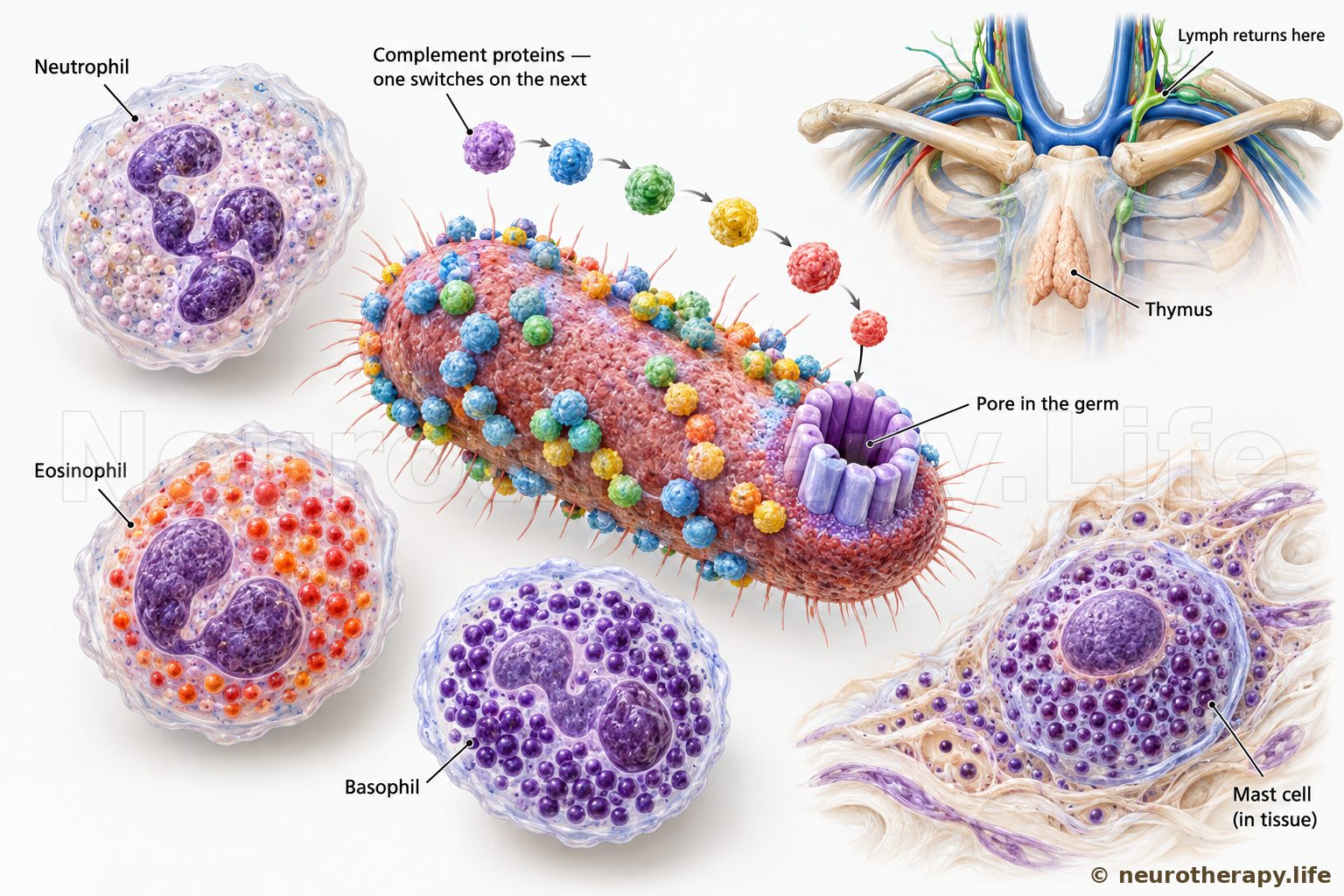
The body's defence has a part that is older than antibodies and works without being taught. It is a chain of proteins in the blood that sits idle until something marks a germ, and then fires one after another, each switching on the next, until the germ is punctured or flagged for eating. It is called the complement system because it completes the work of the other defences.
The Neurotherapy (LMNT) formula named after it draws together almost everything the formulary teaches. In Guruji's words, giving the Complement System after the New UDF formula is beneficial for almost all old diseases. That is why it stands at the very end: it is for the patient who has been ill for years.
That sentence settles the order — a UDF formula first, the Complement System after. It does not say which UDF formula; no formula in the UDF family is actually called 'New UDF'. The UDF formula is chosen for the patient in front of the therapist, by what that patient presents with.
The complement system completes the body's defence. The formula named after it works on the lymph, immunity, four kinds of white cell and inflammation.
What it is for
What is it used for?
Almost all old, long-standing diseases — given after a UDF formula, for the patient whose defences have run down.
To reduce the sensation of pain, help saliva and digestion, and set the organs of the belly working.
To clean the lymph channel and ease joint pain linked with carbonic acid settling in the joints.
To raise immunity — except where the immune system is already attacking the body.
To reduce the effects of infection and inflammation, control infection, improve digestion, and finish on inflammation.
Points it works through
Which points does it work through?
I Endorphin · II Ptyalin · III (3) Raman · IV Subclavian + Mukha Dhauti · V (1) Thymus · VI (1) Lymph · VII (1) Ton 'T' · VIII (½) Ku – 20 secs · IX (½) Ku – 13 secs · X (½) Ku – 6 secs · XI (½) Ku – 3 secs · XII New CNNS 'Gal – Liv' × 2 treatments · XIII CNNS – Pan : Pan : Gal : Liv : Gas : Gas : Gal : Liv · XIV (6) Adr
The fourteen parts fall into four groups by what they do. The points are listed here as a set with each one's stated purpose. The exact method is taught hands-on in the Neurotherapy (LMNT) course, and this formula is for experienced therapists. This page lists the points of the formula and what each one contributes; it does not describe how any point is given. For the method, watch the demonstration video of each point on its own page and learn hands-on from a trained Neurotherapist. Please do not give a formula from a written description alone.
Half Ku, the shortest hold in Neurotherapy (LMNT), named for mast cells. The four Ku holds together reduce the effects of both inflammation and infection.
(6) Adr, the adrenal point on the back — for inflammation. The formula ends here.
Position:Several positions — seated for the neck, collarbone and shoulder parts; face down for Ku and the adrenal point; lying on the back for the digestive points.
The exact technique is taught hands-on in the Neurotherapy (LMNT) course. See the course →
How it works
How does it work?
Read the shape of it once and it stops being a list of fourteen things. The first group settles the ground: pain down, saliva and digestion up, the belly's lining roused, the lymph channel cleaned and the joints emptied of their carbonic acid.
The second group raises the defence — and these are exactly the parts that come out when the defence has already turned against its owner. The third group is one tool used at four settings: the same half-Ku hold at four lengths, each named for a different white cell.
The last group finishes on digestion and inflammation, because that is where every treatment in Neurotherapy (LMNT) finishes. Because the formula is written in numbered parts, three of them can be lifted out safely without disturbing the rest.
Its family
Which formulas are related?
The Complement System closes the formulary and leans on formulas taught before it.
General UDF formula — A UDF formula is given first; the Complement System comes after.
Diabetes, or any autoimmune disorder: the three immunity parts — Thymus, Lymph and Ton 'T' — are left out. Where the immune system is already attacking the body, it is not stimulated further. Autoimmune disorders
Know means know: the therapist checks the patient's medicines and reports for diabetes or autoimmune disease before giving the formula — not just asking once. Diabetes
(6) Adr reduces immunity, so it is not given where immunity is already low — septicaemia, cancer, AIDS. It is also barred in high blood pressure. (6) Adr
Ku is not given during menstruation, and not to people with low blood pressure. Low blood pressure
Subclavian is given only after the ring-finger check, and no pressure is ever put on the front of the throat. Subclavian
This is a very long and complex formula, for experienced therapists only.
Keep taking the medicines your doctor prescribed. Neurotherapy (LMNT) works alongside your medical care.
Guruji says
“Wherever there is a question mark, it is an indication that this is my own thinking, on which other people can now do research.”
— Dr. Lajpatrai Mehra
Common questions
Why is it given after a UDF formula?
Neurotherapy (LMNT) clears the ground first — undigested food and the infection that comes with it — and raises the defences afterwards. The UDF formula is chosen by the therapist for your own findings.
I have diabetes. Can I have this formula?
Yes, but without the three immunity parts. The formula is written in numbered parts precisely so those can be taken out while the rest is given.
Will it take a long time?
It is the longest formula in Neurotherapy (LMNT), with rests between its parts, so a session is long. Your therapist will plan it with you.
Does it act on the real complement system in my blood?
The formula is named after the complement system because, like it, it is meant to complete the body's defences. That link is Neurotherapy (LMNT)'s own reasoning; it has not been measured in the laboratory.
Surprising facts
1More than thirty proteins, firing in a chain
The complement system is made of more than thirty proteins, most of them made by the liver. Once triggered, each activates the next, and the last ones assemble into a ring that punches a hole in a germ's wall.
Source: Janeway's Immunobiology, 9th ed., the complement system and innate immunity.
2Four white cells, four different jobs
Neutrophils are the most numerous white cells and the first at an infection. Eosinophils rise in allergy and fight parasites. Basophils are rare — under one in a hundred white cells. Mast cells live in the tissues, packed with histamine and heparin.
Source: Guyton & Hall Textbook of Medical Physiology, 14th ed., leukocytes; Janeway's Immunobiology, 9th ed.
3Most lymph comes home on the left
Lymph from both legs, the whole abdomen and the left side of the upper body drains into the thoracic duct, which empties into the veins at the base of the left side of the neck. Only the right arm, right chest and right side of the head drain on the right.
Source: Gray's Anatomy, 41st ed., the thoracic duct and right lymphatic duct.
4Lymph moves without a pump
The blood has the heart, but lymph has no pump of its own. It is pushed along by muscle movement, breathing and the gentle squeezing of its own vessels — only a few litres a day.
Source: Guyton & Hall Textbook of Medical Physiology, 14th ed., the lymphatic system (lymph flow and the lymphatic pump).
This page explains what a Neurotherapy (LMNT) treatment is for; it is not a self-treatment guide and does not diagnose. Neurotherapy (LMNT) works alongside your medical care — keep taking the medicines your doctor prescribed.
Ready to begin?
Send COURSE for course details, or your name, age and health issue for a consultation.