1A slow river
The heart pumps thousands of litres of blood a day, but only about two to four litres of lymph return to the blood in the same time.
Source: Guyton & Hall, Textbook of Medical Physiology (lymph flow about 2–3 L/day).
Also called: Lymphs, Lymph point, लिम्फ
Lymph is the Neurotherapy (LMNT) point that rouses the lymph nodes of the thighs, the filter stations that drain the whole leg and foot. It is given high on both thighs, near the groin, while you lie on your back, and it opens the Viral Treatment Formula used to help protect the body from disease. It is held back in autoimmune disorders, diabetes and kidney disorders.
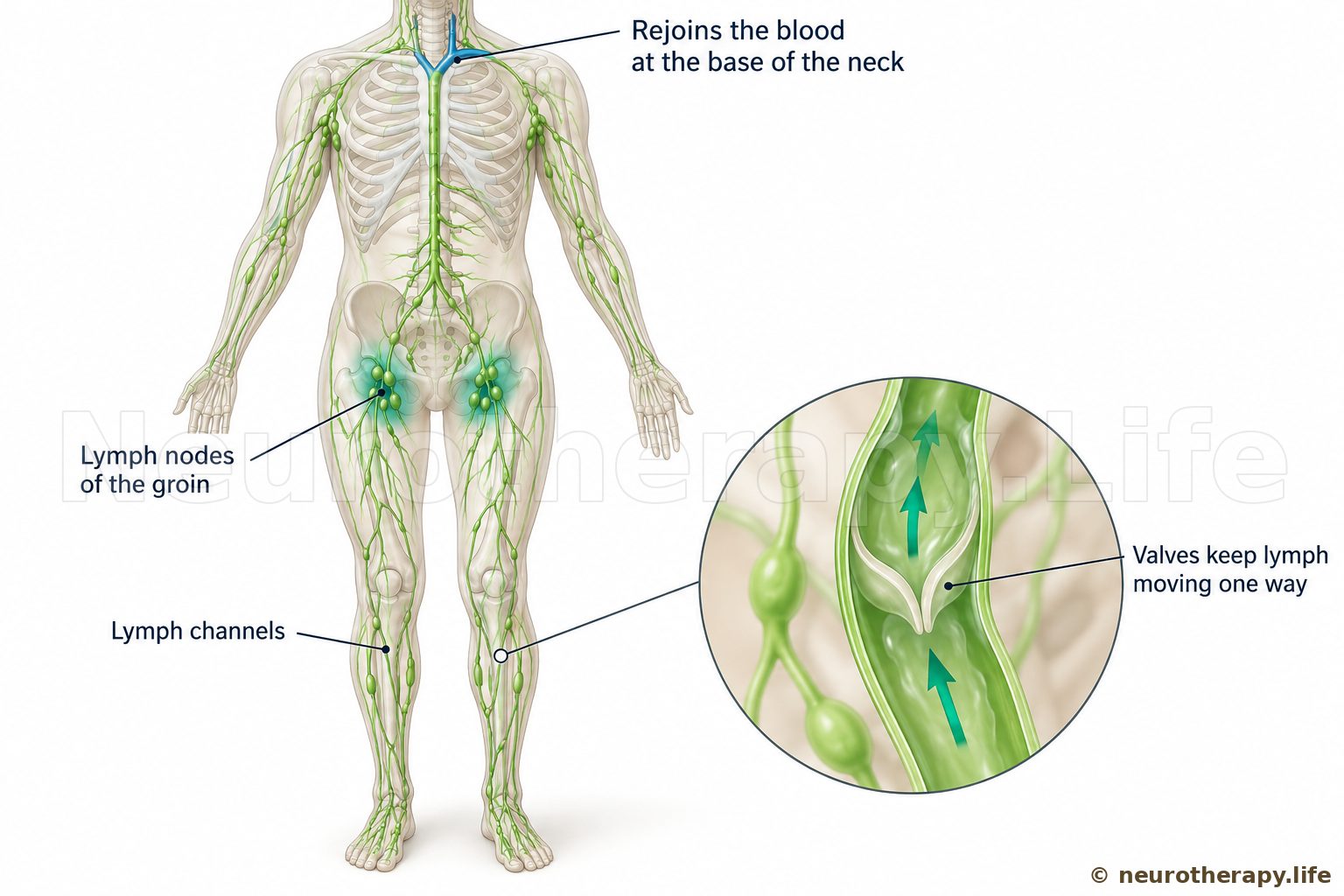
Blood does not touch your cells directly. A clear fluid seeps out of the smallest blood vessels and bathes the tissues; most of it seeps back, and the rest — carrying debris, fats from the gut and the body's defence cells — is collected into thin channels of its own. That returning fluid is lymph. It rejoins the blood near the base of the neck.
On the way, lymph passes through lymph nodes — small filter stations, the "glands" that swell in your neck when your throat is sore. They make no hormone; they are checkpoints where the body inspects what has been collected and mounts a defence. Just below the crease of the groin sit the nodes that drain the whole leg and foot.
Lymph has no pump. Blood is driven by the heart; lymph moves only when you move — muscles squeezing its channels, one-way valves keeping it going forward. That is why the bed-bound and the desk-bound swell, and why in such patients a therapist's hands and feet stand in for a walk they cannot take. The Lymph point is given to rouse the nodes of the thighs.
You lie on your back with one pillow under both thighs. Lymph is given on both thighs at once, very close to the groin.
It looks like the Pan treatment, a hand's breadth away on the same thighs, but it is a different treatment. In Lymph the therapist's heels touch each other and the toes stay on the inner side of your thighs, well away from the groin crease where the leg's main artery, vein and nerve lie under little more than skin.
How this point is given — the tool, the pressure, the count and the exact movement — is deliberately not described here. A demonstration video for this point is being prepared; until it is on this page, learn the method hands-on from a trained Neurotherapist before giving it. Please do not give any point from a written description alone: a point given in the wrong place or the wrong way can do harm.
The exact technique is taught hands-on in the Neurotherapy (LMNT) course. See the course →
The teaching says Lymph rouses the lymph nodes of the thighs — the ducts that carry the lymph. Body science confirms that lymph moves only with outside squeezing and the vessels' own contractions; that this point rouses the defence cells is the therapy's own reasoning.
Lymph belongs to the immunity points, and it has a look-alike on the same thighs.
Lymph is mostly given inside the viral formulas — after the blocked list has been checked, because it is held back in several conditions.
Lymph, the spleen and Thymus Only — for everyone, even after fever, and for small children.
Lymph and Thymus Only — for old diseases like cancer; the spleen only if its point is tender.
The old heavy form, with the armpits and Ton 'P' — now replaced by the mild forms.
The written line of the chronic-disease form.
“If someone has a boil or a pimple on any toe of the foot, or has been injured anywhere on the foot, there will be a great deal of pain in the lymph node of that thigh; and as soon as we rouse that node by our treatment, the pain will reduce immediately.”
No. They are a hand's breadth apart and use different parts of the foot. Lymph uses the heels, touching; Pan uses the middle of the sole.
The therapy's view is that the body has cells that do this, and the viral formulas aim to rouse them. It is support, not a replacement for medicine when an infection needs it.
No. In autoimmune conditions, rousing the lymphocytes may increase the disease, so it is held back.
Lymph has no pump; it moves only when your muscles move. Walking and flexing the ankles keep it flowing.
The heart pumps thousands of litres of blood a day, but only about two to four litres of lymph return to the blood in the same time.
Source: Guyton & Hall, Textbook of Medical Physiology (lymph flow about 2–3 L/day).
Lymph is pushed uphill against pressure by the rhythmic squeezing of the collecting vessels themselves, with one-way valves, helped by outside compression from muscles and breathing.
Source: Moore JE Jr, Bertram CD, Lymphatic system flows, Annu Rev Fluid Mech 2018;50:459–482.
The deep veins and lymph channels of the calf run inside the muscle. Each step squeezes them and drives their contents upward — which is why soldiers standing still on parade sometimes faint.
Source: Guyton & Hall, Textbook of Medical Physiology (venous and lymphatic pumps).
A review of how lymph moves: it is carried back to the blood against a pressure gradient by collecting vessels that contract on their own, with one-way valves, helped by outside compression. The system is robust, but when it fails, fluid builds up as lymphoedema.
Moore JE Jr, Bertram CD. Lymphatic system flows. Annual Review of Fluid Mechanics. 2018;50:459–482.
This page explains what a Neurotherapy (LMNT) treatment is for; it is not a self-treatment guide and does not diagnose. Neurotherapy (LMNT) works alongside your medical care — keep taking the medicines your doctor prescribed.
Send COURSE for course details, or your name, age and health issue for a consultation.