Also called: Thymus + Chest, Thymus Chest, Th+Ch, थाइमस चेस्ट
Th + Ch, or Thymus + Chest, is the Neurotherapy (LMNT) treatment that works the breastbone, the chest and the armpit together, side by side. It is known above all as a pain-killer after a blow or a sprain, and it carries one of the longest lists of people who must not receive it.
Overview
What is Th + Ch?
The chest group of Neurotherapy (LMNT) has four members built out of one another. Th. Only works the breastbone alone. Ch. Only works the chest alone. Armpit works the armpit. Th + Ch is all three together — breastbone, chest and armpit — and that is what its name means.
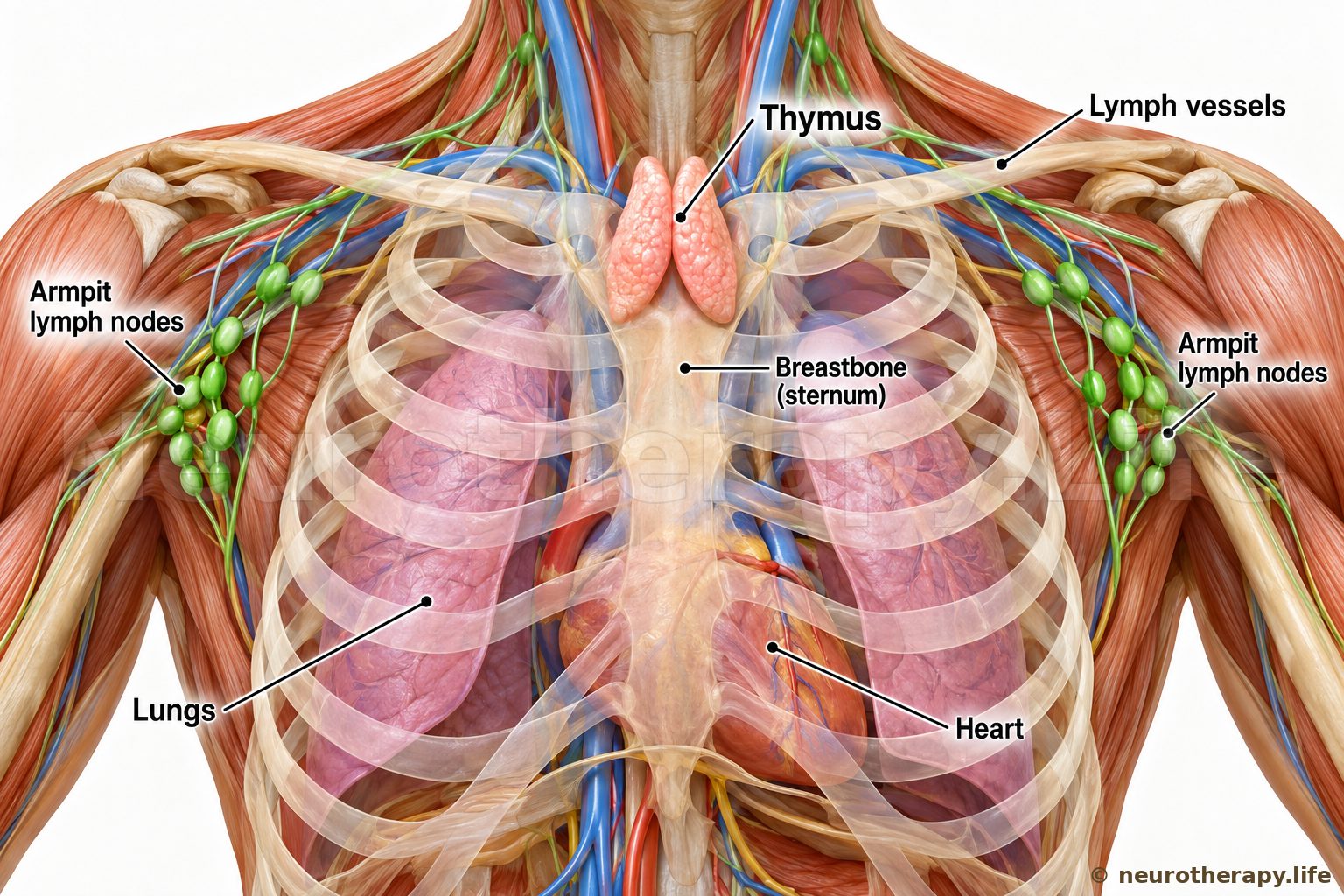
Th stands for the thymus. The thymus is a small gland that sits just behind the top of the breastbone. It is the school where T cells — the white blood cells that recognise germs — learn their job. Ch stands for the chest, and the armpit holds a large cluster of lymph nodes, the small filter stations of the body's defence system.
Guruji called Th + Ch a sure-shot remedy, rāmbāṇ, that acts as a pain-killer when there has been a blow or injury. Because it raises the body's defences, it is also held back from every patient whose defences are already misbehaving.
Th + Ch reaches three areas at once: the breastbone over the thymus, the chest, and the armpit with its lymph nodes.
Where it is given
Where is Th + Ch given?
PositionLying on the back
Body areaFront of the chest on both sides: breastbone, chest to shoulder, and armpit to upper arm
You lie flat on your back with no pillow at all — not under the head, not under the thighs. The chest and the shoulders need to be level for this treatment.
The work covers the front of the chest on one side — from the breastbone, out across the chest toward the shoulder, and through the armpit to the upper arm — and then the same on the other side. Before each side you are asked to turn your face away from the side being treated.
How it is given
How is Th + Ch given?
How this point is given — the tool, the pressure, the count and the exact movement — is deliberately not described here. Watch the demonstration video on this page, and learn the method hands-on from a trained Neurotherapist before giving it. Please do not give any point from a written description alone: a point given in the wrong place or the wrong way can do harm.
Feels likeA smooth, light sweep across the chest and armpit — no digging
The exact technique is taught hands-on in the Neurotherapy (LMNT) course. See the course →
What it does
What does Th + Ch do?
In the source teaching, Th + Ch is credited with these effects:
It acts as a pain-killer after being struck, or after a sprain.
It helps fill minerals into bones and tissues, so that wounds fill up quickly, and it fades old wounds and the marks of burns.
It helps dry up excess water anywhere in the body — such as water or pus that keeps coming from the ear or the eyes.
It is used in an enlarged prostate, in fibroid or cyst of the uterus, and to help dry up bleeding or a blood clot inside the brain.
It is given for ringing or bell sounds in the ears, and in Ménière's disease, where dizziness comes even on turning in bed.
Organs it reaches
Thymus — The gland behind the breastbone where T cells are trained
Lymph nodes — The armpit nodes, filter stations of the defence system
Blood — Carries the white cells that fight infection
The word Only was added to the other chest points to show exactly which part is given. That matters, because the bars on the thymus do not apply to Ch. Only.
Th. Only — The breastbone alone — the thymus without chest or armpit
Ch. Only — The chest without the thymus; used in its place where the thymus is barred
The New Genes form for pain below the navel without diabetes or autoimmune disease
Safety: when it is held back
Not in pregnancy: after Th + Ch the baby begins to move about vigorously, which suggests discomfort, so it is never given to a pregnant woman. Pregnancy care
Not in polio or in inflammatory diseases. Inflammation
Not in rheumatoid arthritis or any autoimmune disorder — where the defence system is already misbehaving, it is not stimulated. Autoimmune disorders
Not in heart disease and not in diabetes. Diabetes
Not in kidney diseases, because almost all kidney diseases are autoimmune. Kidney disease
Injury in such a patient: Ch. Only with Round Arrow is given in place of Th + Ch — the chest work stays, the thymus is left out. Ch. Only
Children receive light treatment. Keep taking your medicines; Neurotherapy (LMNT) works alongside medical care, and a chest injury with breathlessness or suspected broken ribs needs a doctor first. Lighter formulas for children, the elderly and the weak
A teaching case
Teaching case: the sore chest wall
A middle-aged driver came three weeks after a fall, with pain across one side of the chest and a shoulder he could not move freely; an X-ray had ruled out a broken bone. Th + Ch was chosen because it is named for pain after a blow, with the armpit included on each side. When another therapist later worked one side far more heavily than the other, he felt sick on the mat; it passed once he was laid flat and watched. Given evenly again, it passed without trouble, and he was back at work without pain within a couple of months.
A composite case written to teach the reasoning — not one patient’s file.
Common questions
Why must the armpit always be included?
Because Th + Ch means all three parts. If only the breastbone and chest are given, the patient has received something else — a different treatment with a different effect.
Is it painful?
No. It is a light glide, not a press. It should feel smooth and comfortable throughout.
I have diabetes and a sprained wrist. Can I have Th + Ch?
No. Diabetes is on its list of bars. For an injury in such a patient, the therapist keeps the chest work as Ch. Only with Round Arrow and leaves the thymus out.
Why do I turn my face away?
It keeps the side of the neck and the face clear of the area being worked, and it is part of how the treatment is given.
Surprising facts
1A gland that shrinks on schedule
The thymus begins to shrink early in life and keeps losing roughly 3% of its working tissue a year until middle age, then about 1% a year. By old age most of it has turned to fat.
Source: Palmer DB. The effect of age on thymic function. Front Immunol 2013;4:316.
2The T in T cell
T cells are named after the thymus, because that is where they mature and learn to tell the body's own cells from invaders.
Each armpit holds a large cluster of lymph nodes — commonly around twenty to forty — that filter lymph from the arm and much of the chest wall.
Source: Standring S (ed). Gray's Anatomy, 41st ed. Elsevier, 2016.
Watch
INJURY TREATMENT
A shorter Hindi demonstration of the same Injury formula: the toe work on the left foot three times, then Gal, Liv and Chest Only, then Gal, Liv with Thymus and Chest at four and at eight, with a minute's rest between parts.
In LMNT teaching the armpits are always given with Thymus + Chest; this video does not show them. Thymus + Chest is not given in diabetes, heart disease, pregnancy or autoimmune disease.
TREATMENT FOR PAIN DUE TO LFT OV - LMNT Neurotherapy
A demonstration, in Hindi, for period pain felt on the left side: (30) Medulla on the nape, then (6) Lt. Ov. on the forearm, and Thymus + Chest.
(30) Medulla is not given to heart patients. Thymus + Chest is not given in pregnancy, diabetes, heart, kidney or autoimmune disease. Ovary points are not given to teenagers or in cancer.
TREATMENT FOR PAIN DUE TO RT. OV. - LMNT Neurotherapy
A demonstration, in Hindi, for period pain felt on the right side: (30) Medulla, then (6) Rt. Ov. on the forearm, and Thymus + Chest.
(30) Medulla is not given to heart patients. Thymus + Chest is not given in pregnancy, diabetes, heart, kidney or autoimmune disease. Ovary points are not given to teenagers or in cancer.
Treatment for Pain Due to Fibroid in Uterus | LMNT Neurotherapy
A demonstration, in Hindi, for period pain where a fibroid is present: (30) Medulla, then (3) WD on both forearms, and Thymus + Chest.
A fibroid must be followed by a doctor. (30) Medulla is not given to heart patients; Thymus + Chest is not given in pregnancy, diabetes, heart, kidney or autoimmune disease; WD is not given in cancer.
Test yourself
Research
Strong evidence
A review of how the thymus changes with age: it starts shrinking early in life, loses about 3% of its tissue a year until middle age and about 1% a year after that, so the output of new T cells falls steadily.
This page explains what a Neurotherapy (LMNT) treatment is for; it is not a self-treatment guide and does not diagnose. Neurotherapy (LMNT) works alongside your medical care — keep taking the medicines your doctor prescribed.
Ready to begin?
Send COURSE for course details, or your name, age and health issue for a consultation.