Chest and armpit treatments: Thymus, Chest, Armpit and Thymus Chest
Four light rubbing treatments are given on the chest and armpit with the patient lying flat. Together, as Thymus Chest, they are used to ease pain after a blow or injury; Armpit is used to support immunity.
Overview
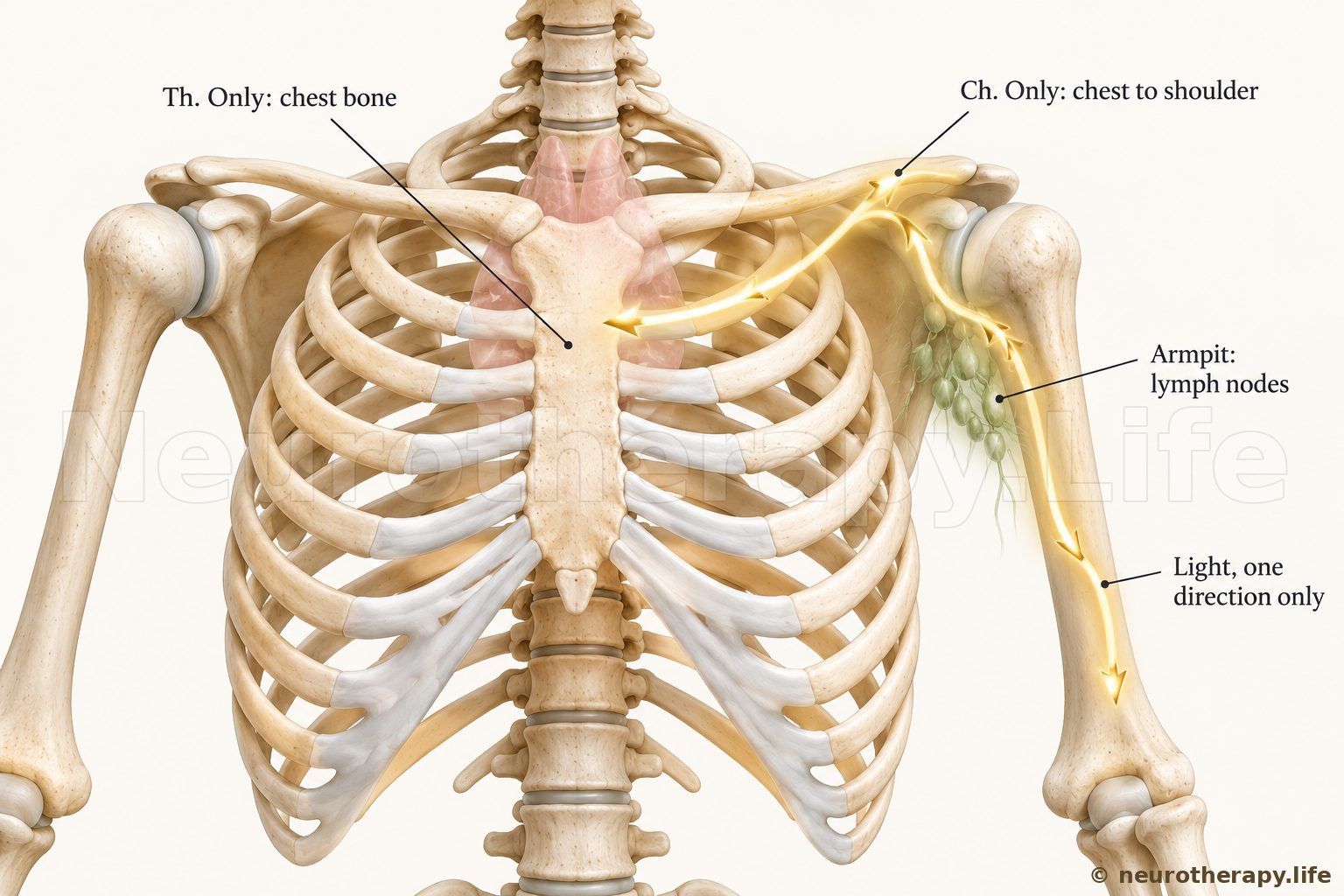
Up to this point most supine treatments are a press held and released. The chest group is different: it is ghisai, a rub. The contact slides lightly along a set path, always in one direction. In Thymus Only there is almost no downward force at all. A rub given backwards is a different treatment.
Th. Only works over the breastbone, behind which the thymus gland sits; the thymus is largest in childhood and shrinks steadily after that. Ch. Only rubs from the chest up to the shoulders. Its right-side form eases the pain of Liv° and its left-side form the pain of Mu°. Armpit rubs through the armpit to the upper arm and rouses the lymph nodes there, to support the body's immunity.
Th + Ch, or Thymus Chest, joins all three. The source calls it a sure remedy that works as a pain-killer after a blow or injury. One side is completed before the other, and the patient turns the face away from the side being treated. A boil on a finger often makes the armpit of that arm painful, and Armpit can bring quick relief.
Balance matters. If one side is roused far more than the other at one time, the sudden swing in the acid-alkali balance can bring on nausea or vomiting in some people. So the work is shared between both sides in small amounts.
Key points
- The chest group is a light one-way rub, not a press.
- Th. Only: breastbone. Ch. Only: chest to shoulder. Armpit: lymph nodes.
- Thymus Chest joins all three and eases pain after a blow or injury.
- Both sides are kept in balance to avoid nausea.
- Thymus is withheld in inflammation and autoimmune disease.
Go deeper
Th. Only
Th. Only, the thymus point
Ch. Only
Ch. Only, the chest rub
Armpit
Armpit, for the lymph nodes and immunity
Th + Ch
Th + Ch, Thymus Chest
Thymus
The thymus gland
Sprain and injury
Sprains and injuries
Fire and Swelling: Inflammation, Injury and Infection
Inflammation, where Thymus is withheld
The Front of the Body II: Glands, Toes, Lymph, Chest and Arms
The front of the body: glands, chest and limbs
Read the full guide
This topic is part of: The Front of the Body II: Glands, Toes, Lymph, Chest and Arms
Safety: when it is held back
- Thymus and Thymus Chest are not given in inflammation or in autoimmune diseases. Ch. Only and Armpit, as separate points, are not covered by this rule. Autoimmune disorders
- In cancer, Thymus is never given. Cancer care: Neurotherapy (LMNT) support
- Loveleen, a chest-and-flank rub, is never given to kidney or heart patients, and chest pain is never treated as gas until a qualified doctor has ruled out the heart. Loveleen
- Consent, covering and a chaperone are not optional for chest work. The patient is told where the contact will travel, kept covered, and asked each session. Consent, dignity and a chaperone during treatment
- The armpit holds the main vessels and nerves of the arm. Tingling, numbness, heaviness or weakness in the hand means stop at once.
- The exact method is taught hands-on in the course, under a trained therapist. Please do not try it on yourself or others from this page.
Watch

This page explains what a Neurotherapy (LMNT) treatment is for; it is not a self-treatment guide and does not diagnose. Neurotherapy (LMNT) works alongside your medical care — keep taking the medicines your doctor prescribed.