1A crowd of filters
The armpit holds roughly twenty to forty lymph nodes, arranged in several groups along the vessels of the arm.
Source: Gray's Anatomy, 41st ed., axillary lymph nodes.
Also called: Armpits, (12) Armpits, आर्म पिट, बग़ल पॉइंट
Armpit is the Neurotherapy (LMNT) point that works on the lymph nodes of the armpit, the small filters of the body's defence system. It is given lying on your back with a light rub through the armpit to the upper arm, and is used to raise the body's resistance to infection.
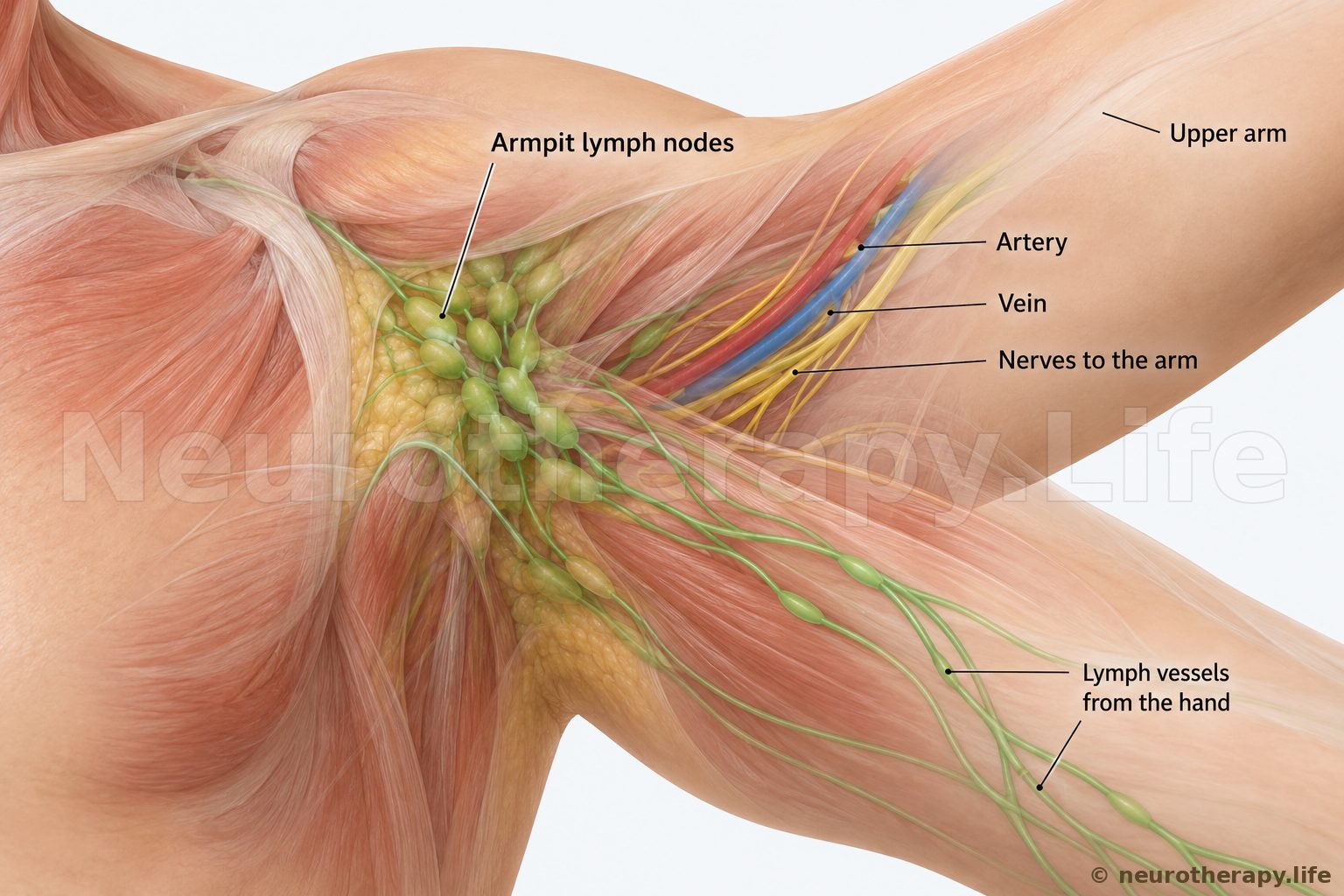
Your armpit holds a cluster of lymph nodes — small, bean-shaped filters that catch germs carried in the lymph, the clear fluid that drains from the tissues. When your hand or finger is infected, these nodes swell and ache as they fight.
The teaching says the Armpit treatment opens the small blockages within these nodes and so rouses their work, which is useful for increasing the body's immunity. It belongs to the chest group of points — Thymus, Chest, Armpit and their combination — and it is one of the six points of immunity.
There is a firm rule about it: whenever Thymus + Chest is written, the armpits must be given too. Without them, Thymus + Chest has not been given.
You lie flat on your back with no pillow at all, so that the chest and shoulder are level, and the arm rests a little away from the side.
The point is worked through the inner part of the armpit, from the side of the chest out to the middle of the upper arm, on both sides.
The armpit is one of the most crowded small spaces in the body. Under little more than skin and fat lie the main artery and vein of the arm and the great cords of nerves on their way into it — which is why the pressure here is kept light and moving.
How this point is given — the tool, the pressure, the count and the exact movement — is deliberately not described here. Watch the demonstration video on this page, and learn the method hands-on from a trained Neurotherapist before giving it. Please do not give any point from a written description alone: a point given in the wrong place or the wrong way can do harm.
The exact technique is taught hands-on in the Neurotherapy (LMNT) course. See the course →
LMNT teaching describes Armpit as opening the small blockages in the lymph nodes of the armpit and so stimulating them. Body science agrees that these nodes filter the lymph of the arm and the side of the chest and are a meeting place for the immune cells that fight infection. That a rub can open them is the therapy's own explanation, from clinical experience.
Armpit belongs to the chest group and to the six points of immunity.
Read the bars first: this family has one of the longest lists of people who must not have it.
The Acid formula ending with Thymus + Chest, which brings the armpits with it.
Thymus and Chest with the armpits, for injury.
Each arm in this treatment ends with a press inside the armpit.
The same manoeuvre in the acid-reducing order.
Lymph from the finger drains up the arm to the armpit nodes, which swell and ache as they fight the germs. The teaching uses the Armpit point for quick relief of that pain.
No. It is blocked in diabetes, which the therapy treats as an auto-immune disorder.
It is a light, sliding rub. Some people feel ticklish at first. Any tingling or numbness in the hand means the therapist stops at once.
Because the teaching writes Thymus + Chest as three contacts — breastbone, chest and armpit. Leave the armpit out and a different treatment has been given.
The armpit holds roughly twenty to forty lymph nodes, arranged in several groups along the vessels of the arm.
Source: Gray's Anatomy, 41st ed., axillary lymph nodes.
About three-quarters of the lymph from the breast drains to the armpit nodes — which is why doctors examine the armpit when they examine a breast lump.
Source: Gray's Anatomy, 41st ed., lymphatic drainage of the breast.
When a hand infection spreads into the lymph vessels, a thin red line can run up the inner arm toward the armpit — a sign to see a doctor the same day.
Source: Standard clinical description of lymphangitis.
Every nerve that moves and feels the arm passes through the armpit as the brachial plexus, beside the axillary artery and vein.
Source: Gray's Anatomy, 41st ed., axilla.

A full Hindi demonstration of the Injury formula: 60 Toe-Finger twists on the third and fourth toes of the left foot, three rounds; then Gal, Liv and Chest Only; then Gal, Liv, Thymus and Chest with the armpits, at four and at eight — a minute's gap between parts, and only as much weight as the patient can bear.
This page explains what a Neurotherapy (LMNT) treatment is for; it is not a self-treatment guide and does not diagnose. Neurotherapy (LMNT) works alongside your medical care — keep taking the medicines your doctor prescribed.
Send COURSE for course details, or your name, age and health issue for a consultation.