Also called: Mauneesh alkali treatment, Maunish alkali order
The alkali order of Mauneesh is a Neurotherapy (LMNT) treatment that works along all four limbs toward the trunk, following the body's lymph drainage. It is used to lower raised alkali, and is given for stiffness and spasticity, as in cerebral palsy and fits.
Overview
What is the Mauneesh alkali order?
Mauneesh is a pair of treatments, not one. Both use the same patient position and the same gentle work along the arms and legs. Only the order in which the four limbs are taken changes — and in Neurotherapy (LMNT) that order is the whole instruction. One order lowers alkali. The other lowers acid.
This page is about the alkali order. Its stated work is to bring raised alkali down, so that stiffness eases and the muscles become soft. It belongs to the cranial nerve and lymph group of treatments.
The treatment carries the name of an old student of Guruji's, Shri Mauneesh Vyas ji, as a mark of respect. Like other named treatments, the name tells you nothing about what it does, so it has to be learnt.
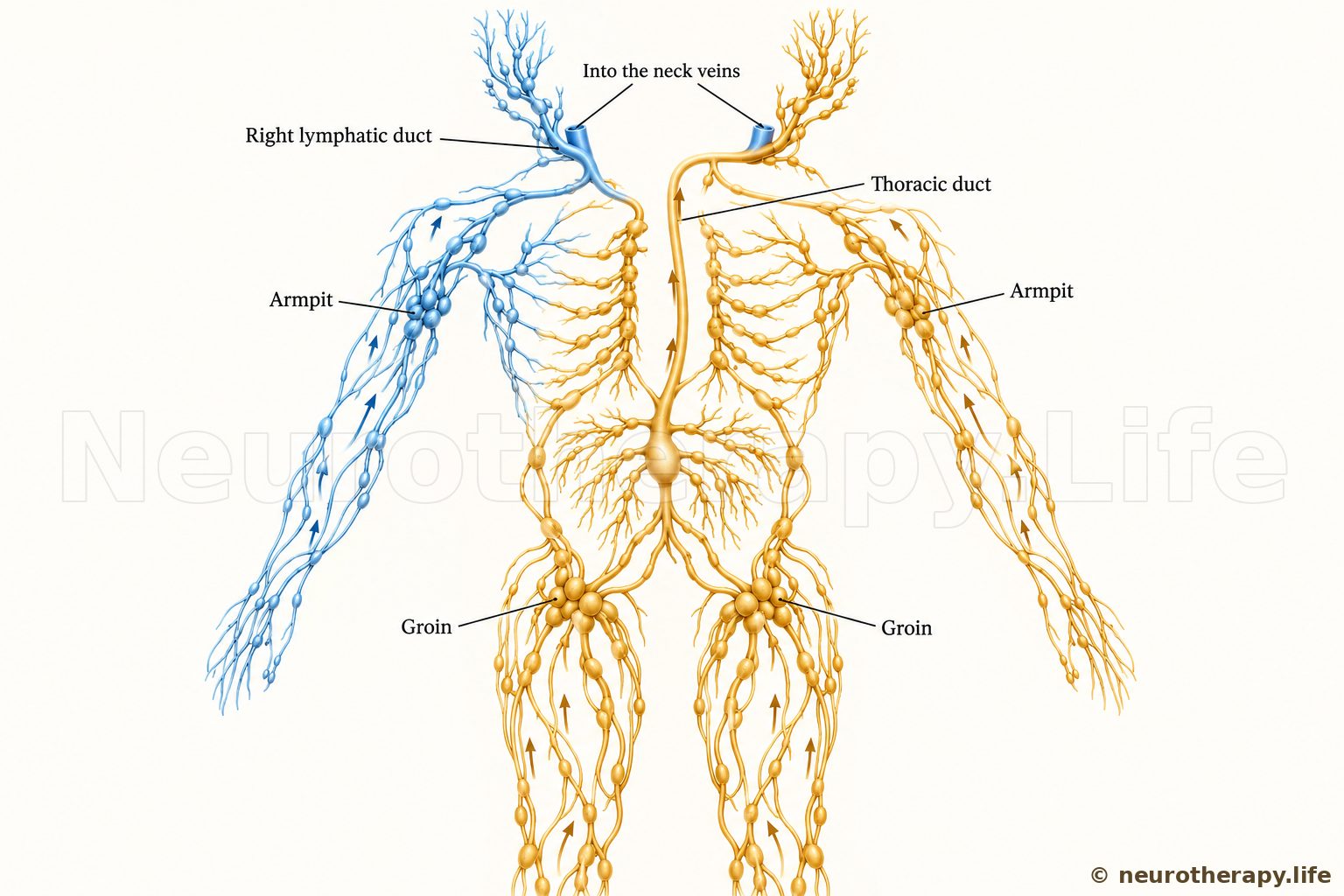
Mauneesh works along all four limbs toward the trunk. Two ducts carry the lymph back to the blood, and they drain very unequal territories.
What it is for
What is the alkali order used for?
To reduce raised alkali in the body.
To ease stiffness, so that tight muscles become soft.
For patients with cerebral palsy, fits and spasticity, as the source names them.
Points it works through
Where does the alkali order work?
right hand, right leg, left leg, then at the end left hand
Mauneesh is a route treatment, not a set of single points. It works along each arm from the palm toward the armpit, and along each leg from the heel toward the groin — always toward the trunk, where the lymph drains. The order of the limbs and the exact method are taught hands-on in the Neurotherapy (LMNT) course. This page lists the points of the formula and what each one contributes; it does not describe how any point is given. For the method, watch the demonstration video of each point on its own page and learn hands-on from a trained Neurotherapist. Please do not give a formula from a written description alone.
A sister idea: the lymph point also works on the body's drainage system, by a different route.
Position:The patient first turns onto the side, then lies on the back with both arms raised and bent beside the head and the knees turned outward. The patient is turned onto each side as the legs are worked.
The exact technique is taught hands-on in the Neurotherapy (LMNT) course. See the course →
How it works
Why does the order of the limbs matter?
Lymph from the two sides of the body does not return to the blood the same way. A short duct on the right carries lymph only from the right arm, the right side of the head, heart, lung and chest. A long duct on the left — the thoracic duct — carries lymph from both legs, the left arm, the left side of the head and chest, and every organ of the abdomen.
So the two sides are not mirror images. Neurotherapy (LMNT) teaching uses this: a sequence that finishes on one side empties last into the great duct, and one that finishes on the other side empties last into the small one. Which of the two is wanted decides which order is given. The alkali order is the one chosen to bring alkali down.
Why only about a quarter of the lymph goes to the right side is a question Neurotherapy (LMNT) itself leaves open for research.
Its family
Which treatments are related?
The alkali order has a twin, and both sit in the cranial nerve and lymph group beside other drainage treatments.
Mauneesh, the acid order — The same position and the same work, with the limbs taken in a different order — to reduce acid.
Maunish treatments — Made by the same student: treating the armpit or groin when a hand or foot is infected or injured.
ALTF (chief form) — The main Neurotherapy (LMNT) formula for raised alkali, given through points on the front of the body.
Subclavian treatment — Another treatment of this group that works where the lymph meets the veins below the collar bone.
What it is used for
When is the alkali order used?
The source names a small, clear group of patients. The order is chosen only after the therapist has found that alkali, not acid, is raised that day.
The two orders do opposite jobs. The therapist checks the navel kidney points, Liv° and Mu°, on the day, to know whether alkali or acid is raised, before choosing an order. Giving the wrong order pushes the body further the wrong way. Liv°
Neurotherapy (LMNT) never gives an alkali-lowering formula (ALTF) in acidosis, nor an acid-lowering formula (ATF) in alkalosis. The same care applies when choosing between the two Mauneesh orders. Acidosis
A child or adult with fits keeps taking the medicine the doctor prescribed, every day. Neurotherapy (LMNT) works alongside it, never instead of it. How to tell a patient to see a doctor
Common questions
Why does only the order change between the two Mauneesh treatments?
Because the work along each limb is the same in both. Neurotherapy (LMNT) holds that where the sequence ends — on the side of the great lymph duct or the small one — decides which way the body is moved.
Is it a massage?
No. It is a pressure treatment with a fixed direction, toward the trunk, and a fixed purpose. The exact method is taught hands-on in the Neurotherapy (LMNT) course.
Can it replace medicine for fits or cerebral palsy?
No. It is given alongside medical care. Medicines for fits are never stopped or reduced because of a treatment session.
Who was Mauneesh?
Shri Mauneesh Vyas ji, an old student of Guruji's. The Maunish treatments for the armpit and groin are also his.
Surprising facts
1Three quarters of your lymph drains up one side
The thoracic duct collects lymph from both legs, the whole abdomen and the left upper body, and empties it into the veins at the root of the left side of the neck. The right lymphatic duct serves only the right arm, right chest and right side of the head.
Source: Standard anatomy: Gray's Anatomy, 41st ed., lymphatic system; Moore JE Jr, Bertram CD. Lymphatic system flows. Annu Rev Fluid Mech. 2018;50:459–482.
2Lymph has no heart of its own
Blood is pushed by the heart, but lymph moves by the squeezing of the lymph vessels themselves and of the muscles around them, with one-way valves stopping it from sliding back. Movement of the limbs helps it along.
Source: Moore JE Jr, Bertram CD. Lymphatic system flows. Annual Review of Fluid Mechanics. 2018;50:459–482.
3Litres of fluid come home every day
Every day a few litres of fluid leak out of the tiny blood vessels into the tissues. The lymph system gathers it up and returns it to the blood at the base of the neck. Without that return, the tissues would swell.
Source: Guyton and Hall Textbook of Medical Physiology, 14th ed., the lymphatic system (roughly 2–3 litres of lymph per day).
Test yourself
Research
Strong evidence
This review explains how lymph is pushed along by the contraction of its own vessels and by the surrounding tissues, and how it finally returns to the veins at shoulder level. It is the body science behind the idea of working toward the trunk.
This page explains what a Neurotherapy (LMNT) treatment is for; it is not a self-treatment guide and does not diagnose. Neurotherapy (LMNT) works alongside your medical care — keep taking the medicines your doctor prescribed.
Ready to begin?
Send COURSE for course details, or your name, age and health issue for a consultation.