Cranial Nerve and Brain Formulas
Twelve pairs of nerves leave the brain directly. In Neurotherapy (LMNT) each pair is linked with the Medulla treatment that carries its own number, and the left and right sides work in opposite directions. This guide also covers the slow lymph, the Subclavian and Maunish treatments, and the gentle Feather Touch.
Overview
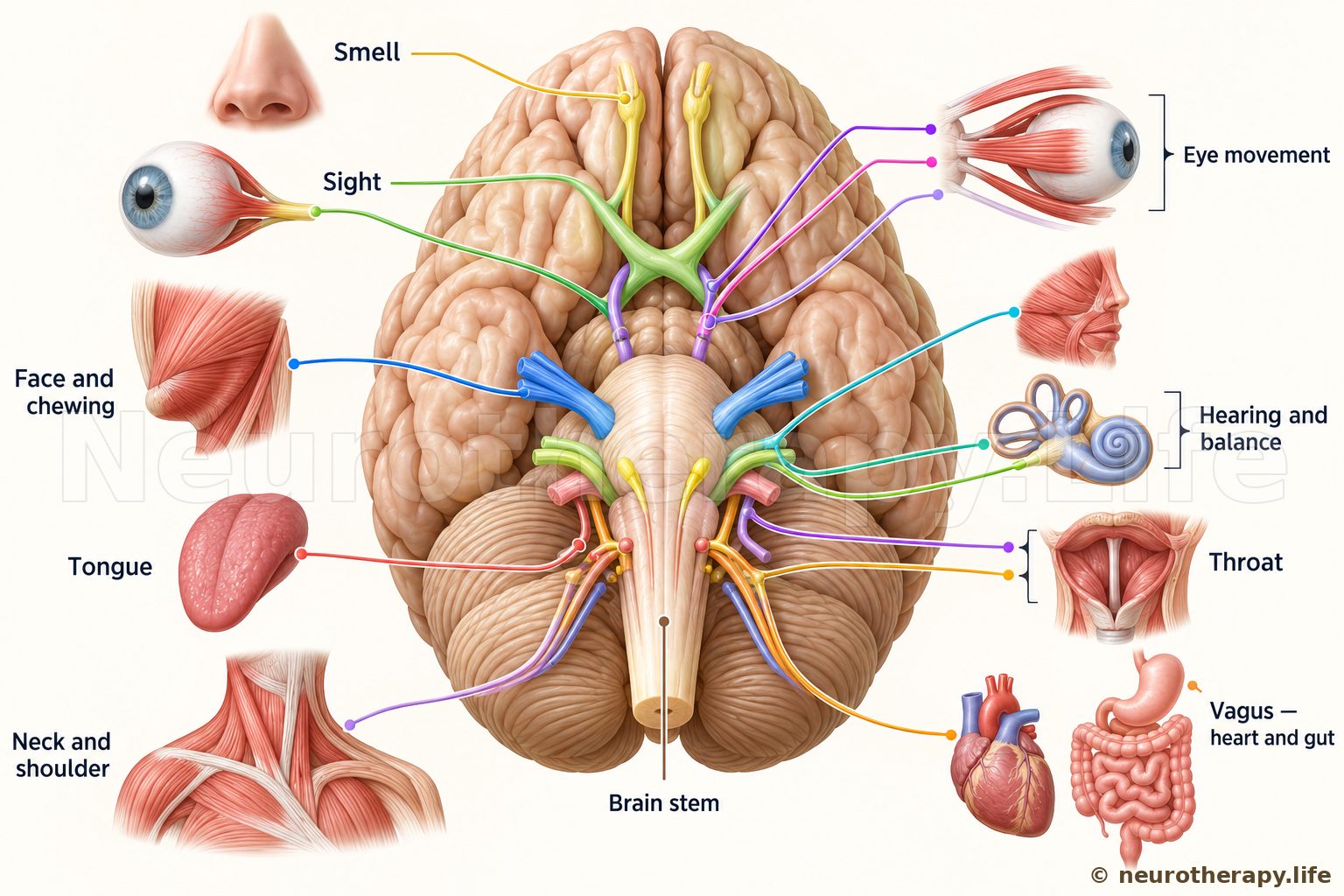
Twelve pairs of nerves leave the brain directly. In Neurotherapy (LMNT) each pair is linked with the Medulla treatment that carries its own number, and the left and right sides work in opposite directions. This guide also covers the slow lymph, the Subclavian and Maunish treatments, and the gentle Feather Touch.
Three doctors who could not smell
At a conference of alternative medicine in Delhi, before about seven hundred doctors, Guruji asked whether anyone present could not smell at all, though the nose was clear. Three men stood up. Two had lived with it for years and had never thought it worth mentioning. They were given (1) Medulla in front of the hall, and then the same bar of soap was passed under their noses. All three said they could smell it.
The lesson for the therapist is simple: almost nobody complains of a lost sense of smell. You have to ask.
Twelve pairs, and a number for each
Thirty-one pairs of nerves leave the spinal cord. Above them, twelve pairs leave the brain itself, through small holes in the floor of the skull, and go straight to the parts they serve. Each is a pair — one on the right, one on the left — and they are numbered from front to back, so the first is smell and the twelfth is the tongue.
The central teaching is stated as a discovery found by trying treatments on many patients: every cranial nerve can be stimulated by the Medulla treatment of the same number. (1) Medulla is linked with the nerve of smell, (7) Medulla with the nerve of the face, (10) Medulla with the vagus. Since all the brain's work passes through these nerves, the teaching asks whether many brain disorders can be helped this way. (15) Medulla, which is described as supplying acetylcholine — the messenger chemical these nerves use — is used alongside this work.
Some functions need two nerves, and then both numbers are needed. Taste is the clearest example: the teaching works on both (5) Medulla and (7) Medulla for problems of taste. Swallowing, the throat and vomiting are shared by several nerves in the same way.
- First — smell. A clear nose that smells nothing.
- Second — sight, and the retina's own brain chemicals; one of the three long nerves.
- Third, fourth and sixth — the eye muscles, the eyelid and the pupil; double vision and squint.
- Fifth — all feeling of the face and the chewing muscles; migraine, toothache, sinus and most coughs; a long nerve.
- Seventh — the face's expressions, tears and taste at the front of the tongue; Bell's palsy.
- Eighth — hearing and balance; deafness, ringing and vertigo.
- Ninth — the throat, taste at the back, and the sensors for blood pressure and oxygen; hiccups.
- Tenth — the vagus, the 'wanderer': voice, airways, heart rate and most of the gut; the longest.
- Eleventh — the neck and shoulder muscles; a neck that will not turn, a frozen shoulder.
- Twelfth — the tongue's movements; a tongue pulling to one side, thick speech.
Left is not right
The second discovery is about side. Left Medulla increases acid; Right Medulla increases alkali. Joined with Swt (which reaches the adrenal medulla, the core of the gland on top of the kidney), the left side opens — sphincters and arteries widen — and the right side closes — they narrow. So the side belongs to the treatment's identity; it is never a detail.
Teaching cases show both ends. A man who could barely swallow because the ring of muscle at the top of his stomach stayed tight was given the left-side pair and ate properly that evening. A woman with legs swollen from varicose veins was given the right-side pair and the swelling came down. At a camp, a woman with painful urination was asked one question — does the stream come so hard it hits the wall? — and her 'yes' showed a narrow opening before any hand touched her.
The slow river: lymph
Blood has a pump; lymph has none. It carries heavy freight — proteins, fats and the white cells that defend the body — so it moves slowly, and only a few litres return each day. Most of it, from both legs, the abdomen and the left side of the body, drains into a vein beneath the left collarbone; the right upper body drains on the right.
The Maunish treatments, made by an old student of Guruji, work on the lymph nodes. When a cut or infection on the hand leaves pain in the armpit, or one on the foot leaves pain in the groin, the drainage station must be treated — until it settles, the finger or toe will not. The Subclavian treatment works on the lymph through the veins at the base of the neck; a check of the ring fingers decides whether it is the right choice, and if the finger pain does not clear, Raman, a treatment of the peritoneum (the lining of the abdomen), is the next answer. The Complement System formula, named after the body's ancient chain of defence proteins, is described as beneficial in almost all long-standing diseases.
Feather Touch, and the honest question mark
Feather Touch was found in 2007 at an airport gate in Delhi. An elderly woman in a wheelchair could not take a step because of pain. Guruji, wanting to ease her, passed his palm very softly down her cheek. She said the pain had lessened and asked for it again; then she stood up. After months of study the touch became a treatment, so light that powder on the skin is not wiped away. Its visible sign is the hair standing up on the skin. It is the treatment for those who can bear nothing heavier, and is used in paralysis, stiffness, pain and brain disorders.
This field carries more marked uncertainty than any other, and those marks belong to the teaching itself. The functions of (6) Medulla and (10) Medulla are openly said to need further discovery. The exact method of every treatment here is taught hands-on in the course.
Key points
- Twelve pairs of cranial nerves leave the brain directly, numbered from front to back.
- Each cranial nerve is linked with the Medulla treatment of its own number.
- Left Medulla raises acid and opens; Right Medulla raises alkali and closes — the side is never optional.
- Where a function uses two nerves, such as taste, both numbers are worked.
- Lymph moves slowly; treating the drainage station frees the painful finger or toe.
- Feather Touch is the gentlest treatment, for those who can bear nothing heavier.
- Lost smell is rarely reported — always ask.
Topics in this guide
Go deeper
Cranial nerves
The twelve pairs of nerves in detail
The Medulla Family: One Place, Many Treatments
The graded Medulla family and its bars
Seated Treatments I: The Back of the Head and the Neck
The seated points for the brain and neck
Complement System
The formula for long-standing illness
Subclavian treatment
Lymph through the veins at the neck
Maunish treatments
Treating the lymph nodes
Feather Touch
The lightest treatment there is
Loss of smell (anosmia)
Loss of smell
Safety: when it is held back
- In heart disorders, (10) Medulla is given only as (10) Left Medulla, never on both sides. The rows for a narrowed food pipe and for widening the voice box are also (10) Left Medulla only. (10) Medulla
- (10) Medulla also carries its own bars in diabetes and cancer, and these pass to every formula that contains it. Diabetes
- (30) Medulla is not given to heart patients, and never in cancer. (30) Medulla
- In cancer, never give (10) Pan, Thymus, Pit, Lu + Sh, Rt. Ov., Lt. Ov. or (30) Medulla. Cancer care: Neurotherapy (LMNT) support
- Always write the side (left or right) with every Medulla and Swt treatment; the two sides do opposite things. SWT
- Feather Touch in inflammatory disease: do not stroke over the thymus on the chest or the upper back from T1 to T6. Feather Touch
- Children get light treatment. Never stop prescribed medicines; sudden loss of vision, facial weakness, or difficulty swallowing or speaking needs a doctor at once. How to tell a patient to see a doctor
Guruji says
“Wherever there is a question mark, it is an indication that this is my own thinking, on which other people can now do research.”
Common questions
Why do you work on the back of my neck when my problem is in my face?
Twelve pairs of nerves come straight out of the brain. The one that works your face passes through the brain stem, at the back of the neck. The treatment works where its traffic passes.
Why does it matter whether the left or right side is treated?
Because they act in opposite directions: the left side is used to open what is too tight, the right side to tighten what is too slack. A Medulla treatment written without its side is incomplete.
My finger healed but still hurts. Why treat my armpit?
The lymph from the hand drains to the nodes in the armpit. If that drainage station is still swollen and painful, the finger stays sore until it is set right.
Is Feather Touch safe for very weak patients?
It is the lightest treatment there is, with no weight at all, which is why it is used for those who can bear nothing else. In inflammatory disease, the thymus area and the upper back are left out.
Watch

Shows (15) Medulla four times below both ears, a fingertip head massage in lines from the forehead to the back of the head, and gentle circles between the eyebrows. It is shared as self-care for relief in migraine and headache.
Note: the video gives (15) Medulla; the LMNT migraine treatment uses (5) Medulla. Follow your therapist's plan.

Shows a five-minute self-routine before bed: (8) Medulla below the ears three times, pressure while sitting in Vajrasana, massage just below the knees and at the back of the head, plus tips on screens and dim light. It is shared to support better sleep.

This video shows the right way to give (4) Medulla, Raman and the T1–T2 point for neck and shoulder pain and numbness.
Test yourself
Research
- Strong evidence
Explains how smell reaches the brain's outer layer without first passing through the thalamus, the relay station every other sense uses.
Shepherd GM. Perception without a thalamus: how does olfaction do it? Neuron. 2005;46(2):166–168.
Explore more
Organs
Body systems
Diseases
Points
Formulas
Topics
Read more
This page explains what a Neurotherapy (LMNT) treatment is for; it is not a self-treatment guide and does not diagnose. Neurotherapy (LMNT) works alongside your medical care — keep taking the medicines your doctor prescribed.