1The eye is part of the brain
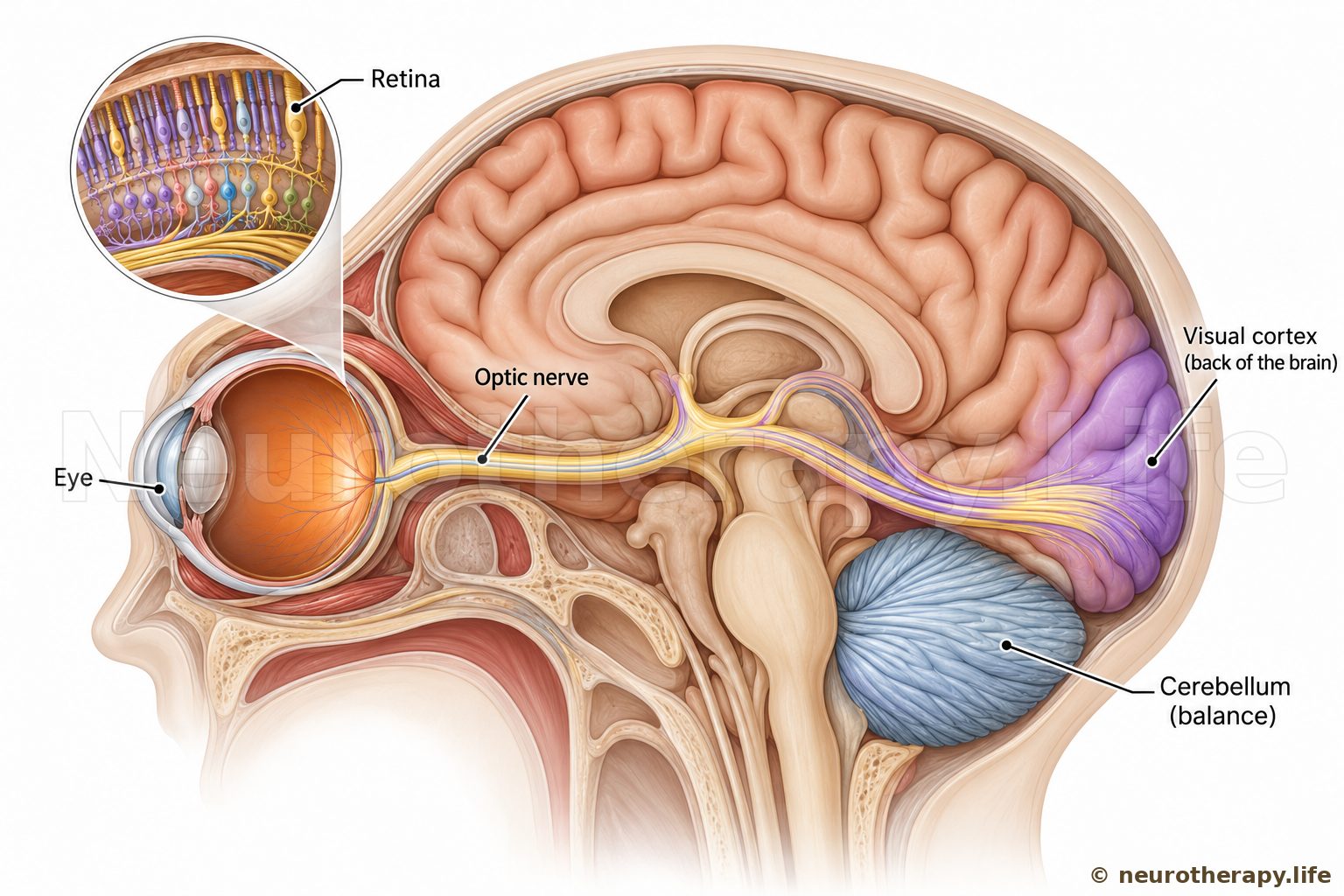
The retina grows out of the developing brain in the embryo. It is the only part of the central nervous system you can see directly, through the pupil.
Source: Gray's Anatomy (41st ed.), development of the eye.
Also called: 2 Medulla, the optic nerve treatment, ऑप्टिक नस का ट्रीटमेंट
(2) Medulla is the smallest member of the Medulla family. It is given behind the ears and is held to work like the optic nerve and the nerve cells of the retina — used for the eyes, for speech, for balance, and in ataxia and Parkinson's disease.
(2) Medulla belongs to the Medulla family — nine treatments given at one place behind the ears, each chosen by the number written before the name. (2) and (4) were the last two to be discovered, which is why they come at the end of the family's order, not because they matter least.
It is held to stimulate the second cranial nerve — the optic nerve, which carries sight from the eye to the back of the brain. Up to twelve, the Medulla number points to the cranial nerve of the same number, and two is the nerve of sight.
The retina at the back of the eye is not a passive film. It is a sheet of working nerve cells that release several chemical messengers — acetylcholine, dopamine, GABA and others. LMNT teaching infers from this that (2) Medulla releases GABA, a calming messenger whose chief job is to stop unwanted movements of the hands and feet.
You sit on a firm chair, feet flat and back supported. A very ill or very weak patient can receive it lying down.
It is given on both sides of the neck, one side at a time: behind each ear, just below the skull bone, and down the side of the neck towards the shoulder. The front of the neck is never touched.
How this point is given — the tool, the pressure, the count and the exact movement — is deliberately not described here. A demonstration video for this point is being prepared; until it is on this page, learn the method hands-on from a trained Neurotherapist before giving it. Please do not give any point from a written description alone: a point given in the wrong place or the wrong way can do harm.
The number written before a point's name is not a strength setting. Each numbered form is a separate named treatment with its own method and timing, taught hands-on in the course.
The exact technique is taught hands-on in the Neurotherapy (LMNT) course. See the course →
LMNT teaching holds that (2) Medulla acts like the second cranial nerve and rouses the nerve cells of the retina, which make GABA, acetylcholine and dopamine. Body science confirms that the retina makes these messengers and that GABA calms movement; the link from the neck to the retina is the therapy's own clinical finding.
(2) Medulla shares its place and touch with the other Medulla treatments, and is often followed by work at the back of the head.
Observations from centres across the country are recorded for (2) Medulla. They are reports of improvement alongside other care, not promises.
The nine Medulla members set out as one family.
The third part of the retinitis pigmentosa treatment, after (2) Medulla and Necklace.
No. It is given behind the ears on the neck. It is named for the nerve of sight it aims at, not for where it is given.
Because the retina makes GABA, a calming messenger that stops unwanted movements. LMNT teaching infers that (2) Medulla releases it — and Parkinson's patients have reported their shaking easing.
No such promise is made. One long-treated patient began to see slightly after some months, and his treatment was still going on. It is recorded as an observation, not a cure.
No. The number chooses a different treatment, not a strength. (2) works on sight and movement; (10) on digestion.
The retina grows out of the developing brain in the embryo. It is the only part of the central nervous system you can see directly, through the pupil.
Source: Gray's Anatomy (41st ed.), development of the eye.
Each optic nerve carries roughly 1.2 million nerve fibres from the retina to the brain.
Source: Gray's Anatomy (41st ed.), optic nerve.
Although the eyes are at the front, the main visual area — Brodmann's area 17 — lies at the very back of the brain, in the occipital lobe.
Source: Guyton & Hall, Textbook of Medical Physiology (14th ed.), the visual cortex.
Stand on one foot and close your eyes: most people wobble at once. The brain blends signals from the eyes, the inner ear and the joints to keep you upright.
Source: Guyton & Hall, Textbook of Medical Physiology (14th ed.), vestibular sensations and equilibrium.
This page explains what a Neurotherapy (LMNT) treatment is for; it is not a self-treatment guide and does not diagnose. Neurotherapy (LMNT) works alongside your medical care — keep taking the medicines your doctor prescribed.
Send COURSE for course details, or your name, age and health issue for a consultation.