Also called: 8 Medulla, the serotonin treatment, सेरोटोनिन ट्रीटमेंट
(8) Medulla is the member of the Medulla family linked to serotonin, the brain chemical of sleep and mood. Given behind the ears, it often sends a person into deep sleep within a short while. It is also used for the ears, giddiness and balance — but never in inflammation, cancer or high blood pressure.
Overview
What is (8) Medulla?
(8) Medulla is one of the nine numbered Medulla treatments, all given at the same place behind the ears. The whole of its story grew from one observation: after it is given, the person begins to fall into deep sleep within a short while.
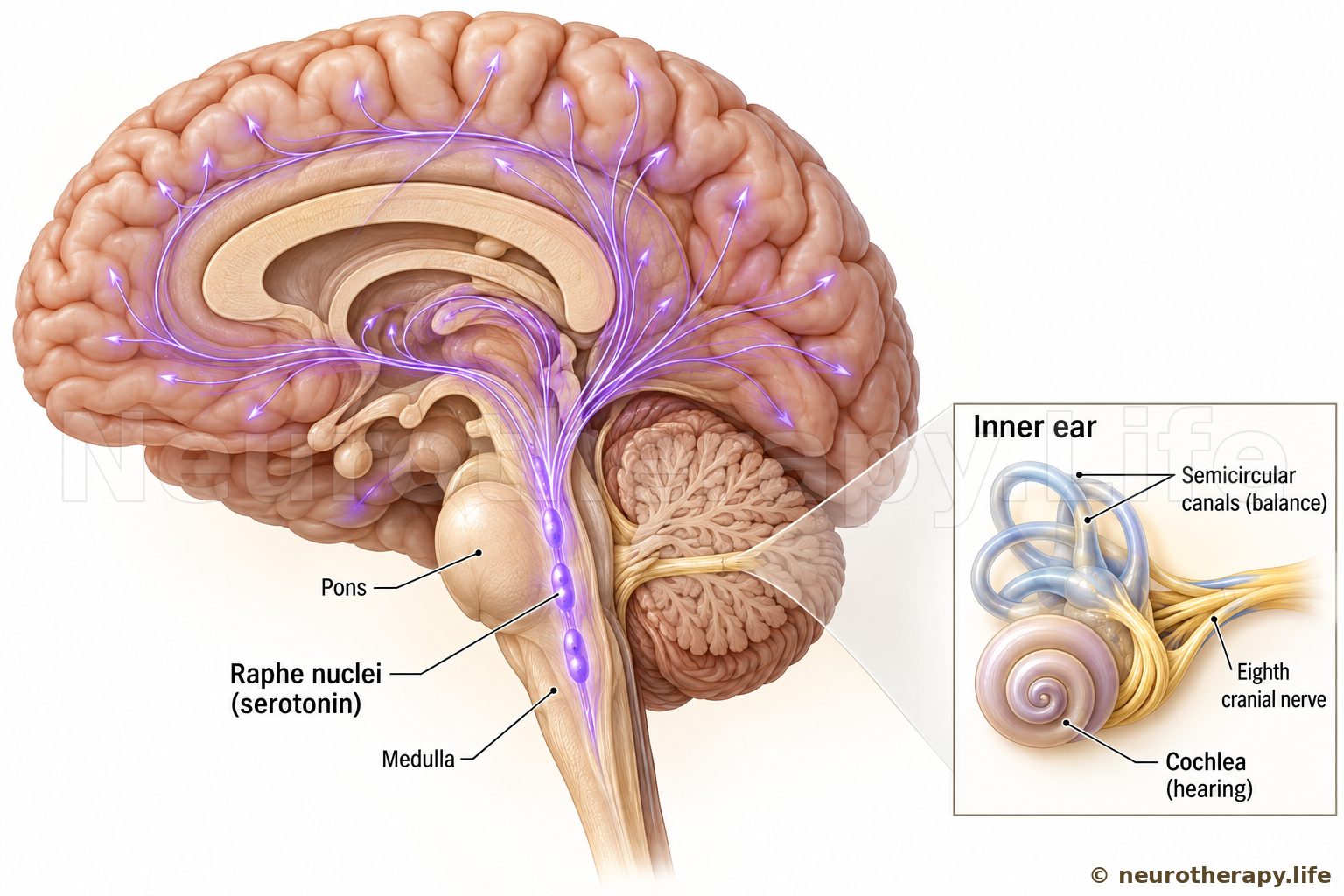
From that, the therapy holds that (8) Medulla stimulates serotonin — a chemical messenger needed for sleep and for a steady mood. Serotonin is made mainly in a strip of brainstem called the raphe, and also by nerve cells in the wall of the gut.
(8) Medulla also has its place among the cranial-nerve treatments: up to twelve, the Medulla number points to the nerve of the same number, and the eighth cranial nerve is the nerve of hearing and balance. That is why it is the safety-net treatment for all problems of the ear.
Serotonin is made in the raphe of the brainstem; the eighth cranial nerve carries hearing and balance — the two worlds of (8) Medulla.
Where it is given
Where is (8) Medulla given?
PositionSitting
Body areaBoth sides of the neck, behind and below the ears
You sit on a firm chair, feet flat, back supported. A very ill or very weak patient can receive it lying down.
It is given on both sides of the neck, one side at a time: behind each ear, just below the skull bone, and down the side of the neck towards the shoulder.
How it is given
How is (8) Medulla given?
How this point is given — the tool, the pressure, the count and the exact movement — is deliberately not described here. Watch the demonstration video on this page, and learn the method hands-on from a trained Neurotherapist before giving it. Please do not give any point from a written description alone: a point given in the wrong place or the wrong way can do harm.
The number written before a point's name is not a strength setting. Each numbered form is a separate named treatment with its own method and timing, taught hands-on in the course.
The exact technique is taught hands-on in the Neurotherapy (LMNT) course. See the course →
What it does
What does (8) Medulla do in the body?
LMNT teaching holds that (8) Medulla stimulates serotonin and the raphe of the brainstem, and works through the eighth cranial nerve. Body science confirms that serotonin does each of the jobs below; the link from the neck is the therapy's own clinical finding.
Sleep and mood: serotonin is needed to bring sleep and to lift extreme sadness.
The ear: hearing, ringing in the ears, and giddiness from the balance canals of the inner ear.
Smooth muscle and gut: helps smooth muscle contract and increases the secretions of the intestine.
Blood vessels: used where vascular permeability — the passage of substances across the vessel wall — needs to increase.
Height: dopamine and serotonin both raise growth-hormone release, so (8) and (20) Medulla are given together for growing children.
Organs it reaches
Brain — The raphe of the brainstem, the main source of serotonin, and the cerebellum for balance.
Ears — Hearing and balance, through the eighth cranial nerve.
Intestines — Most of the body's serotonin is actually made in the gut wall.
Blood vessels — Serotonin narrows blood vessels — one reason it is barred in high blood pressure.
Its family
Which treatments is it related to?
(8) Medulla shares its place and touch with the Medulla family, and is often given beside two of its members.
Medulla — The parent point — one place, nine treatments.
(20) Medulla — Dopamine — given with (8) Medulla for height.
(2) Medulla — Given with (8) Medulla when balance fails because of the eyes or ears.
(30) Medulla — The member used for inflammation, where (8) Medulla is barred.
(6) Adr — Added with (8) Medulla when the ear is inflamed.
What it is used for
What is (8) Medulla used for?
The therapist chooses (8) Medulla from today's findings, after checking for inflammation, cancer and high blood pressure.
ComaListed for a disturbed reticular activating system, the brainstem network that keeps us awake — only alongside hospital care.
Safety: when it is held back
Inflammation: (8) Medulla is not given, because in inflammation serotonin acts like histamine and increases it. (30) Medulla is the member used there instead. Inflammation
Sudden giddiness with double vision, slurred speech, weakness or a severe headache is an emergency — send to hospital, no neck work. How to tell a patient to see a doctor
Low mood with thoughts of self-harm needs a doctor or helpline today. Never stop antidepressants or sleeping medicines on your own. Depression (extreme sadness)
Do not drive straight after a session if you feel drowsy.
Common questions
Why do I feel sleepy after (8) Medulla?
That is the observation the whole treatment grew from. It is held to stimulate serotonin, which the body needs to fall asleep.
I have high blood pressure. Can I have (8) Medulla for sleep?
No — it is barred in high blood pressure because serotonin can raise the pressure. Your therapist will choose a different route.
Why is it used for ear problems?
Because up to twelve the Medulla number points to a cranial nerve, and the eighth is the nerve of hearing and balance. When the exact part of the ear at fault is not clear, (8) Medulla is the treatment used.
Can it help with diabetes or wound healing?
The therapy says both are still to be tried. They are open questions, not uses.
Surprising facts
1Most serotonin lives in the gut
About 90% of the body's serotonin is made in the lining of the gut, not in the brain.
Source: Gershon MD, Tack J. The serotonin signaling system: from basic understanding to drug development for functional GI disorders. Gastroenterology 2007;132:397–414.
2Sleep is made from serotonin
At night the pineal gland turns serotonin into melatonin, the hormone that tells the body it is time to sleep.
Source: Guyton & Hall, Textbook of Medical Physiology (14th ed.), the pineal gland.
3Your balance organ is a set of spirit levels
Each inner ear has three fluid-filled canals set at right angles, one for each direction your head can turn.
Source: Gray's Anatomy (41st ed.), the vestibular apparatus.
4Platelets carry serotonin
When a vessel is cut, platelets release serotonin, which squeezes the vessel and helps slow the bleeding.
Source: Guyton & Hall, Textbook of Medical Physiology (14th ed.), haemostasis.
Watch
बिना दवा गहरी नींद कैसे पाएं? | LMNT Serotonin Treatment for Sleep Disorders | Insomnia Root Cause
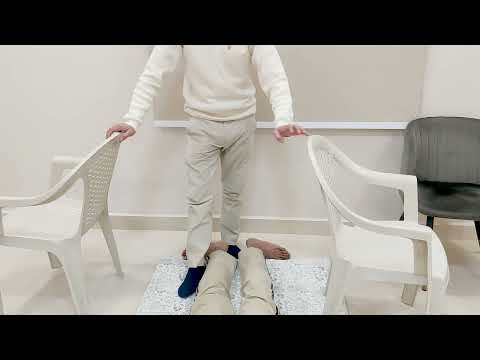
Shows the Serotonin treatment for sleep: (8) Medulla below the ears, 1 Gas 'I' at six points on the shin, (6) Adr on the upper back, and gentle massage behind the knees and at the back of the head. It is given to support deep, natural sleep.
Note: (8) Medulla is not given in high BP, inflammation or cancer; (6) Adr is not given in high BP, diabetes, cancer or HIV.
This page explains what a Neurotherapy (LMNT) treatment is for; it is not a self-treatment guide and does not diagnose. Neurotherapy (LMNT) works alongside your medical care — keep taking the medicines your doctor prescribed.
Ready to begin?
Send COURSE for course details, or your name, age and health issue for a consultation.