Also called: मेडूला, Medulla point, the Medulla family
Medulla is the Neurotherapy (LMNT) treatment given at the side of the neck, just behind and below the ears, and named for the medulla oblongata — the stalk at the base of the brain. One place, one touch, but the number written before it chooses one of nine different treatments.
Overview
What is the Medulla point?
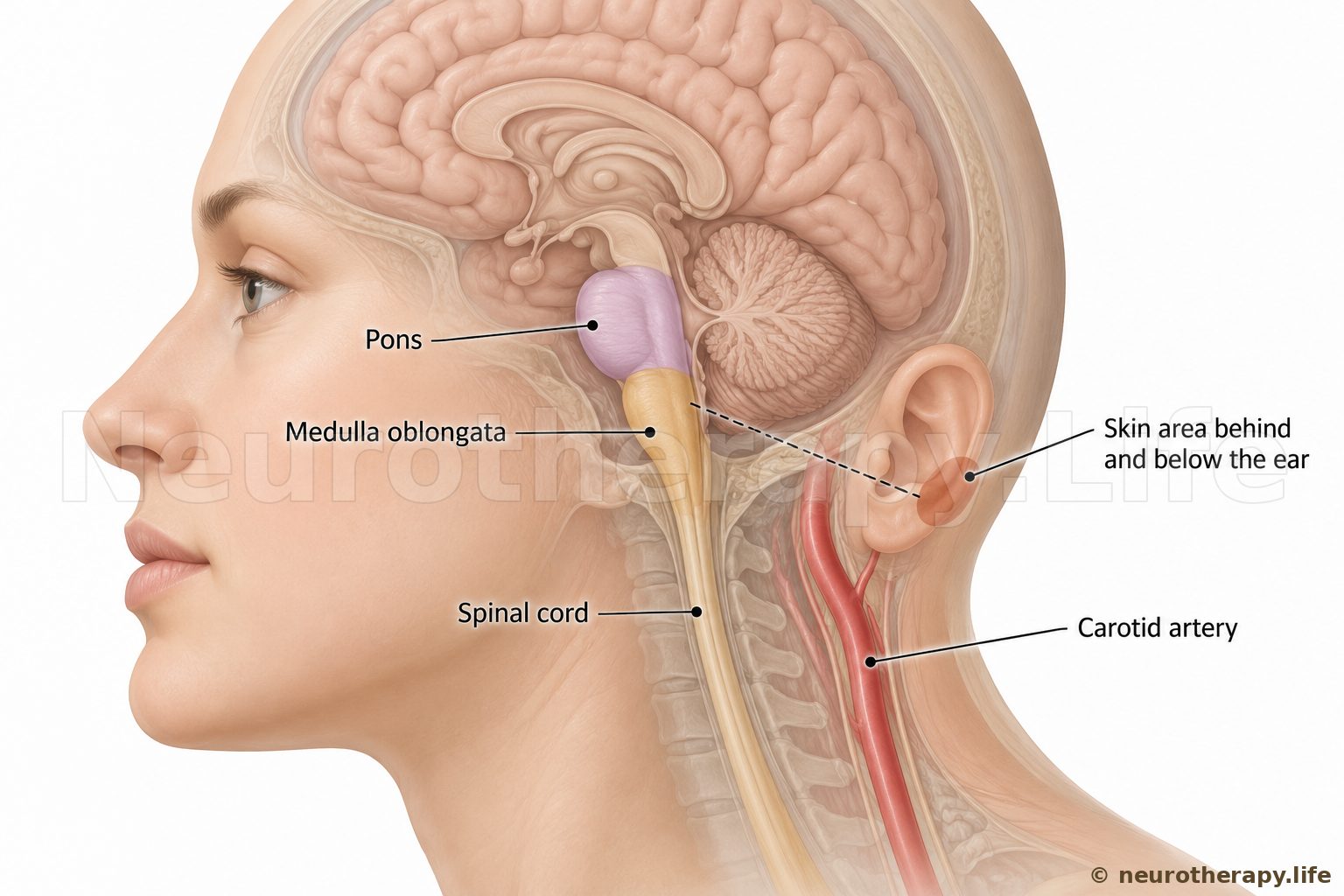
The medulla oblongata is the lowest part of the brain, where the brain narrows into the spinal cord. Every nerve message travelling between the brain and the body passes through it. It also holds the centres that keep you breathing, set your heart rate and blood pressure, and run swallowing, coughing and vomiting.
The treatment began with children whose parents said their bodies had improved with stomach treatment but their minds had not. Guruji studied how the brain is supplied, and found that the arteries to the brain run up the neck past the ear, and that the medulla lies inside the skull at about the level of the skin between the ear and the neck. He worked that patch of skin, saw changes in several of those children, and named the treatment Medulla.
The medulla itself sits behind bone and no hand reaches it. The name records what the treatment is aimed at, not what it touches. What does lie under the skin there are the nerves of the back of the head and the upper neck, which meet the nerves of the face on the same cells of the spinal cord — one honest reason a point on the neck can be felt in the head.
Over the next thirty years, Guruji found that working the same place a different number of times gave a different result. So Medulla is a family of nine treatments: (2), (4), (6), (8), (10), (12), (15), (20) and (30) Medulla. Up to twelve, the number points to a cranial nerve or a brain area; above twelve, to a body chemical such as acetylcholine, dopamine or prostaglandins.
The medulla lies inside the skull. The treatment is given on the skin nearest to it, behind and below the ear.
Watch first: how the Medulla is given
Medulla Point Treatment | Drug-Free Healing for Chronic Disease — LMNT Neurotherapy Explained Simply
The Medulla Chart — all 16 Medulla treatments
Many of you ask us for the Medulla chart. Here it is — the same chart Dr. Diwakar Shukla uses in class, in English and in Hindi. Read it on this page, or download the PDF and keep it on your phone.
Facial — Bell's palsy. Trouble closing the eye or smiling.
(8)
16
Vestibulocochlear — All ear problems. Serotonin for sleep and deep sadness.
(9)
18
Glossopharyngeal — Taste and swallowing. Choking while eating.
(10)
20
Vagus — Whole digestive system, lungs, fast heart rate. Heart: Left Medulla only.
(11) Left
22
Accessory (left) — Frozen shoulder. Cannot lift the shoulder; stiff and painful.
(11) Right
22
Accessory (right) — Shoulder dislocation, after a blow or other cause.
(12)
24
Hypoglossal — Hippocampus. Fits in sleep or on waking. Intestinal worms.
B · Chemical Medulla treatmentsThese stimulate body chemicals rather than a cranial nerve.
Medulla
Rubs
Nerve / chemical · what it is used for
(15)
30
Acetylcholine — Stimulates muscles. Breathing that seems to stop at night.
(20)
40
Dopamine — Parkinson's. Pneumonia in children. Raised prolactin in women.
(30)
60
Prostaglandins — Inflammation, drug side-effects, ulcer, asthma. Not for heart patients.
Safety — read before you treat
Heart patients: (10) Left Medulla only, never full (10).
(30) Medulla is not given to heart patients.
Learn each point from a trained therapist.
Not a replacement for medical care.
How to give the treatment
Downward gentle rubbing, on the exact point.
Slight to moderate pressure. Never hard.
1 minute pause between rounds.
Plenty of water afterwards.
Watch the technique video first.
Learn Neurotherapy (LMNT) with us
Foundation Course in Neurotherapy (LMNT) (FCN) — live online, twice a week, 8–9 PM IST · 12 weeks · Hindi with English terms · recording + handout the next day · weekly test, community, certificate. To join, send COURSE on WhatsApp to +91 8100 34 0081.
Body areaBoth sides of the neck, behind and below the ears, down the side of the neck towards the shoulder
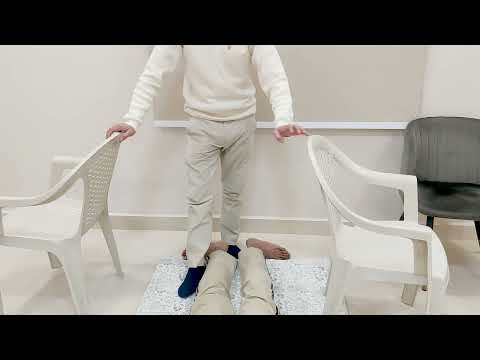
You sit on a firm chair with your feet flat, your back supported and your hands loose in your lap. A patient who is very ill or very weak can receive it lying down.
It is given on both sides of the neck, one side at a time: behind each ear, just below the edge of the skull bone, and along the side of the neck towards the shoulder. When a card says Left Medulla or Right Medulla, only that side is worked.
It stays at the side and back of the neck. The front of the neck, where the windpipe and the big blood vessels lie, is never part of it.
How it is given
How is Medulla given?
How this point is given — the tool, the pressure, the count and the exact movement — is deliberately not described here. Watch the demonstration video on this page, and learn the method hands-on from a trained Neurotherapist before giving it. Please do not give any point from a written description alone: a point given in the wrong place or the wrong way can do harm.
The number written before a point's name is not a strength setting. Each numbered form is a separate named treatment with its own method and timing, taught hands-on in the course.
SidesBoth sides one at a time, or one side when Left or Right is written
The number before itSelects one of nine treatments — it is never a strength dial
The exact technique is taught hands-on in the Neurotherapy (LMNT) course. See the course →
What it does
What does Medulla do in the body?
LMNT teaching credits each numbered Medulla with stirring a different part of the brain or a different body chemical. Body science confirms that these structures and chemicals do what is listed; the link from the neck to each of them is the therapy's own finding, several parts of which Guruji marked as still under research.
(2) Medulla — the optic nerve and GABA: eyes and vision, balance, ataxia and Parkinson's disease.
(4) Medulla — given in its own clockwise form with T1/T2: the neck bones, chest, upper arm and shoulder.
(6) Medulla — the hypothalamus, which runs temperature, hunger and thirst: meningitis, epilepsy, paralysis. It was the first Medulla ever found.
(8) Medulla — serotonin: deep sleep, low mood, giddiness and vertigo.
(10) Medulla — the vagus nerve, which stirs the digestive glands; stomach acid rises strongly.
(12) Medulla — the hippocampus: fits that come during sleep, and small worms in children.
(15) Medulla — acetylcholine, the nerve messenger for breathing and voluntary muscle: MND, GBS, myasthenia, MS. It is given before any cranial-nerve treatment.
(20) Medulla — dopamine: Parkinson's disease, raised prolactin, and with (8) Medulla for height.
(30) Medulla — prostaglandins: inflammation, side effects of medicines, PMS and asthma.
Organs it reaches
Medulla (brainstem) — The brain stalk the treatment is named for — breathing, heart rate, swallowing and every nerve path between brain and body.
Brain — The hypothalamus, hippocampus, cerebellum and other areas named by different members of the family.
Vagus nerve — The tenth cranial nerve, reached for by (10) Medulla — it carries messages to the heart, lungs and gut.
Cranial nerves — Up to twelve, the Medulla number indexes a cranial nerve — eyes, face, swallowing and voice.
Neck — The skin, muscles and nerves the thumbs actually work on.
Its family
What are the members of the Medulla family?
Nine treatments share one name, one place and one touch. They were not found in number order: (6) came first, then (10), then (30), and the smallest, (2) and (4), came last. Each carries its own cautions, and a caution written against one number does not travel to the others.
(2) Medulla — Eyes, balance, GABA; ataxia and Parkinson's.
(4) Medulla — The clockwise form, given with T1/T2 — neck, chest, shoulder and arm.
(6) Medulla — The hypothalamus — the first Medulla found.
(30) Medulla — Prostaglandins — inflammation and drug side effects. Not in heart disease.
Mesencephalon — A sister point in the next lane of the nape, in the soft grooves beside the midline bone.
Dorsal — The third lane of the nape, on the beads of the spine themselves.
Thoracic T1/T2 — The station at the base of the neck that (4) Medulla is paired with.
What it is used for
What is Medulla used for?
Each condition below belongs to a particular member of the family. The therapist chooses the number from today's findings, after checking the blocked list.
Built without (10) Medulla, because it is barred in diabetes.
Safety: when it is held back
The number is the treatment. A wrong count is not a weaker or stronger dose; it is a different treatment the patient did not come for. This is why Medulla is given only by a trained therapist. Why each Medulla number is a different treatment
Heart disease: (10) Medulla is never given on both sides — only (10) Left Medulla. (20) Medulla and (30) Medulla are not given. (2), (4) or (6) Medulla may be given. Heart
(10) Medulla is not given in diabetes — not even inside the undigested-food treatment — because it can raise blood sugar. It is also not given in cancer, where stomach acid is already raised (acidity, ulcer), in constipation, in piles, fissure, fistula and rectal prolapse, or in kidney failure. (10) Medulla
(20) Medulla makes dopamine and raises blood pressure, so it is not given in high blood pressure or heart disease; (30) Medulla or the Chole formula is given in its place in high blood pressure. High blood pressure
(30) Medulla is not given in heart disease, because nobody yet knows which prostaglandins it stirs. It is also blocked in low blood pressure and in infections, and never given in cancer. (30) Medulla
(8) Medulla is not given in inflammation, in cancer or in high blood pressure. (8) Medulla
(6) Medulla is not given to boys and girls of 13 to 20 who come for treatment to increase height, unless there is a special need. (15) Medulla is not given while (2) Pan is being given for a tumour. Low height in children (short stature)
A caution belongs to the number it is written against. A diabetic is not denied (30) Medulla for a swollen knee just because (10) Medulla is barred — refusing everything is also a mistake. What each Medulla treatment is used for
Stop and send to a doctor today: a first-ever headache that began suddenly, especially with neck pain or a drooping eyelid; or unsteadiness that came on suddenly with vomiting, double vision or slurred speech. No neck contact of any kind until a doctor has checked. How to tell a patient to see a doctor
A patient with a brain shunt may receive Medulla, but only with less pressure on the neck. A very ill or weak patient receives it lying down. Hydrocephalus
Never stop or reduce your medicines because of Medulla. Tell your doctor you are receiving it.
Guruji says
“Different counts show different effects, so take care that there is no mistake in the count.”
— Dr. Lajpatrai Mehra
“Apart from calling these treatments a gift of nature, or the grace of Hari, there is no other way in which their effect can be described.”
— Dr. Lajpatrai Mehra
A teaching case
Teaching case: the headache that was not touched
A teaching case, put together to show screening: a man in his fifties who had never had headaches felt something 'tear' at the back of his head while lifting a heavy shutter, and nine days later still had a stiff neck and a drooping left eyelid. Together these can be the warning of a tear in a neck artery before a stroke. He was given no Medulla and no neck contact at all, and was sent to a doctor that same day for a scan of the neck vessels. Knowing when not to treat is part of the treatment.
A composite case written to teach the reasoning — not one patient’s file.
Common questions
Does Medulla press on my brain?
No. The medulla oblongata lies inside the skull, behind bone, and no thumb reaches it. The treatment is named for what it aims at. It works on the skin and nerves at the side of the neck.
Why are there so many numbers — (6), (10), (30)?
Because each number is a different treatment for a different purpose, all given at one place. (10) Medulla works through the vagus for digestion; (30) Medulla through prostaglandins for inflammation. A bigger number is not a stronger version.
I have a heart problem. Can I receive Medulla?
Some forms, yes. (2), (4) or (6) Medulla may be given. (10) Medulla is given only on the left side, as (10) Left Medulla. (20) and (30) Medulla are not given. Tell your therapist about every heart diagnosis and stent.
I am diabetic. Is all Medulla blocked for me?
No. Only (10) Medulla is barred in diabetes, because it can raise blood sugar. Other members, such as (30) Medulla for inflammation or (15) Medulla for breathing, are not barred by diabetes.
Why does Medulla make me sleepy?
(8) Medulla is the serotonin treatment, and many people fall into deep sleep soon after it. Do not drive straight after a session if you feel drowsy.
Can I do Medulla on myself?
Only a form your trained therapist has taught you and chosen for you. Because each number is a different treatment with its own cautions, guessing the count is never safe.
Surprising facts
1Your breathing is run from a stalk the size of a thumb
The medulla oblongata is only about 3 cm long, yet it holds the centres that keep you breathing and set your heart rate and blood pressure. It also runs swallowing, coughing, sneezing and vomiting.
Vagus is Latin for wandering. This nerve leaves the brainstem, runs down the neck, and reaches the heart, the lungs and most of the gut — the longest journey of any cranial nerve.
Source: Breit S et al., Front Psychiatry 2018;9:44; Gray's Anatomy.
3Most of the vagus listens rather than speaks
About 80 to 90% of the fibres in the vagus nerve carry messages up from the organs to the brain. Only a small share carry orders down.
Source: Breit S, Kupferberg A, Rogler G, Hasler G. Front Psychiatry 2018;9:44.
4Why a sore neck can feel like a headache
Nerves from the back of the head and upper neck meet the nerves of the face and the coverings of the brain on the same cells at the top of the spinal cord. The brain cannot always tell which one is calling.
5Ten of the twelve cranial nerves start in the brainstem
You have twelve pairs of cranial nerves. All but the nerves of smell and sight leave from the brainstem — which is why one patch of the neck could become a whole index of eye, face, throat and voice treatments.
Where the carotid artery divides in the neck sits a small swelling, the carotid sinus, that senses blood pressure. Pressure there can slow the heart — one reason neck work stays at the side and back, and stays gentle.
Source: Guyton & Hall, Textbook of Medical Physiology, baroreceptor reflex.
Watch
M HAPARIN FORMULA
A demo of the M. Heparin formula — the Heparin formula headed by Medulla ((6) Medulla, (8) Pan, (7) Liv, (8) Chest Only) — used for neck and shoulder pain and for headache that keeps coming back.
How to Give 4 Medulla, Raman & T1 T2 in Neurotherapy | LMNT Cervical, Shoulder pain & Numbness
This video shows the right way to give (4) Medulla, Raman and the T1–T2 point for neck and shoulder pain and numbness.
बिना दवा गहरी नींद कैसे पाएं? | LMNT Serotonin Treatment for Sleep Disorders | Insomnia Root Cause
Shows the Serotonin treatment for sleep: (8) Medulla below the ears, 1 Gas 'I' at six points on the shin, (6) Adr on the upper back, and gentle massage behind the knees and at the back of the head. It is given to support deep, natural sleep.
Note: (8) Medulla is not given in high BP, inflammation or cancer; (6) Adr is not given in high BP, diabetes, cancer or HIV.
Test yourself
Research
Strong evidence
A review of the vagus nerve: it is the main calming nerve of the heart and gut, it reaches the throat, lungs, liver and pancreas, and most of its fibres carry signals up to the brain rather than down.
In an animal study, stirring the nerve at the back of the head made the nerve cells at the top of the spinal cord more responsive to signals from the brain's coverings. It supports the idea that the upper neck and the head share one pain-relay station.
This page explains what a Neurotherapy (LMNT) treatment is for; it is not a self-treatment guide and does not diagnose. Neurotherapy (LMNT) works alongside your medical care — keep taking the medicines your doctor prescribed.
Ready to begin?
Send COURSE for course details, or your name, age and health issue for a consultation.