Dorsal is one of the three Neurotherapy (LMNT) points worked at the back of the neck while you sit on a chair. It is given on the midline itself — the row of small bony bumps of the neck — and research on its uses is still going on.
Overview
What is the Dorsal point?
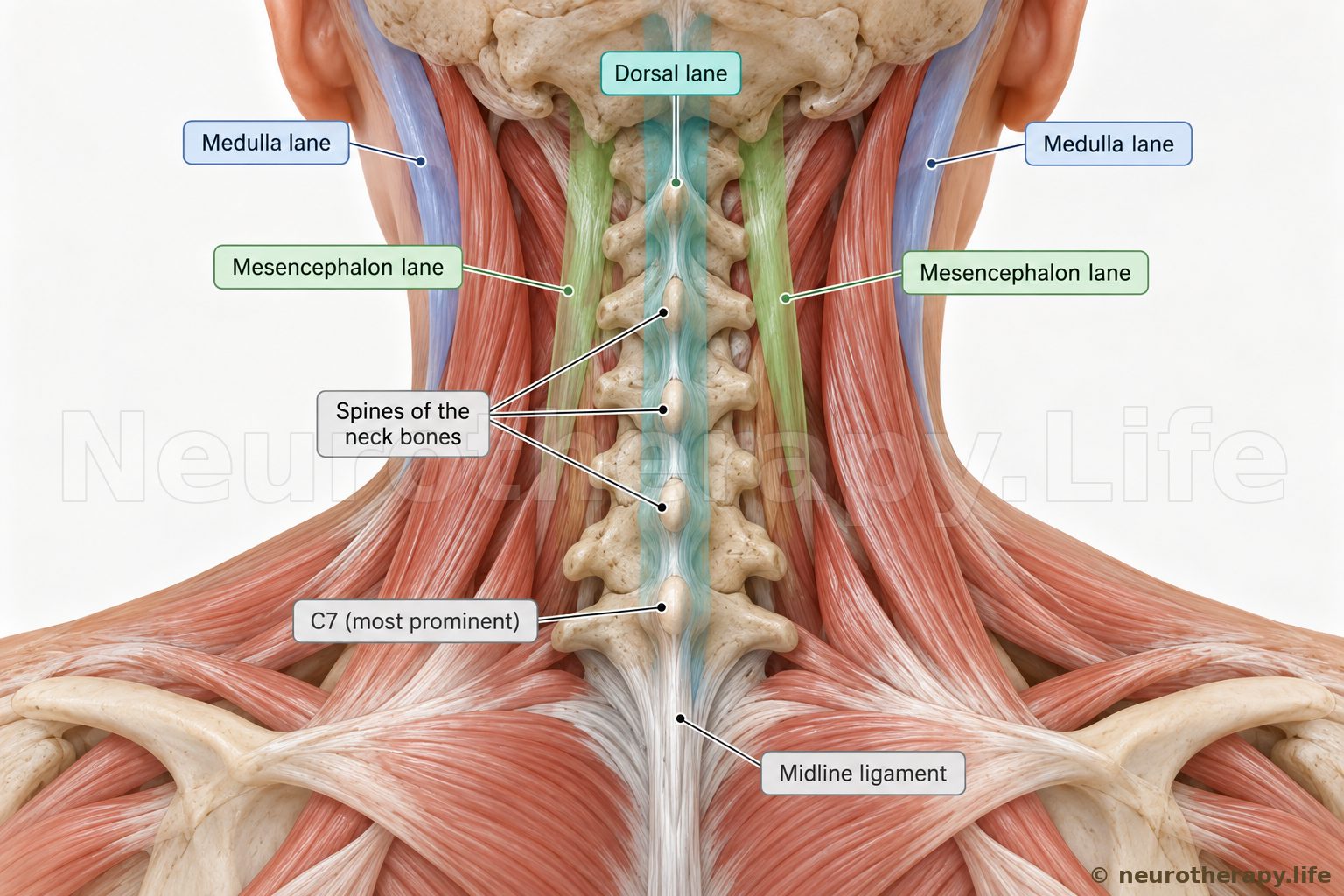
The back of the neck in LMNT has three lanes. Medulla runs behind the ears and down the sides of the neck. Mesencephalon runs in the soft grooves on either side of the bone. Dorsal runs on the bone itself — the beads of the spine down the middle of the nape.
'Dorsal' simply means 'of the back'. A student who knows a little anatomy may think of the dorsal (thoracic) bones behind the chest, but this point is not there. Here it names the back of the neck — the column of bumps you feel when the head drops forward. The upper chest bones are a separate station with its own name, Thoracic T1/T2.
Dorsal is counted among the 'chemical' points of the seated group, like Medulla and Mesencephalon. The therapy is open about it: research on what it is used for is still going on.
Three lanes of the nape. Dorsal is the middle one, on the beads of the spine.
Where it is given
Where is Dorsal given?
PositionSitting
Body areaBack of the neck, on the midline row of bony bumps
You sit well back on a firm, flat chair, feet flat on the floor, hands loose in the lap. If a patient is very ill or very weak, it may be given lying down instead, so that nobody can faint and fall from a chair.
Dorsal is given on the back of the neck, exactly on the midline — over the small bony bumps of the neck bones — and never on the front or the sides of the neck.
How it is given
How is Dorsal given?
How this point is given — the tool, the pressure, the count and the exact movement — is deliberately not described here. A demonstration video for this point is being prepared; until it is on this page, learn the method hands-on from a trained Neurotherapist before giving it. Please do not give any point from a written description alone: a point given in the wrong place or the wrong way can do harm.
Feels likeA light, smooth downward glide on the back of the neck
The exact technique is taught hands-on in the Neurotherapy (LMNT) course. See the course →
What it does
What does Dorsal do?
The source names Dorsal for the back of the spine and does not yet state a fixed list of uses — research on it is still going on. What can be said is what lies under the thumbs.
Works over the backward-pointing spines of the neck bones and the strong ligament joining them from the skull to the shoulders.
Belongs to the same family of gentle nape work as Medulla and Mesencephalon, which reach the brain stem region by name and by intention, not by touch.
Kept light on purpose: heavy pressure on bare bone hurts out of all proportion to any good it could do.
Organs it reaches
Spine — The beads of the neck — the bony spines Dorsal travels over.
Spinal cord — Runs inside the bony canal of the neck, deep to the midline.
Neck — The nape, where the three lanes of the seated group lie.
Its family
Which points are its neighbours?
Dorsal, Medulla and Mesencephalon are one movement in three lanes, told apart only by where the thumbs are.
Medulla — Behind the ears and down the sides of the neck — the best-known seated point.
Mesencephalon — In the soft grooves either side of the neck bones.
Thoracic T1/T2 — The separate station just below the base of the neck — not to be confused with Dorsal.
Endorphin — Starts at the Medulla site and presses down the back of the neck.
What it is used for
What is Dorsal used for?
The source does not yet give Dorsal a list of diseases of its own — research on it is still going on. It is given only when a qualified therapist writes it on the card, usually alongside the other nape points.
No pressure ever falls on the front or the sides of the neck, by any hand, in any treatment.
Stop and send for urgent medical help if there is new neck pain or a headache unlike any before, with dizziness, double vision, slurred speech, unsteadiness, or numbness of the face or a limb. How to tell a patient to see a doctor
No neck work in anyone who has had a stroke or a passing weakness, numbness or loss of vision within the last three months. Paralysis and stroke
No. Here 'dorsal' means the back of the neck — the midline bumps you feel when you drop your head forward. The upper back has its own station, Thoracic T1/T2.
Why is it so light?
Because the midline of the neck is almost bare bone. A heavy press there only hurts; a light glide is the only sensible way.
What is Dorsal for?
The therapy says plainly that research on its uses is still going on. It is given only when a qualified therapist writes it on your card.
Surprising facts
1The bump you can always find
The seventh neck bone, C7, has the longest spine of the neck and stands out at the base of the nape — it is called the 'vertebra prominens'.
This page explains what a Neurotherapy (LMNT) treatment is for; it is not a self-treatment guide and does not diagnose. Neurotherapy (LMNT) works alongside your medical care — keep taking the medicines your doctor prescribed.
Ready to begin?
Send COURSE for course details, or your name, age and health issue for a consultation.