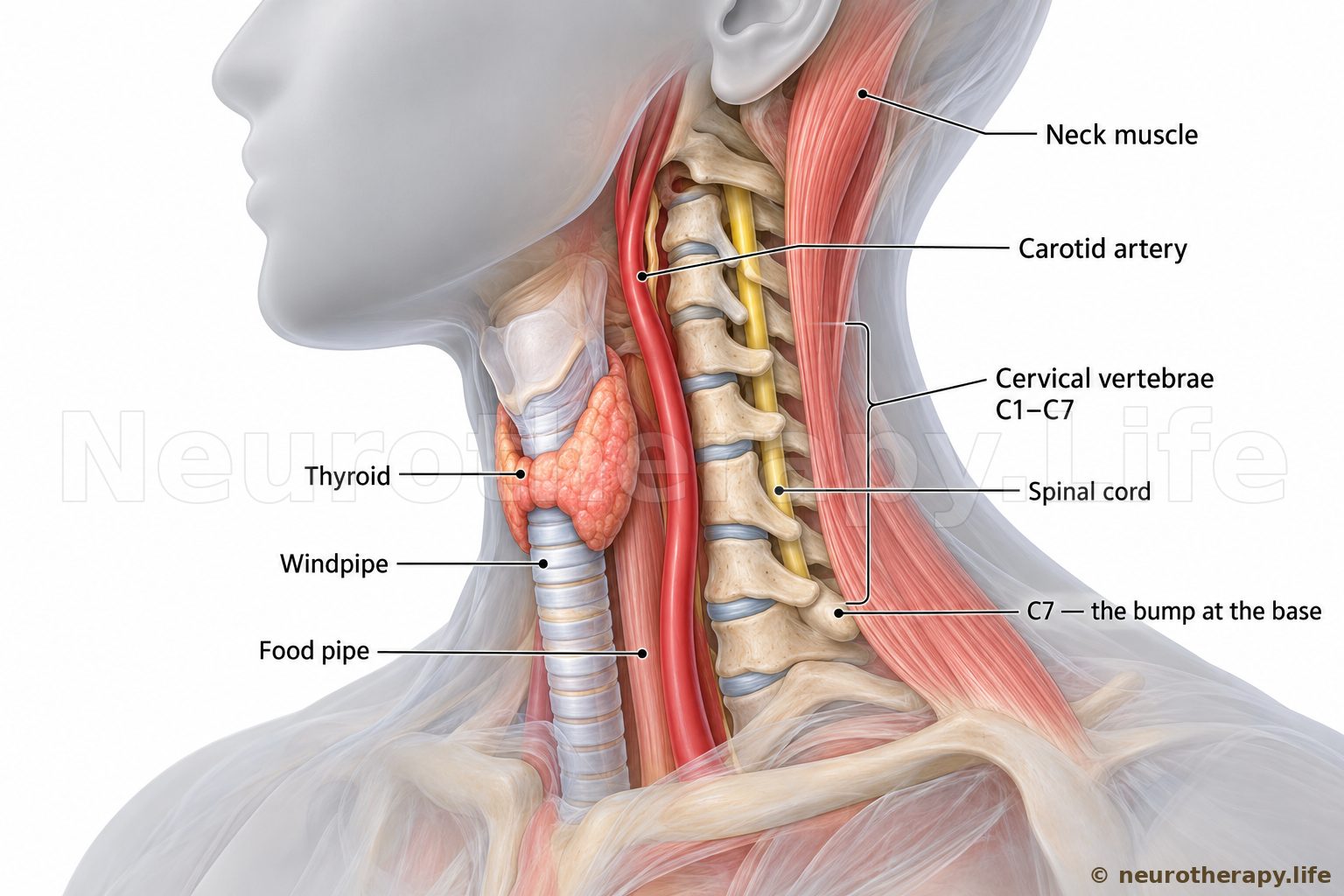
Your neck is a short, busy bridge between head and body. Seven small vertebrae carry and turn a head weighing about 5 kg, while the windpipe, the food pipe, the thyroid, the great arteries to the brain and the nerves to your arms and breathing muscle all pass through it. That crowding is why neck pain is so common — and why LMNT never presses on the front of the neck.
Overview
What is the neck?
The neck — doctors call it the cervical region — joins the skull to the chest and shoulders. At its core is the cervical spine: seven vertebrae, C1 to C7, the smallest and most mobile in the whole spine. Muscles wrap it on every side.
The neck holds up and balances the head, turns it, nods it and tilts it. At the same time it is a crowded passage: air, food, blood to the brain, and every nerve signal between the brain and the body pass through it.
Neck pain is very common — in 2017 nearly 290 million people worldwide were living with it. Most of it comes from the muscles and joints, often tied to posture, and it usually eases. A few neck symptoms, though, are warning signs that need a doctor the same day.
A short bridge with heavy traffic: bones and muscles behind, and in front the pipes for air, food and blood to the brain.
Function
What does the neck do?
The neck has two jobs that pull against each other: it must be free enough to point the eyes and ears anywhere, and steady enough to protect everything that passes through it.
Holds up and balances a head weighing about 4.5 to 5.5 kg.
Turns, nods and tilts the head; about half of all turning happens at the joint between the first two vertebrae.
Protects the spinal cord as it leaves the skull.
Carries air to the lungs and food to the stomach, and houses the voice box.
Carries blood to the brain through four arteries — two carotid and two vertebral.
Sends out the nerves to the arms and to the diaphragm, the main breathing muscle.
Senses blood pressure: pressure sensors in the carotid artery report to the brain every heartbeat.
How does the neck work with other organs?
Spinal cord — The cord runs down inside the neck vertebrae; the nerves to the arms and diaphragm leave it here.
Brain — Four arteries in the neck carry the brain's whole blood supply.
Medulla (brainstem) — The lowest part of the brainstem sits just above the top of the neck, where LMNT gives its Medulla treatments at the nape.
Thyroid — The thyroid wraps around the front of the windpipe, low in the neck.
Vagus nerve — The vagus nerve runs down the side of the neck beside the carotid artery on its way to the heart and gut.
Heart — Pressure sensors in the neck arteries help the brain adjust the heart rate and blood pressure.
Lymph nodes — Chains of lymph nodes line the neck and swell with throat and mouth infections.
Jaw — The jaw and neck muscles work together in chewing, swallowing and holding the head.
Anatomy
What are the parts of the neck?
Bones and joints at the back, muscles all round, and in front and at the sides the pipes, vessels, glands and nerves.
Bones and joints
C1 — the atlas — A ring of bone that holds up the skull, named after the giant who held up the sky; it lets you nod 'yes'.
C2 — the axis — Has a peg of bone on which the atlas pivots; it lets you shake your head 'no'.
C3 to C7 — Small vertebrae with discs between them. C7 has the long knob you can feel at the base of the neck.
Discs and facet joints — Cushions between C2 and C7, and small paired joints at the back that guide movement; both wear with age.
Hyoid bone — A small U-shaped bone above the voice box that is not joined to any other bone; it anchors the tongue and swallowing muscles.
Muscles
Sternocleidomastoid — The strap from behind the ear to the collarbone that stands out when you turn your head. Its back border is a safe working line; the front of the neck in front of it is not.
Trapezius — A large diamond-shaped muscle from the skull to the shoulders and mid-back; it lifts and steadies the shoulder blades.
Levator scapulae — Lifts the shoulder blade; often tight and tender in desk workers.
Scalenes — Muscles at the side of the neck that help lift the upper ribs in deep breathing.
Muscles under the skull — Small deep muscles joining the top two vertebrae to the skull; they fine-tune head position and are a common source of headache.
Deep neck flexors — Deep muscles in front of the spine that hold the neck's curve; they weaken with a forward-head posture.
Nerves
Spinal cord — Passes down through the ring of each neck vertebra.
Eight pairs of neck nerves — There are eight cervical nerves (C1–C8) but only seven neck vertebrae; C8 leaves below C7.
Nerves to the arm (brachial plexus) — Formed from C5 to T1, they run under the collarbone to the shoulder, arm and hand.
Phrenic nerve — From C3, C4 and C5; it drives the diaphragm, the main muscle of breathing.
Vagus nerve — Runs down beside the carotid artery to the heart, lungs and gut.
The front of the neck: vessels, pipes and glands
The most delicate part of the neck, under thin skin — the part LMNT never presses.
Carotid arteries — One on each side; each divides at about the level of the upper edge of the Adam's apple, and at the fork its wall carries pressure sensors (the carotid sinus).
Vertebral arteries — Climb through small holes in the neck vertebrae and turn a sharp corner at the top before entering the skull to feed the back of the brain.
Jugular veins — Carry blood back from the head to the heart.
Windpipe, voice box and food pipe — The air passage in front, the voice box at the Adam's apple, and the food pipe just behind the windpipe.
Thyroid and parathyroids — A butterfly-shaped gland on the front of the windpipe, with four tiny parathyroid glands behind it.
Lymph nodes — Chains of small nodes along the sides of the neck and under the jaw.
Where is the neck?
The neck runs from the base of the skull and the lower jaw down to the collarbones and the top of the shoulder blades. The prominent bump at the back of its base is the knob of C7; the two vertebrae just below it are T1 and T2, the first bones of the upper back.
The top of each lung rises a little into the root of the neck, above the collarbone, and the nerves and vessels of the arm cross there over the first rib. In LMNT the working areas are the back and sides of the neck, behind the strap muscle, and the nape just under the skull.
From the side, a healthy neck curves gently forward — the cervical curve — so that the ear sits above the shoulder. When you turn your head, the strap muscle stands out like a rope from behind the ear to the collarbone.
At the front, the voice box forms the Adam's apple, larger in men. At the back, the C7 knob is the one bump you can easily feel. With years of looking down at screens, the head drifts forward and the upper back rounds.
How big is the neck?
The neck vertebrae are the smallest in the spine, yet together with their muscles they carry a head of about 4.5 to 5.5 kg — around 8% of body weight — all day long.
Seven vertebrae, eight pairs of nerves, four arteries to the brain and two great veins share a column only a hand's width across.
Conditions and disorders
What conditions and disorders affect the neck?
Most neck pain comes from the muscles, joints and discs and settles with time. Some neck problems press on nerves to the arm, some come from the organs in the front of the neck, and a few are emergencies.
Neck pain and stiffness
Cervical spondylosisAge-related wear of the neck discs and joints, often with stiffness and pain into the shoulders.
Sprain and injuryA strained neck from a jolt, fall or sudden movement.
Headache and migraineTight muscles at the base of the skull are a common trigger of headache.
Shoulder blade painNeck strain often spreads to the muscles between the shoulder blades.
Frozen shoulderA stiff shoulder changes how the neck muscles work.
When the nerves are pressed
Carpal tunnel syndromeTingling in the fingers can come from a nerve pressed at the wrist — or at the neck; a doctor tells them apart.
Vertigo and giddinessDizziness usually comes from the inner ear, but new dizziness with neck pain needs checking the same day.
Lipoma and cystA lump in the neck is always looked at by a doctor before anyone rubs it.
Neck signs that are emergencies
MeningitisFever, severe headache and a stiff neck together — hospital at once.
Paralysis and strokeA tear in a neck artery can cause neck pain and headache before a stroke.
What are common signs of a neck problem?
Pain and stiffness, difficulty turning to look over the shoulder
Headache starting at the back of the head
Pain, tingling or numbness spreading into the shoulder, arm or fingers
Weak grip, clumsy hands or unsteady walking — these need prompt medical attention
A lump in the neck that has lasted more than a couple of weeks
Emergency signs: a new, unusual headache with neck pain and disturbed vision, slurred speech or numbness; or fever with a stiff neck
What tests check the neck?
Examination — Movement, tender spots, and tests of strength, feeling and reflexes in the arms and legs.
X-ray — Shows the bones, alignment and wear; wear is common in necks that do not hurt.
MRI — Shows discs, nerves and the spinal cord; used for nerve or cord symptoms.
Nerve conduction studies — Help tell a nerve pressed in the neck from one pressed at the wrist or elbow.
Blood tests and ultrasound — Thyroid tests, markers of inflammation, and an ultrasound of a lump or the thyroid.
Carotid Doppler or angiography — Check the neck arteries when a stroke or artery tear is suspected.
How are neck problems treated?
Keep moving, gently — Normal, gentle movement within comfort helps most neck pain settle.
Posture and work set-up — Screen at eye level, regular breaks, and loads carried evenly.
Exercise and physiotherapy — Strengthening the deep neck and shoulder muscles is the main long-term treatment.
Heat and short-term pain relief — Warmth and, if a doctor agrees, a short course of pain medicine.
Collar only briefly — A soft collar is used only for a short time, if at all; long use weakens the neck muscles.
Injections and surgery — For nerve pain that does not settle, or pressure on the spinal cord.
Neurotherapy (LMNT)
In LMNT the neck is both a busy treatment area and the place of the therapy's strictest safety rule. The rule comes first: no pressure falls on the front or the sides of the neck, by foot or by hand, in any treatment, whatever a card says. Where feet rest beside the neck, they carry no weight. The reason is anatomical — at the fork of the great artery to the brain lie pressure sensors, and squeezing them can slow the heart and make a patient faint. All seated neck work is a glide, never a thrust: no turning of the head, no pulling, no levering, no jerks. Within those limits the neck is worked from behind and at the sides: Neck ghisai relaxes the muscles all round it in four stages; Neck Clockwise circles the side muscles from ear to shoulder; Necklace presses along the edge of the skull; and (4) Medulla clockwise with T1/T2 is credited with the territories of the neck nerves — C1–C4 and the chest, C5–C8 and the whole arm. The teaching also warns against chasing the neck: in a stiff neck with a slow, acidic body, the digestion and direction are put right first and the neck is allowed to follow, because relief from muscle work alone wears off in days. This works alongside medical care, never instead of it.
Points
Neck Ghisai — For pain of the neck, head, shoulders, arms and fingers, and given in cervical spondylosis. Four stages in order: front and back muscles with light hands, then the two sides, then a necklace-like pass, then the muscles fixed to the shoulder blade.
Neck Clockwise — Fingers gathered into a soft pad circle clockwise on the side muscles from the ear down to the shoulder — left side first, then right. The back border of the strap muscle is the working line.
Necklace — The tip of the thumb presses three times at each of many close points along the edge of the skull, from behind one ear to the other, to relax the muscles just below the bone. The teaching says the pains of the whole body become much less.
(4) Medulla — Given clockwise with T1/T2: credited with C1–C4 troubles (pain of the chest, mitral valve, spleen and upper diaphragm) and C5–C8 troubles (all pains of the arm, elbow, wrist, hand and fingers).
Thoracic T1/T2 — The two vertebrae just below the C7 bump — given with light hands, because thin bone fails here first in the elderly and those long on steroids.
Raman — Both hands over the shoulders from behind lift the back muscles upward for six seconds, three times, followed by five or six easy breaths; for pain of the neck, shoulders or knees. Added to (4) Medulla when the fourth finger of both hands is painful — after checking Liv° and Mu°.
Subclavian — A closed loop along the inner collarbone, into the hollow below and back along the edge of the neck, three times. The teaching calls it a very powerful pain-relieving treatment; the thumb presses onto bone, never deep into the hollow.
Electrical Waves — Given from behind the ear downward, behind the strap muscle, to relax the neck muscles; found excellent for asthma and breathing difficulty.
Stretch — Pressing the fingertips and pulling them outward relaxes the muscles of the neck.
Satnam — A headache treatment that draws the tissue from the brow out to the temples and along the edge of the skull back to the neck vertebrae, without letting go.
Medulla — The nape lanes just under the skull where the Medulla family is given, seated, with the thumbs gliding downward.
In the teaching's worked example of head or neck pain with pain at Mu°: if the pain returns within hours and Mu° is still painful on the third day, A. Heparin is given with Neck ghisai.
If Mu° is no longer painful: (4) Medulla clockwise with T1/T2, then M. Heparin with Neck ghisai, for two treatments. M. Heparin is also listed for face, neck and shoulder pain and headache.
In the full protocol for joint pain and RA, (4) Medulla clockwise with T1/T2 comes first — with Neck ghisai added only if the neck hurts — then this formula, then the ghisai of all the joints.
“Whether or not the patient gets immediate benefit from our treatment, let no harm reach him through our carelessness — attend to this.”
— Dr. Lajpatrai Mehra
“We do not give treatment for any one disease; rather we treat according to the condition of the body on that day.”
— Dr. Lajpatrai Mehra
“Only they know the pain; you do not.”
— Dr. Lajpatrai Mehra
Never do this
Emergency: a new neck pain or a headache unlike any before, with disturbed vision, unsteadiness, dizziness, slurred speech, or numbness of the face or a limb — stop, treat nothing at the head or neck, and get medical help the same day (call 108/112 if symptoms are severe). A tear in a neck artery announces itself this way before a stroke. Paralysis and stroke
Fever with a stiff neck and a severe headache, especially with a rash, vomiting or confusion — hospital at once. Meningitis
After a fall or accident with neck pain, or with new weakness or numbness in both arms, clumsy hands or unsteady walking — keep the neck still and get medical help; do not treat. How to tell a patient to see a doctor
The anterior-neck rule: no pressure on the front or sides of the neck, by foot or hand, in any treatment. Feet placed beside the neck carry no weight. Pressing the artery fork can slow the heart and cause fainting. The Front of the Body II: Glands, Toes, Lymph, Chest and Arms
No neck pressure of any kind after a stroke or a passing stroke-like episode in the last three months. Extra care in older people, anyone on blood thinners, and anyone with a swelling in the neck, a goitre or a fast-running thyroid. Neck Ghisai
Subclavian: press onto the bone, never deep into the hollow above the collarbone; stop at once for pain, numbness or weakness running into the arm. A lump above the collarbone or at the side of the neck is referred, not rubbed. Subclavian
T1/T2 with light hands only — in the elderly, anyone long on steroid tablets, and where cancer may have reached bone, this is where a vertebra gives way. Thoracic T1/T2
Raman is added only after checking Liv° and Mu° to decide the side; it does not suit every body. Raman
Very ill or weak patients receive the seated neck treatments lying down — a seated faint is a fall. In side-lying treatments, a pillow under the head is compulsory for anyone with neck pain or cervical spondylosis. Where pillows go during treatment, and where they never go
Cancer: if the person has cancer, (10) Pan, Thymus, Pit, Lu + Sh, Rt. Ov / Lt. Ov and (30) Medulla are never given — the therapist changes the plan.
Keep taking your prescribed medicines, and tell your therapist about blood thinners, steroids and any thyroid treatment. Neurotherapy (LMNT) works alongside your medical care, never instead of it.
Care
How can I keep my neck healthy?
The neck suffers most from staying in one position for too long.
Bring the screen up to your eyes
Keep a computer screen at eye level and hold your phone higher rather than bending your head down to it.
Take movement breaks
Every 30 minutes, roll the shoulders, gently turn the head and look into the distance.
Choose the right pillow height
Lying on your side, your nose, breastbone and navel should be in one line — the same check LMNT uses on the treatment mat.
Carry loads evenly
Use both shoulders, or a backpack with both straps, rather than one heavy shoulder bag.
Do not crack or jerk your neck
Move it slowly within comfort. Sudden twisting is exactly what the neck arteries do not like.
Keep the upper back strong
Simple shoulder-blade squeezes and chin tucks help the head sit back over the shoulders.
Common questions
Is it safe to have my neck pressed? I have heard of strokes after neck treatment.
What you have heard about is twisting and jerking the neck. LMNT does none of that: the thumbs slide and press on the back and sides, never on the front, and the head is never turned or pulled. Your therapist should ask about vision, speech and walking first, and stop at once if anything changes.
My X-ray says cervical spondylosis. Is that why my neck hurts?
Maybe, but not necessarily. In a large MRI study of people with no symptoms, most had disc bulges, and wear increased with age. Such findings are very common in necks that do not hurt. A doctor links the picture with your symptoms and examination.
Why do my arm and fingers tingle when my neck hurts?
The nerves to the arm leave the neck between C5 and T1. If one is pressed or irritated, the tingling is felt along its path in the arm or hand. A nerve pressed at the wrist can feel similar, so a doctor may test both.
Should I wear a cervical collar?
Only if a doctor advises it, and usually only briefly. Keeping the neck still for long periods weakens its muscles and can make stiffness worse. Gentle movement within comfort usually helps more.
Can neck trouble make me dizzy?
Sometimes a stiff neck is linked with a feeling of unsteadiness, but most dizziness comes from the inner ear, blood pressure or other causes. New dizziness together with neck pain, a new headache, double vision, slurred speech or numbness is an emergency — see a doctor the same day.
Why does the Neurotherapist work on my stomach for my neck?
LMNT reads the whole body first. In the teaching's own case of a stiff neck with long constipation, the digestion and the acid direction were treated first and the neck was allowed to follow, because relief from neck muscle work alone wears off in days. The neck is not ignored — it simply comes in its turn.
What should I ask my doctor or therapist?
Is my neck pain from muscles and joints, or is a nerve or the spinal cord involved?
Which symptoms mean I should come back at once or go to hospital?
Do I need an X-ray or MRI, and what will it change?
Which neck and shoulder exercises should I do, and how often?
How should I set up my desk, screen and pillow?
(To the therapist) Will you work only on the back and sides of my neck, and which points are blocked for me?
Surprising facts
1You have as many neck bones as a giraffe
Almost every mammal — a mouse, a human, a giraffe — has exactly seven neck vertebrae. The giraffe's are simply enormous, each one up to about 25 cm long. Changes to this number are so rare in mammals that scientists study why it is held so tightly.
Source: Galis F. J Exp Zool 1999;285(1):19–26 ('Why do almost all mammals have seven cervical vertebrae?'); giraffe vertebra length (up to about 25 cm) as commonly reported in zoological descriptions.
2Half of your head-turning happens at one joint
The first vertebra, the atlas, spins around a peg of bone on the second, the axis. This single pivot gives about half of all the turning of the head; the rest is shared by the joints below. The top vertebra is named after Atlas, the giant who held up the sky, because it holds up the head.
Source: Gray's Anatomy (42nd ed.) — atlanto-axial joint; about 50% of cervical rotation occurs at C1–C2.
3Eight neck nerves, only seven neck bones
The first neck nerve leaves above C1, between the skull and the atlas, so each neck nerve exits above the vertebra of the same number — until C8, which has to leave below C7. That is why there are eight cervical nerves but seven cervical vertebrae.
The diaphragm sits under the lungs, but its nerve — the phrenic nerve — starts high in the neck from C3, C4 and C5. Medical students learn it as 'three, four and five keep the diaphragm alive'. It is why a very high neck injury can stop a person breathing, while an injury lower down may spare the breath.
Where each carotid artery forks, at about the level of the upper edge of the Adam's apple, its wall is packed with pressure sensors. They report every heartbeat to the brain. Squeeze them and the brain thinks the pressure is too high, slows the heart and drops the pressure — the patient may go pale and faint. This is the reason for LMNT's rule never to press the front of the neck.
Source: Guyton & Hall, Medical Physiology — carotid sinus baroreceptors. LMNT anterior-neck rule: db section 17.1.
6The bone that touches no other bone
The small U-shaped hyoid bone, just above the voice box, is the only bone in the body that does not form a joint with any other bone. It hangs in a sling of muscles and ligaments and anchors the tongue and the muscles of swallowing.
Source: Gray's Anatomy (42nd ed.) — the hyoid bone.
7Looking down at a phone may multiply the load on your neck
Upright, your neck carries a head of about 5 kg. A computer model estimated that tilting the head forward 15° loads the neck like about 12 kg, 30° like 18 kg, 45° like 22 kg and 60° like 27 kg. It is a model rather than a measurement, but it explains why hours of looking down can leave the neck sore.
Source: Hansraj KK. Surg Technol Int 2014;25:277–279 (computer-model estimate; not a direct measurement).
8Most pain-free necks show 'wear' on MRI
In a study of 1,211 people with no neck symptoms, bulging discs were seen on MRI in about 88% of them, and the changes grew more common with every decade of age. A report of 'degenerative changes' is often simply a description of an ordinary, ageing neck.
Source: Nakashima H et al. Spine 2015;40(6):392–398.
Your neck in numbers
7neck vertebrae — the same as a giraffe
8pairs of neck nerves
~5 kgof head carried all day
~50%of head-turning at the single C1–C2 joint
4arteries carrying the brain's blood
0pressure on the front of the neck in any LMNT treatment
Yoga
Slow neck movements Grīvā Sañcālana
Benefits
Keeps the neck moving through its easy range after long hours in one position.
Eases stiffness in the side and back neck muscles.
Can be done on a chair, at a desk.
How to do it
Sit tall on the floor or a chair, shoulders relaxed.
Breathing out, turn the head slowly to the right as far as is comfortable; breathing in, come back to the centre. Repeat to the left.
Tilt the right ear gently towards the right shoulder without lifting the shoulder; return. Repeat to the left.
Lower the chin gently towards the chest; return to upright.
Do each movement 5 times, slowly, with the breath.
Take care
Move only within comfort, never fast, and do not roll the head in full circles or tip it far back. Stop at once for dizziness, visual changes, tingling in the arms or a sudden headache. Skip it after a recent neck injury until a doctor has checked you.
Shoulder circles Skandha Cakra
Benefits
Loosens the muscles that join the neck to the shoulder blades.
Moves the shoulders without loading the neck.
A quick reset for desk workers.
How to do it
Sit tall and rest the fingertips on the shoulders.
Bring the elbows together in front of the chest.
Breathing in, lift the elbows up and open them out; breathing out, take them back and down.
Make 5 to 10 slow circles, then reverse the direction.
Keep the head level and still throughout.
Take care
Make smaller circles if the shoulder hurts or is stiff (as in frozen shoulder). Stop if pain or tingling runs down the arm.
Cat and cow Mārjāryāsana – Bitilāsana
Benefits
Moves the neck and the whole spine together, gently.
Eases stiffness between the shoulder blades.
The head hangs free, so the neck muscles can rest.
How to do it
Come onto hands and knees, wrists under shoulders, knees under hips.
Breathing out, round the back up and let the head hang down gently.
Breathing in, let the back sink a little and bring the head up only to look forward and down.
Move slowly with the breath, 5 to 10 times.
Rest by sitting back on the heels.
Take care
Do not throw the head back in the 'cow' position. Put a folded blanket under sore knees, or do a seated version on a chair. Avoid it with a recent neck, back or wrist injury.
Watch
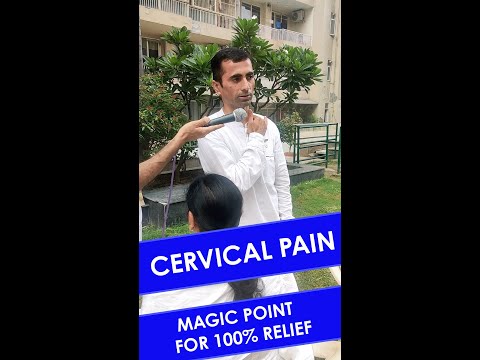
Cervical Pain गायब in 10 Minute! Magic Point for 100% Relief | Neck Pain Solution
Shows a seated routine for neck pain: zig-zag fingertip massage from the base of the skull to the shoulder blades and down the arm, cross-rubbing, rounds of breathing out through the mouth, and a gentle grip massage at the back of the neck. It is shared for relief in cervical pain and tingling in the hands.
How to Give 4 Medulla, Raman & T1 T2 in Neurotherapy | LMNT Cervical, Shoulder pain & Numbness
This video shows the right way to give (4) Medulla, Raman and the T1–T2 point for neck and shoulder pain and numbness.
M HAPARIN FORMULA
A demo of the M. Heparin formula — the Heparin formula headed by Medulla ((6) Medulla, (8) Pan, (7) Liv, (8) Chest Only) — used for neck and shoulder pain and for headache that keeps coming back.
Test yourself
Research
Strong evidence
The Global Burden of Disease study estimated that about 289 million people worldwide were living with neck pain in 2017. It was more common in women and with age, and remains a major cause of disability.
MRI scans of 1,211 people with no neck symptoms showed bulging discs in about 88%, rising with age. Scan findings in the neck must always be matched with symptoms and examination.
The American Heart Association reviewed tears in the neck arteries and found an association with forceful neck manipulation, though cause and effect is not proven. It advised that patients be told of this risk, and that new neck pain with stroke-like signs be treated as an emergency — the same caution behind LMNT's 'glide, never thrust' rule.
This page explains how the body works; it does not diagnose. Neurotherapy (LMNT) works alongside your medical care — keep taking the medicines your doctor prescribed, and see a doctor for any new or severe symptom.
Ready to begin?
Send COURSE for course details, or your name, age and health issue for a consultation.