Lower Shoulder Blade Pain (the palm treatment for the lower shoulder blade)
Also called: Lower shoulder blade, Lower scapula pain
Lower Shoulder Blade Pain is a Neurotherapy (LMNT) treatment named for what it is given for: pain in the lower part of the shoulder blade. It is given by hand, lying face down with the elbows bent and the palms facing up, drawing the muscles from beside the spine out to the fingertips. Followed by BAFA, it is described as of great benefit in neck problems.
Overview
What is Lower Shoulder Blade Pain?
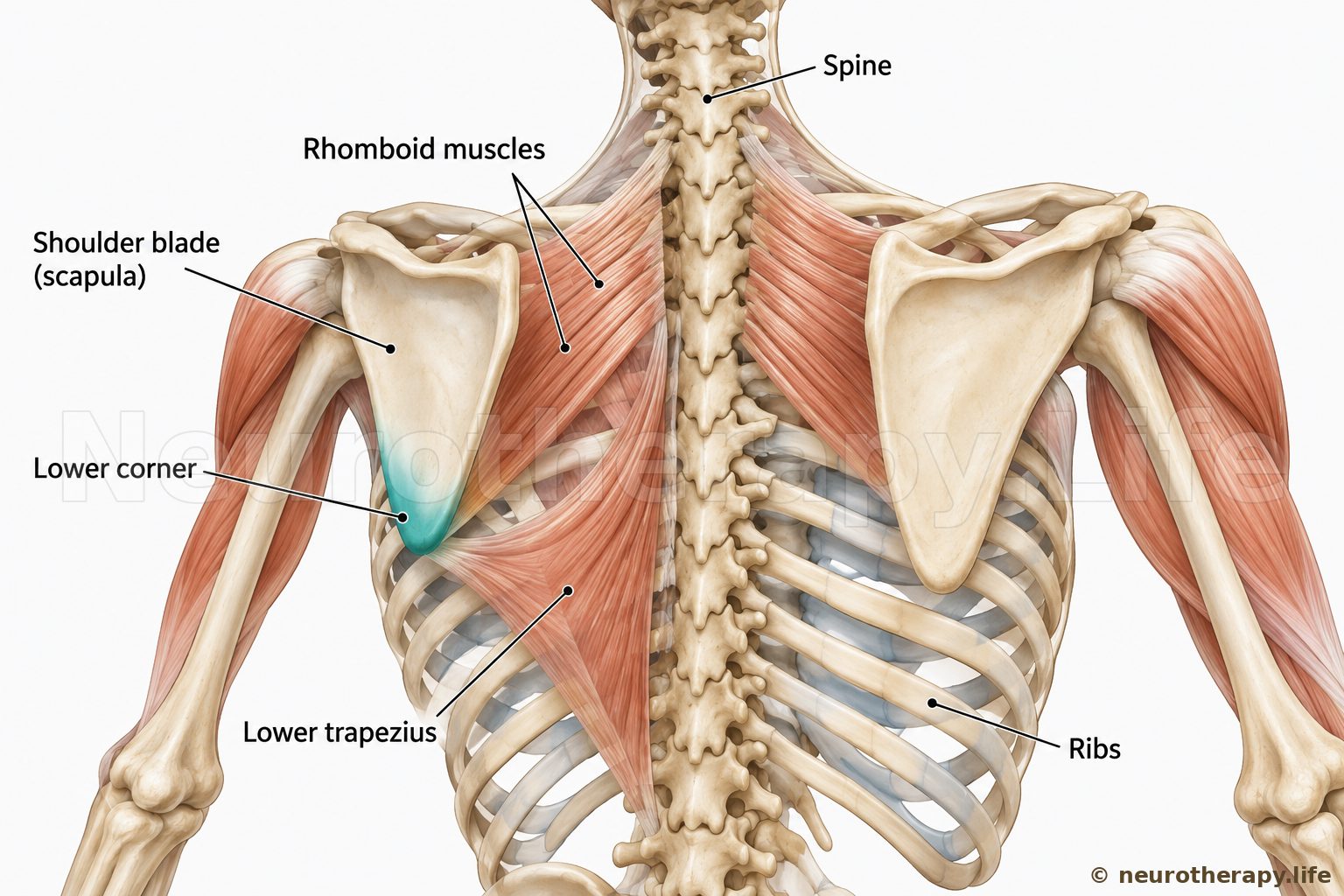
The shoulder blade (scapula) is a flat triangle of bone that does not sit in a socket. It floats on the back of the rib cage, held there by muscle alone, and the muscles that hold it run on into the arm. So a pain in the shoulder blade is rarely a pain in the bone; it is a pain in a sheet of tissue that starts at the spine and ends at the fingers.
That is why this treatment begins beside the spine and finishes at the hand. Neurotherapy (LMNT) has two shoulder-blade treatments, told apart by which part of the blade hurts: this one for the lower part, around its bottom corner, and Upper Shoulder Blade Pain for the upper part.
The shoulder blade is held only by muscle, and those muscles run on into the arm — which is why the treatment travels to the fingertips.
Where it is given
Where is it given?
PositionLying face down
Body areaBeside the spine, the shoulder and the whole arm to the fingertips, lying face down with palms facing up
You lie face down with one and a half pillows under the chest — the chest on the upper pillow, the chin on the lower — so the head stays straight. Your elbows are bent with the palms facing the sky and the arms down beside you.
The treatment covers the area beside the spine, the shoulder, the upper arm down to the elbow, and on across the wrist to the fingertips — on one side, and then on the other.
How it is given
How is it given?
How this point is given — the tool, the pressure, the count and the exact movement — is deliberately not described here. A demonstration video for this point is being prepared; until it is on this page, learn the method hands-on from a trained Neurotherapist before giving it. Please do not give any point from a written description alone: a point given in the wrong place or the wrong way can do harm.
Feels likeA firm drawing of the muscles from the back out along the arm
The exact technique is taught hands-on in the Neurotherapy (LMNT) course. See the course →
What it does
What does it do?
This is a physical treatment for muscle and soft tissue, not a chemical point for a gland.
Puts right pains in the lower part of the shoulder blade — which is exactly why it is named lower shoulder blade.
Draws the muscles that hold the shoulder blade, along their whole length from the spine into the arm.
Followed by BAFA, it is described as of great benefit in cervical (neck) problems.
Organs it reaches
Muscles — The rhomboids and the lower trapezius, which hold the blade to the ribs.
Spine — Where the muscles of the shoulder blade take their origin.
Face down, the one-and-a-half-pillow arrangement under the chest is compulsory, and above all for a stiff neck or cervical spondylosis: a neck left twisted while lying face down can be strained. Where pillows go during treatment, and where they never go
The back reports the trouble of inner organs: the base of the lung lies under the lower shoulder blade. Pain there with cough, fever or breathlessness — or a left-sided pain brought on by exertion — needs a doctor first. How to tell a patient to see a doctor
Tingling or numbness running into the hand during the treatment means stop at once.
“After these two treatments, giving BAFA will be of great benefit in cervical problems.”
— Dr. Lajpatrai Mehra
Common questions
My pain is in my shoulder blade. Why does the therapist work down to my fingers?
Because the muscles that hold the shoulder blade run on into the arm. The treatment follows the whole sheet of tissue, from the spine to the hand.
How is it different from Upper Shoulder Blade Pain?
It is for the lower part of the blade and is given with the palms, palms up, arms down. The upper one is given with the feet, palms down, arms raised.
Does it help a stiff neck?
The teaching says that following the shoulder-blade treatments with BAFA is of great benefit in cervical problems.
Surprising facts
1A bone with no socket
The shoulder blade joins the rest of the skeleton only through the small joint at the end of the collar bone; everything else that holds it to the chest is muscle.
Source: Gray's Anatomy, 41st ed. (scapula and pectoral girdle).
2Seventeen muscles
About seventeen muscles attach to each shoulder blade — which is why pain there so often travels into the neck and the arm.
Source: Gray's Anatomy, 41st ed. (muscles attached to the scapula).
3The back reports inner organs
Organs such as the lungs, heart and gall bladder can send their pain to the back wall, including around the shoulder blades — called referred pain.
Source: Guyton & Hall, Textbook of Medical Physiology (referred pain).
This page explains what a Neurotherapy (LMNT) treatment is for; it is not a self-treatment guide and does not diagnose. Neurotherapy (LMNT) works alongside your medical care — keep taking the medicines your doctor prescribed.
Ready to begin?
Send COURSE for course details, or your name, age and health issue for a consultation.