1The prominent bone
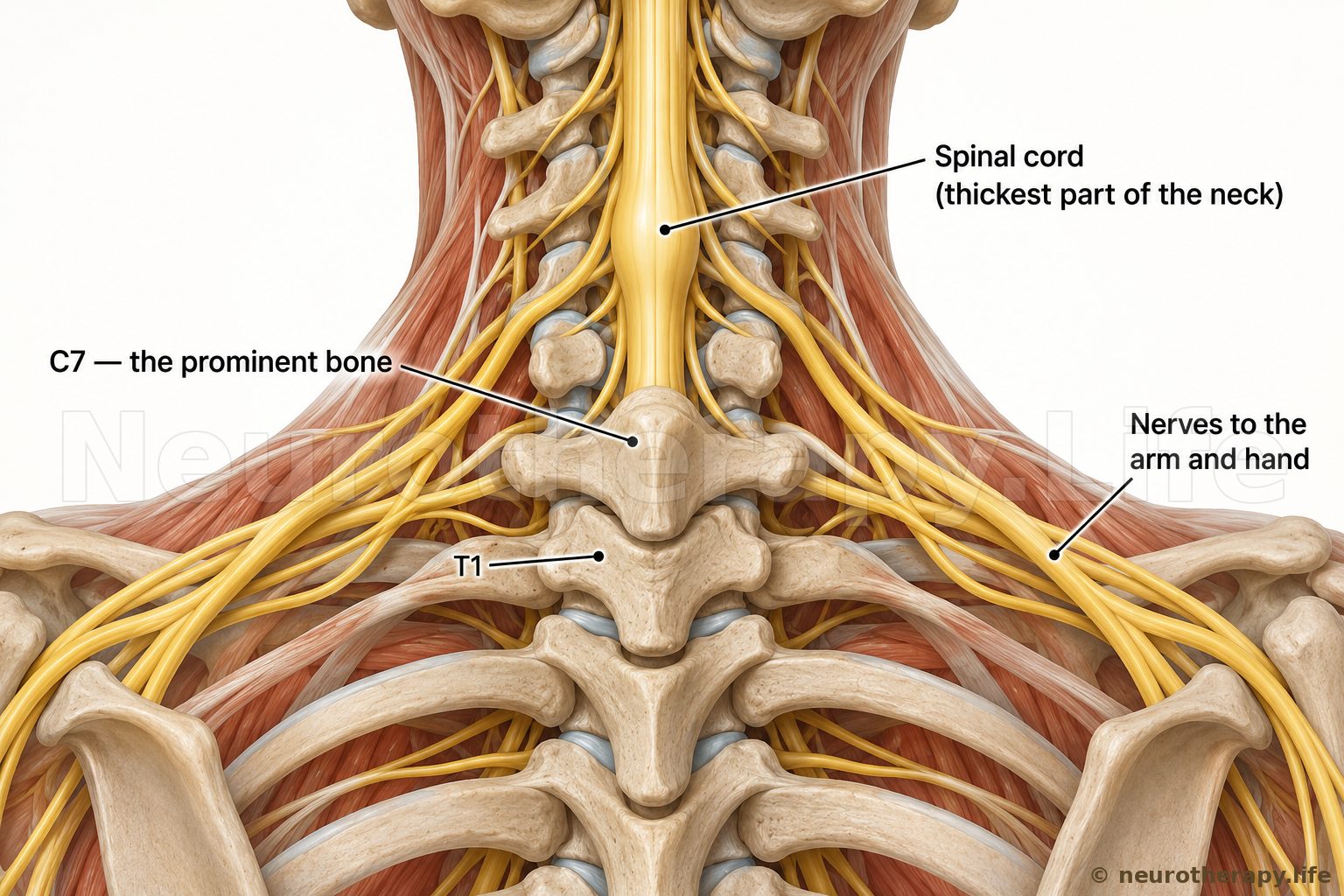
Bend your head forward and the last bone that stands out at the base of your neck is C7 — anatomists call it the 'vertebra prominens'.
Source: Gray's Anatomy (41st ed.), cervical vertebrae.
Also called: Motor neuron point, मोटर न्यूरॉन पॉइंट
The Motor Neuron Point is given with the patient lying face down, on either side of the joint at the base of the neck. It is used for pain or numbness in one half of the body. It is one of the two most forceful points in the therapy, used only after much thought — and despite its name, it is not a treatment for motor neuron disease.
The point lies at the junction of the last neck bone (C7) and the first bone of the upper back (T1). Inside the spinal canal at that level is the thickest part of the spinal cord in the neck — the stretch from which every nerve of the arm and hand departs. Those nerve cells that drive muscles are motor neurons, and the point is named after them.
The name is anatomical, not an indication — like T8 or Ankle Point. Motor neuron disease is a specific, progressive illness diagnosed and managed by a neurologist. The therapy never claims this point treats it, and the name must never be heard as a promise.
What the source does claim is specific: where there is pain or numbness in half the body, from the head down to the foot, this point gives immediate relief.
You lie face down with a raised stack of pillows under the chest and one under the chin, so the head is carried and the neck is not left hanging. Before anything else, the therapist checks by hand that there is room at the front of the throat, so breathing stays easy.
The point is on both sides of the joint between the prominent bone at the base of the neck and the bone just below it — beside the joint, never on it, and never on the neck bones above.
How this point is given — the tool, the pressure, the count and the exact movement — is deliberately not described here. A demonstration video for this point is being prepared; until it is on this page, learn the method hands-on from a trained Neurotherapist before giving it. Please do not give any point from a written description alone: a point given in the wrong place or the wrong way can do harm.
The exact technique is taught hands-on in the Neurotherapy (LMNT) course. See the course →
LMNT teaching reports immediate relief of pain or numbness in half the body. Body science confirms that the cord at this level sends out the nerves of the arm and carries messages for the whole body below; the effect of the point is the therapy's own clinical observation.
The Motor Neuron Point shares its set-up and its warning with one other point, and sits among the uncommon points.
It is used for one written finding, and only after the screening below. It is never routine.
No. It is named after the motor nerve cells in the cord at that level, not after the disease. MND is managed by a neurologist.
So that your head is carried and your chin does not press on your own windpipe while you lie face down. Without them the treatment is not given.
A slight sound may sometimes come, but it is not the treatment and not a sign of success. A therapist should never add force to make it happen.
No. Points that carry a jerk are closed for thin bones. Many gentler points remain open to her.
Bend your head forward and the last bone that stands out at the base of your neck is C7 — anatomists call it the 'vertebra prominens'.
Source: Gray's Anatomy (41st ed.), cervical vertebrae.
The spinal cord is thicker in the lower neck because of the huge number of nerve cells needed to run the arm and hand — the cervical enlargement.
Source: Gray's Anatomy (41st ed.), spinal cord.
In a stroke, about 1.9 million brain cells can be lost every minute untreated — why sudden one-sided weakness means an ambulance, not a session.
Source: Saver JL. Time is brain — quantified. Stroke 2006;37:263–266.
This page explains what a Neurotherapy (LMNT) treatment is for; it is not a self-treatment guide and does not diagnose. Neurotherapy (LMNT) works alongside your medical care — keep taking the medicines your doctor prescribed.
Send COURSE for course details, or your name, age and health issue for a consultation.