Motor neuron disease
Motor neuron disease (MND) is a group of illnesses in which the nerve cells that control the muscles slowly stop working. Weakness spreads over months or years and can affect walking, speech, swallowing and breathing. The commonest form is ALS.
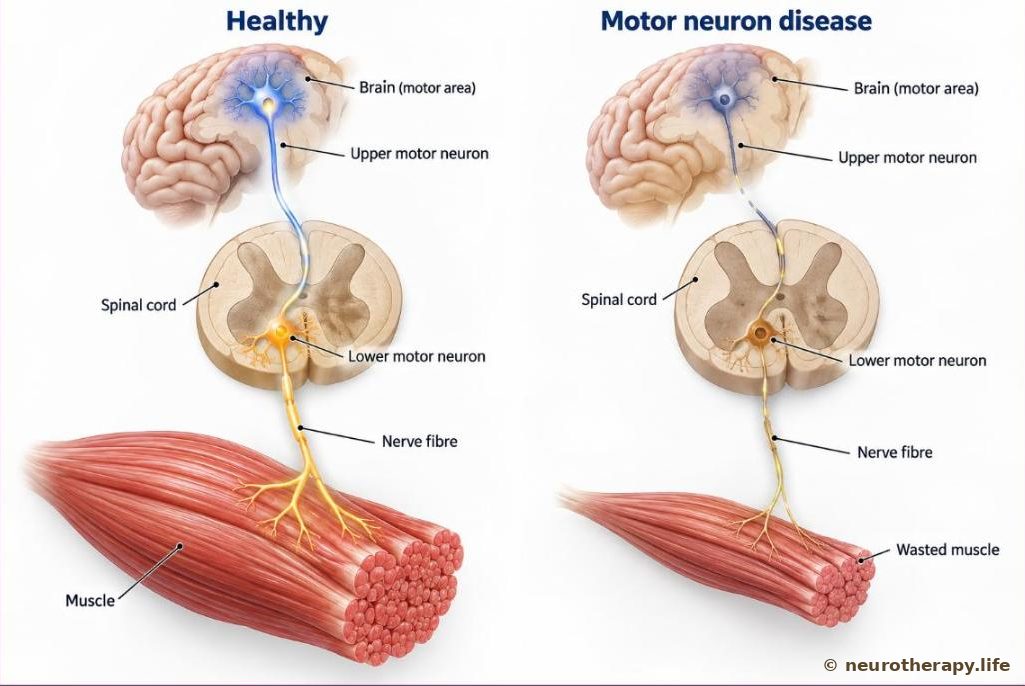
- It usually affects people over 50, though adults of any age can get it
- About 1 in 10 people with MND have a family history of it
- ALS, the commonest form, usually starts between 40 and 60 and affects more men than women
Source: NHS; MedlinePlus; NINDS
What is Motor neuron disease?
Every movement you choose to make — walking, gripping, speaking, swallowing, breathing deeply — starts as a message from motor neurons. Upper motor neurons in the brain pass the message to lower motor neurons in the brainstem and spinal cord, and these carry it to the muscles.
In MND these nerve cells slowly wear out and die. Without their messages the muscles weaken, twitch and waste away. Sensation, such as touch, is usually not affected. MND keeps progressing, so care is about comfort, strength for daily life, safe eating and good breathing.
What are the symptoms?
- Weak or stiff hands — trouble gripping, buttoning or writing
- Weak legs and feet; tripping or trouble walking
- Muscle twitches, cramps or spasms, and muscles getting thinner
- Slurred or thick speech
- Trouble swallowing, coughing or choking on drinks
- Shortness of breath, especially when lying flat
What causes it, and who is more likely to get it?
What is known
- For most people the cause is not clear — probably a mix of genes and other factors
- About 1 in 10 people have a family history
Who gets it more
- People over 50
- Men a little more often than women
Types
- ALS (amyotrophic lateral sclerosis) — upper and lower motor neurons
- Progressive bulbar palsy — speech and swallowing first
- Others, such as primary lateral sclerosis, progressive muscular atrophy and spinal muscular atrophy
How is it found?
There is no single test for MND. A neurologist puts it together from the pattern of weakness and tests that rule out other causes.
EMG and nerve conduction tests
Check how well the nerves carry messages and how the muscles respond.
MRI scan
Of the brain or spine, to rule out other conditions that can look similar.
Blood tests, and sometimes genetic tests
To look for other causes of weakness, or for an inherited form.
The neurotherapist does not diagnose MND. Before treatment, the therapist asks about swallowing and breathing, reads the neurologist's reports, and chooses how much the body can take — from ordinary pressure down to single points or the feather-light touch.
How Neurotherapy (LMNT) sees Motor neuron disease
Guruji's teaching places MND with the disorders in which the body's defence cells work more than needed. That is why its first formula is Ajay Normal — the Normal digestive formula with Spl left out on purpose, because provoking Spl raises the work of those cells. LMNT's first check for MND is simple: make sure Spl has not crept back in out of habit.
Then the plan is written in months, not weeks: the Oxygen-Hormonal treatment daily, with (15) Medulla — held to make or stimulate acetylcholine for the voluntary muscles — added in the second and third months. LMNT also names (½) Ku – 40 secs and (8) Rt. Parkhoo. Two more are marked honestly as unproven: Dorsal ("research still going on") and (30) Medulla ("perhaps"). MND is progressive, and Neurotherapy (LMNT) does not reverse it; it may support comfort and daily function, with reported improvement, alongside the neurologist's care.
Wherever there is a question mark, it is an indication that this is my own thinking, on which other people can now do research.
Neurotherapy (LMNT) treatment for Motor neuron disease, step by step
Examine first — swallowing and breathing
The therapist asks about coughing on drinks, a wet voice after drinking, chest infections and breathlessness; checks Liv° and Mu°; and picks the right level of touch. A frail or bedridden person gets hands only, single points, or feather touch — never jerks or force.
Ajay Normal first — without Spl
(8) Pan (3) Gal (7) Liv (6) Gas 'I'. The gap where Spl would be is the instruction.
Oxygen-Hormonal, on its three-month schedule
Month 1: daily. Month 2: daily, plus (15) Medulla × 6 treatments. Month 3: daily, plus (15) Medulla × 12 treatments. The dose rises by schedule, not because a week felt slow.
(½) Ku – 40 secs and (8) Rt. Parkhoo
Also named for MND in LMNT, given as the findings allow. (½) Ku is one forty-second hold at the tail of the spine.
Safe meals
A glass of water always within reach at every meal, never eating lying flat, and never eating alone out of earshot.
Points and formulas used
Ajay Normal
The Normal formula with Spl left out on purpose — the first formula for MND in LMNT.
Works through
Open →Oxygen-Hormonal treatment
A long, many-part daily treatment for oxygen supply and the hormones; in MND it runs for months, with (15) Medulla added from month two.
Open →(15) Medulla
(15) Medulla — held to make or stimulate acetylcholine for the voluntary muscles; 6 treatments in month two, 12 in month three.
Open →(½) Ku – 40 secs
(½) Ku – 40 secs — one forty-second hold; LMNT links it to the pineal gland and to brain and speech disorders.
Open →Rt. Parkhoo
(8) Rt. Parkhoo — given lying on the side, at two points of the right hip; named for MND in LMNT.
Open →Never do this
- Coughing or spluttering on drinks, a wet voice after drinking, or repeated chest infections can mean food is entering the airway. The person is sent for a proper swallowing assessment as part of the treatment — the texture of food and drink may need to change. Swallowing, difficulty in
- Choking, breathlessness, breathing trouble when lying flat, or a chest infection with fever — go to a doctor or hospital at once. Breathing, difficulty in
- No jerk techniques and no forceful pressure for a frail or bedridden person — not even "gently". The therapist substitutes or leaves them out.
- (½) Ku is not given to women during their period. (½) Ku – 40 secs
- MND is progressive. Neurotherapy (LMNT) may support comfort and daily function; the neurologist, physiotherapy, speech therapy, breathing care and diet advice all continue.
- Cancer: if the person has cancer, (10) Pan, Thymus, Pit, Lu + Sh, Rt. Ov / Lt. Ov and (30) Medulla are never given — the therapist changes the plan.
- Keep taking the medicines your doctor prescribed. Neurotherapy (LMNT) works alongside your medical care, never instead of it.
Watch

A demonstration of the Ajay Normal formula: (8) Pan, (3) Gal, (7) Liv and (6) Gas 'I' at the three-point form — the Normal formula with Spl left out.

A short self-help demonstration for vomiting, including travel sickness: a finger strokes straight down the Medulla line just beside and below the ear, 30 strokes on the left and 30 on the right — (15) Medulla — with a one-minute gap, repeated two or three times. Talc or a little oil is used so the skin is not rubbed raw.
LMNT teaching lists (8) Medulla — not (15) — for giddiness with nausea and vomiting, and the first point it gives for nausea and vomiting is Gas Only. Vomiting with blood, severe belly pain, a stiff neck or signs of losing water needs a doctor first.
Two @neurotherapylife demonstrations: the Ajay Normal formula, the first formula for MND in LMNT; and where (15) Medulla is given, beside and below the ears. The second video is about vomiting — it is shown here only for the technique. With MND, both are given by a trained therapist at the level of touch the body can take.
From Ayurveda and the kitchen
Test yourself
What research says
- Strong evidence
In ALS, the commonest MND, both the upper motor neurons in the brain and the lower motor neurons in the brainstem and spinal cord degenerate. 90–95% of cases are not inherited. Care is best given by a team — neurologist, physiotherapy, speech therapy, breathing care and nutrition — and breathing failure is the main danger.
No clinical trial of Neurotherapy (LMNT) in motor neuron disease has been published yet. Improvements reported by neurotherapists are clinical observations.
For you
Weakness that keeps slowly growing
Weak grip, tripping, twitching muscles or slurred speech that does not go away — see a neurologist. Sudden weakness, a drooping face or thick speech is a stroke emergency: call an ambulance.
Families and carers
Small mouthfuls, unhurried meals, sitting upright, a glass of water close by, and someone within earshot. Tell the doctor about any coughing on drinks.
People with MND
Keep every part of your care team: neurologist, physiotherapist, speech therapist and dietitian. Neurotherapy (LMNT) sits beside them.
This page explains; it does not diagnose. Neurotherapy (LMNT) works alongside your medical care — keep taking the medicines your doctor prescribed, and see a doctor for any new or severe symptom.