Also called: Gas I, gas eye, the intestine gas point, TF Gas 'I', गैस आई
Gas 'I' — read aloud as 'gas eye', the 'I' standing for intestine — is the Neurotherapy (LMNT) point for the small intestine. It is given down both calves while you lie on your back, and it is used to improve blood flow, movement and absorption in the intestine. Because it speeds the bowel, it is never given when there are loose motions.
Overview
What is the Gas 'I' point?
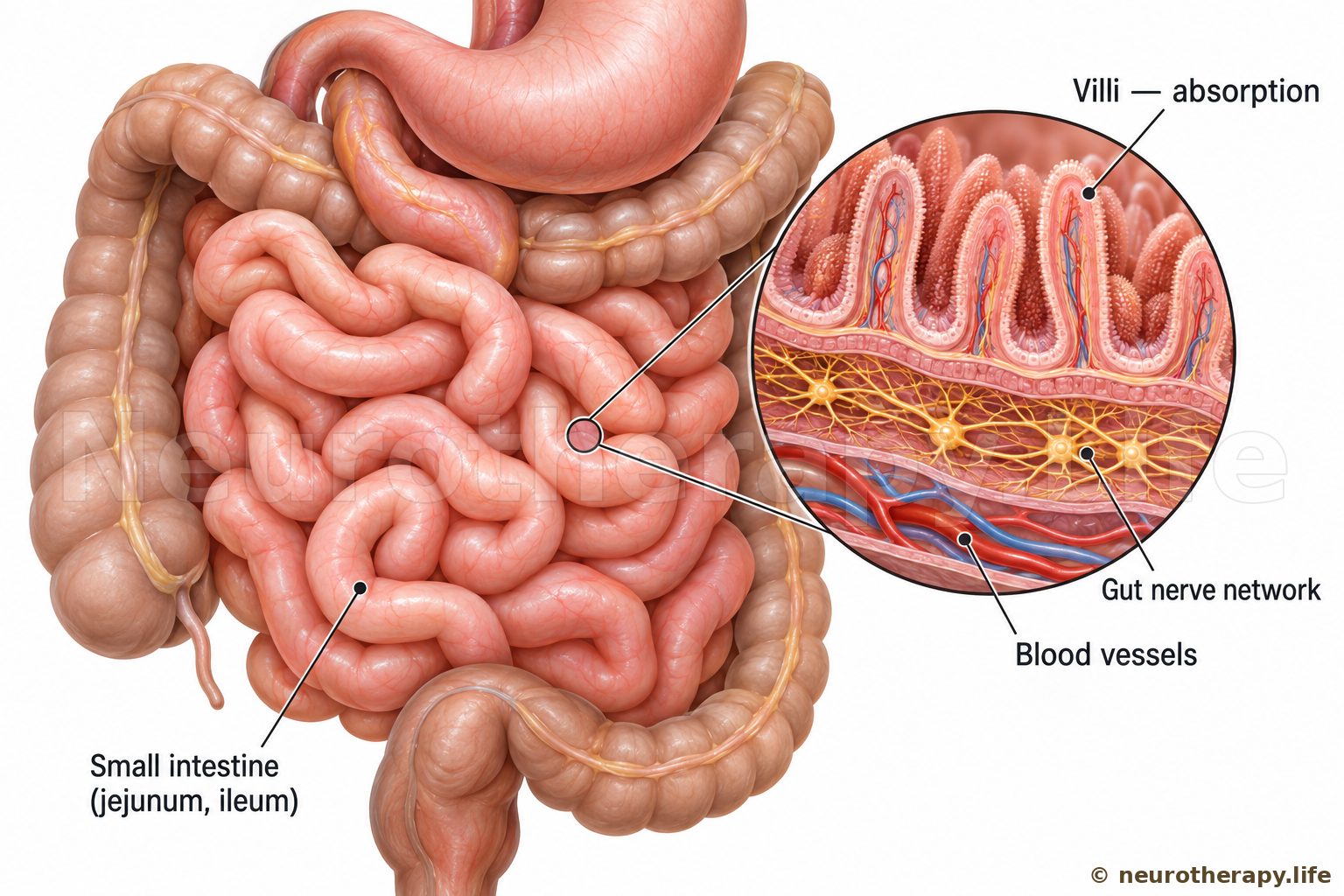
Gas 'I' is the calf form of the two gas points. Its sister, Gas Only, is given on the thighs for the stomach; Gas 'I' is given on the calves for the small intestine — the jejunum and the ileum, the long middle and last stretches of the gut where most food is absorbed.
The small intestine does more than absorb. Its lining sends out hormones such as secretin and CCK (cholecystokinin), which call the pancreas and gall bladder to send their juices. And its wall holds a vast network of nerve cells — the enteric nervous system — that makes, in smaller amounts, many of the same chemicals the brain makes.
That last fact is why Gas 'I' has a whole ladder of named forms. The teaching found that the same point, given as different named treatments, can do quite different things — from helping digestion, to lowering high blood pressure, to helping the tremor of Parkinson's disease.
Gas 'I' is named for the small intestine — its blood flow, movement, absorption and its own nerve network.
Where it is given
Where is Gas 'I' given?
PositionLying on the back
Body areaBoth lower legs together, from below the knee towards the ankle — the demonstration videos show the exact form
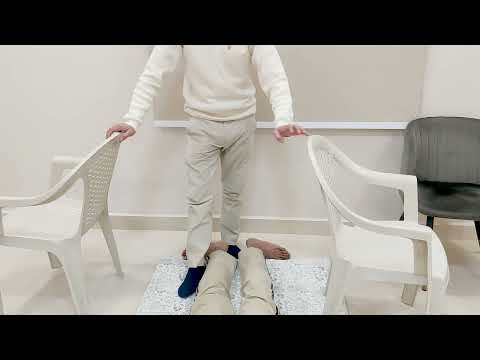
Gas 'I' is given on both lower legs together, from just below the knees towards the ankles, spread out so no space is left empty; the knee and the foot are never taken. Two forms are shown in the demonstration videos — one lying on the back with a pillow under the lower legs, and the 6-point form lying face down with a pillow under the ankles. Follow the video for the form named on your card.
Why the calves, for the intestine? On the Neurotherapy (LMNT) map, the further a pain point lies toward the navel, the further down the limb it is answered. The small intestine coils around the navel, so its answer lies on the lower leg.
How it is given
How is Gas 'I' given?
How this point is given — the tool, the pressure, the count and the exact movement — is deliberately not described here. Watch the demonstration video on this page, and learn the method hands-on from a trained Neurotherapist before giving it. Please do not give any point from a written description alone: a point given in the wrong place or the wrong way can do harm.
The number written before a point's name is not a strength setting. Each numbered form is a separate named treatment with its own method and timing, taught hands-on in the course.
The exact technique is taught hands-on in the Neurotherapy (LMNT) course. See the course →
What it does
What does Gas 'I' do in the body?
The teaching describes Gas 'I' as stimulating the small intestine. Science confirms the gut's hormones and its own nerve network; how a press on the calf reaches them is the therapy's explanation, built from clinical experience.
Increases blood circulation in the intestines and reduces intestinal gas.
Increases the absorption of nutrients.
Stimulates the jejunum and ileum for secretin and CCK, so digestion and absorption proceed properly.
Increases small-intestinal movement in constipated patients.
Reduces pain directly above the navel.
Helps children who drool, where Lu + Sh has not helped.
Organs it reaches
Intestines — The small intestine — Gas 'I' is named for it.
Kidneys — (6) Gas 'I' is held to improve blood flow to the kidney arteries too.
Brain — Gut nerve cells make some of the brain's own chemicals.
Pancreas — Called to send its juices by secretin and CCK.
Its family
What are the forms of Gas 'I'?
Each named form is a separate treatment. One bar — no loose motions — governs every one of them.
(6) Gas 'I' — Blood flow to the gut and kidneys; used to lower systolic blood pressure.
(12) Gas 'I' — For Parkinson's disease — works like (20) Medulla.
Gas Only — The thigh sister, for the stomach. In constipation the two go together.
Lu + Sh — Tried first for drooling; Gas 'I' helps where it has not.
What it is used for
What is Gas 'I' used for?
Gas 'I' is chosen from tenderness around the navel and the nature of the stool — and loose motions close it off at once.
Digestion and the bowel
ConstipationRaises small-intestinal movement; partners Gas Only in constipation.
Never when there are loose motions — Gas 'I' speeds the small intestine. This bar governs the whole Gas 'I' family, every named form. Diarrhoea (loose motions)
A calf swollen on one side only, warm and tender, is a possible clot: it is not pressed or rubbed, and the patient is sent to a doctor the same day. Ask about recent bed rest, long journeys, surgery, a plaster cast, pregnancy or recent delivery, cancer treatment and hormone tablets. Thrombosis (blood clots)
Where feeling has gone from the feet and lower legs — long-standing diabetes above all — firm pressure on the calves is stopped, because the patient cannot report pain. Numbness in the legs
A careless count can turn one named form into another, and one rung of the ladder may raise blood pressure. The therapist does not talk while giving the blood-pressure form. (6) Gas 'I'
“Wherever there is a question mark, it is an indication that this is my own thinking, on which other people can now do research.”
— Dr. Lajpatrai Mehra
A teaching case
Teaching case: the hand that stopped trembling
Recorded in the therapy's own account, with no name kept: an adult with Parkinson's disease had a good deal of pain at Gas 'I', so Gas 'I' was given for that finding — not for his disease. When (12) Gas 'I' was given, his hand trembled very much less. The reasoning about dopamine came only afterwards, and his Parkinson's medicines stayed with his own doctor.
A composite case written to teach the reasoning — not one patient’s file.
Common questions
Why are my calves pressed for a stomach problem?
Because Gas 'I' is the small-intestine point, and on the Neurotherapy (LMNT) map the area around the navel is answered from the calves.
I have loose motions today. Will I get Gas 'I'?
No. Gas 'I' speeds the bowel, so it is withheld in every form while there are loose motions.
Can Gas 'I' replace my blood-pressure tablets?
No. (6) Gas 'I' is given alongside your medicine. If your readings come down, your doctor decides whether the dose changes.
Why did the therapist ask whether my calf is swollen?
A one-sided swollen, warm, tender calf can be a blood clot. Pressing it could be dangerous, so it is checked before any pressure.
Surprising facts
1Half the body's dopamine comes from the gut
A study of patients during abdominal surgery found that the gut and nearby organs produce about 42–46% of the body's dopamine — a chemical most people think of only as a brain messenger.
Source: Eisenhofer G et al. Substantial production of dopamine in the human gastrointestinal tract. J Clin Endocrinol Metab. 1997;82(11):3864–3871.
2The gut has its own nervous system
The wall of the gut carries an extensive reflex control system of nerve cells that runs digestion largely by itself, using messengers such as serotonin, acetylcholine and nitric oxide.
Source: Furness JB. The enteric nervous system and neurogastroenterology. Nature Reviews Gastroenterology & Hepatology. 2012;9(5):286–294.
3The very first hormone came from the gut
Secretin, made by the lining of the small intestine, was the first hormone ever discovered, in 1902. It tells the pancreas to send its juice — one of the two messengers Gas 'I' is held to call out.
Source: Bayliss WM, Starling EH. The mechanism of pancreatic secretion. Journal of Physiology. 1902;28(5):325–353.
Watch
LMNT 1 Gas I Point Practical Training | Dr. Diwakar Shukla |Clinical Guide & Positioning for Student
A practical demonstration of where the Gas 'I' point lies down the calves, how the patient is positioned, and how the six-second presses are given.
The video shows the (1) Gas 'I' count. In Parkinson's the count is (12) Gas 'I' — still exactly six seconds at every place, and never with loose motions.
AJAY NORMAL FORMULA
A demonstration of the Ajay Normal formula: (8) Pan, (3) Gal, (7) Liv and (6) Gas 'I' at the three-point form — the Normal formula with Spl left out.
बिना दवा गहरी नींद कैसे पाएं? | LMNT Serotonin Treatment for Sleep Disorders | Insomnia Root Cause
Shows the Serotonin treatment for sleep: (8) Medulla below the ears, 1 Gas 'I' at six points on the shin, (6) Adr on the upper back, and gentle massage behind the knees and at the back of the head. It is given to support deep, natural sleep.
Note: (8) Medulla is not given in high BP, inflammation or cancer; (6) Adr is not given in high BP, diabetes, cancer or HIV.
Test yourself
Research
Strong evidence
Measuring blood entering and leaving the gut during surgery, researchers found that the abdominal organs make about 42–46% of the body's dopamine — the gut is a major dopamine source, not only the brain.
A review of the gut's own nervous system: an extensive reflex network in the gut wall that controls digestion and uses many chemical messengers also found in the brain.
This page explains what a Neurotherapy (LMNT) treatment is for; it is not a self-treatment guide and does not diagnose. Neurotherapy (LMNT) works alongside your medical care — keep taking the medicines your doctor prescribed.
Ready to begin?
Send COURSE for course details, or your name, age and health issue for a consultation.