(6) Gas 'I' (the Gas 'I' form for high blood pressure)
Also called: 6 Gas I, (6) gas eye, (6) गैस आई
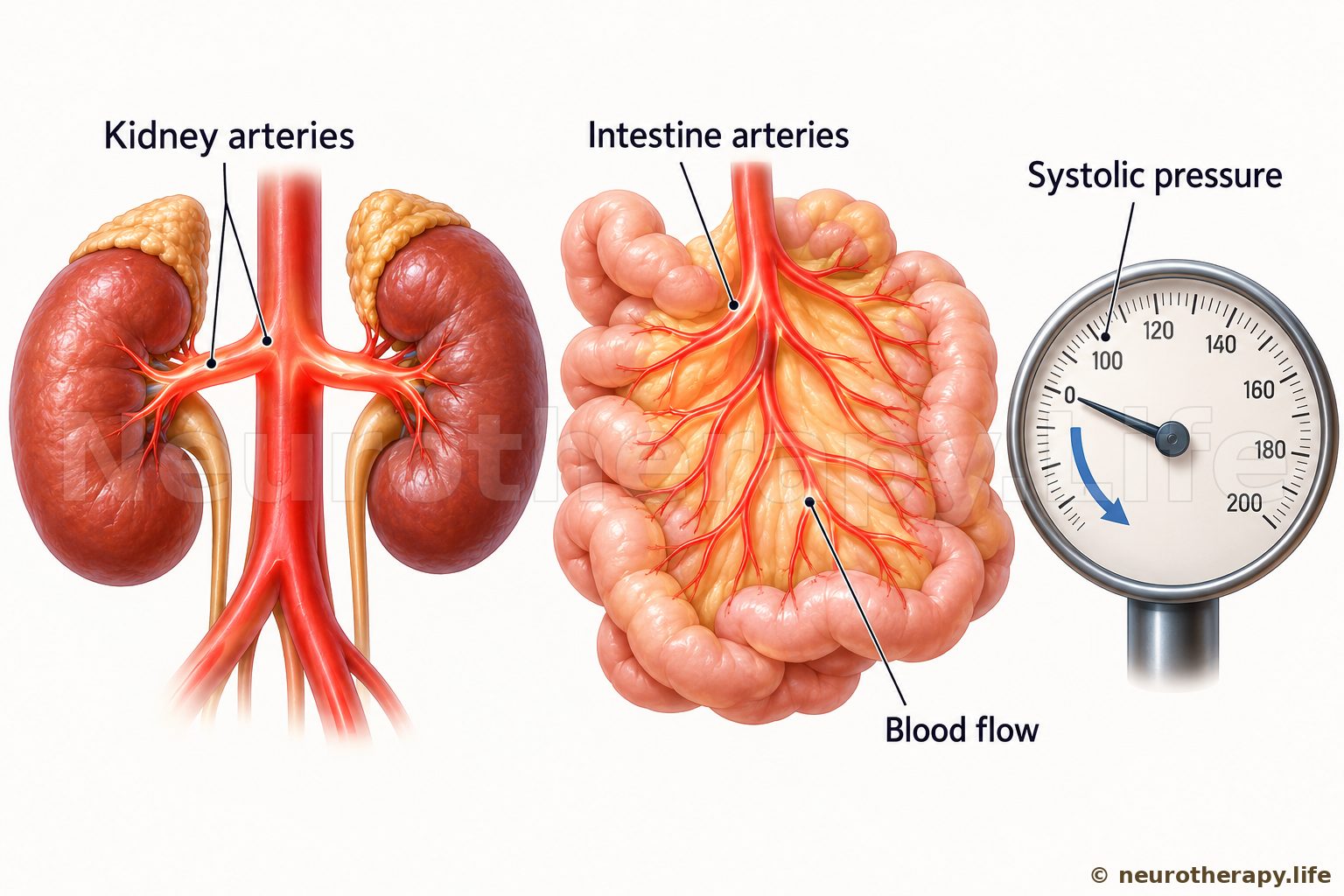
(6) Gas 'I' is a named form of the intestine point Gas 'I', given down both calves. The teaching holds that it increases blood flow in the arteries of the intestines and kidneys and helps bring down systolic blood pressure — and it is given with exceptional care, because a careless count can turn it into a form that may push pressure up.
Overview
What is (6) Gas 'I'?
(6) Gas 'I' belongs to the Gas 'I' family — the point for the small intestine, given on the calves. Its bracket number names a separate treatment with its own purpose.
It came from a line of reasoning the therapy records openly. A Parkinson's patient improved with (12) Gas 'I', and dopamine — the chemical lacking in Parkinson's — was looked up. In hospital medicine, dopamine at a small dose widens the arteries of the kidneys and intestines and lowers systolic pressure, while larger doses raise it. So the therapy reasoned that a lighter Gas 'I' form might lower pressure, tried (6) Gas 'I' on a patient with high blood pressure, and saw the systolic pressure come down.
Since then it has been given for many years to patients with high blood pressure, alongside their medical care. Nothing is injected or swallowed in this treatment; the dopamine table is the reasoning, not a medicine.
(6) Gas 'I' is held to increase blood flow in the arteries of the gut and kidneys, helping lower systolic pressure.
Where it is given
Where is (6) Gas 'I' given?
PositionLying face down
Body areaBack of both calves, six places from just below the knee to just above the ankle; lying face down with a pillow under the ankles
In the demonstration video you lie face down with a pillow under the ankles so the feet hang free. Six places are taken down the back of each calf from just below the knee to just above the ankle, both calves together; the heel and the foot are never taken.
How it is given
How is (6) Gas 'I' given?
How this point is given — the tool, the pressure, the count and the exact movement — is deliberately not described here. Watch the demonstration video on this page, and learn the method hands-on from a trained Neurotherapist before giving it. Please do not give any point from a written description alone: a point given in the wrong place or the wrong way can do harm.
The number written before a point's name is not a strength setting. Each numbered form is a separate named treatment with its own method and timing, taught hands-on in the course.
Parent pointGas 'I', the small-intestine point
The exact technique is taught hands-on in the Neurotherapy (LMNT) course. See the course →
What it does
What is (6) Gas 'I' held to do?
These are the teaching's claims, drawn from its reasoning and from many years of use; science confirms the dopamine facts it reasoned from, not yet the treatment itself.
Increases blood flow in the arteries of the intestines and the kidneys.
Is held to stop the kidney producing renin, a hormone that raises blood pressure, and so to normalise high blood pressure.
Enables the gut's own nerve cells to produce serotonin and other brain chemicals.
Is used in the Chole treatment and in Ajay Normal to stir the small intestine.
Its effect rests on the press being kept exactly as taught. A longer hold can turn it into (9) Gas 'I', which the therapy reasons may raise blood pressure. This is why it is given only by a trained therapist who does not talk while giving it. Gas 'I' ladder
Keep taking your blood-pressure tablets. If your readings fall, your doctor — not the therapist — decides whether the dose changes. Keep checking your pressure. High blood pressure
Very high readings, chest pain, a sudden severe headache, weakness of one side or confusion are an emergency: call emergency services (108/112) first. How to tell a patient to see a doctor
The calf checks of Gas 'I' apply: no pressure on a one-sided swollen, warm calf, and no firm pressure on legs that have lost feeling. Thrombosis (blood clots)
Guruji says
“Wherever there is a question mark, it is an indication that this is my own thinking, on which other people can now do research.”
— Dr. Lajpatrai Mehra
Common questions
Can I stop my BP tablets if (6) Gas 'I' works?
No. Only your doctor changes your medicine. Bring your readings to your doctor and let them decide.
Why did my therapist go silent during this treatment?
Because the count matters so much here. Talking is the easiest way for the count to drift and turn the treatment into one that may raise pressure.
Is (9) Gas 'I' used for low blood pressure?
The teaching thought it might be, but says honestly that patients with low pressure came too rarely to test it. It remains an untested idea.
Surprising facts
1One chemical, opposite effects
In hospital use, low doses of dopamine widen kidney arteries, while high doses tighten blood vessels throughout the body. The same molecule can lower or raise blood pressure depending on the dose.
Source: Standard pharmacology of dopamine infusion (renal, cardiac and α-adrenergic dose ranges).
2Much of our dopamine is made in the gut
Measurements during surgery showed the abdominal organs produce close to half of the body's dopamine.
Source: Eisenhofer G et al. J Clin Endocrinol Metab. 1997;82(11):3864–3871.
3The kidneys get a fifth of every heartbeat
About 20% of all the blood the heart pumps goes to the two kidneys — around a litre a minute — which is one reason they have such a say in blood pressure.
Chole Treatment in Neurotherapy | LMNT Formula for Digestion, Acidity & Fat Metabolism
A demo of the Chole treatment ((10) Medulla, (6) Gas 'I', (3) Gal), shared for acidity, heavy meals and the digestion of fats.
AJAY NORMAL FORMULA
A demonstration of the Ajay Normal formula: (8) Pan, (3) Gal, (7) Liv and (6) Gas 'I' at the three-point form — the Normal formula with Spl left out.
Test yourself
Research
Strong evidence
Measuring blood entering and leaving the gut during surgery, researchers found the abdominal organs make about 42–46% of the body's dopamine — the chemical the (6) Gas 'I' reasoning was built on.
This page explains what a Neurotherapy (LMNT) treatment is for; it is not a self-treatment guide and does not diagnose. Neurotherapy (LMNT) works alongside your medical care — keep taking the medicines your doctor prescribed.
Ready to begin?
Send COURSE for course details, or your name, age and health issue for a consultation.