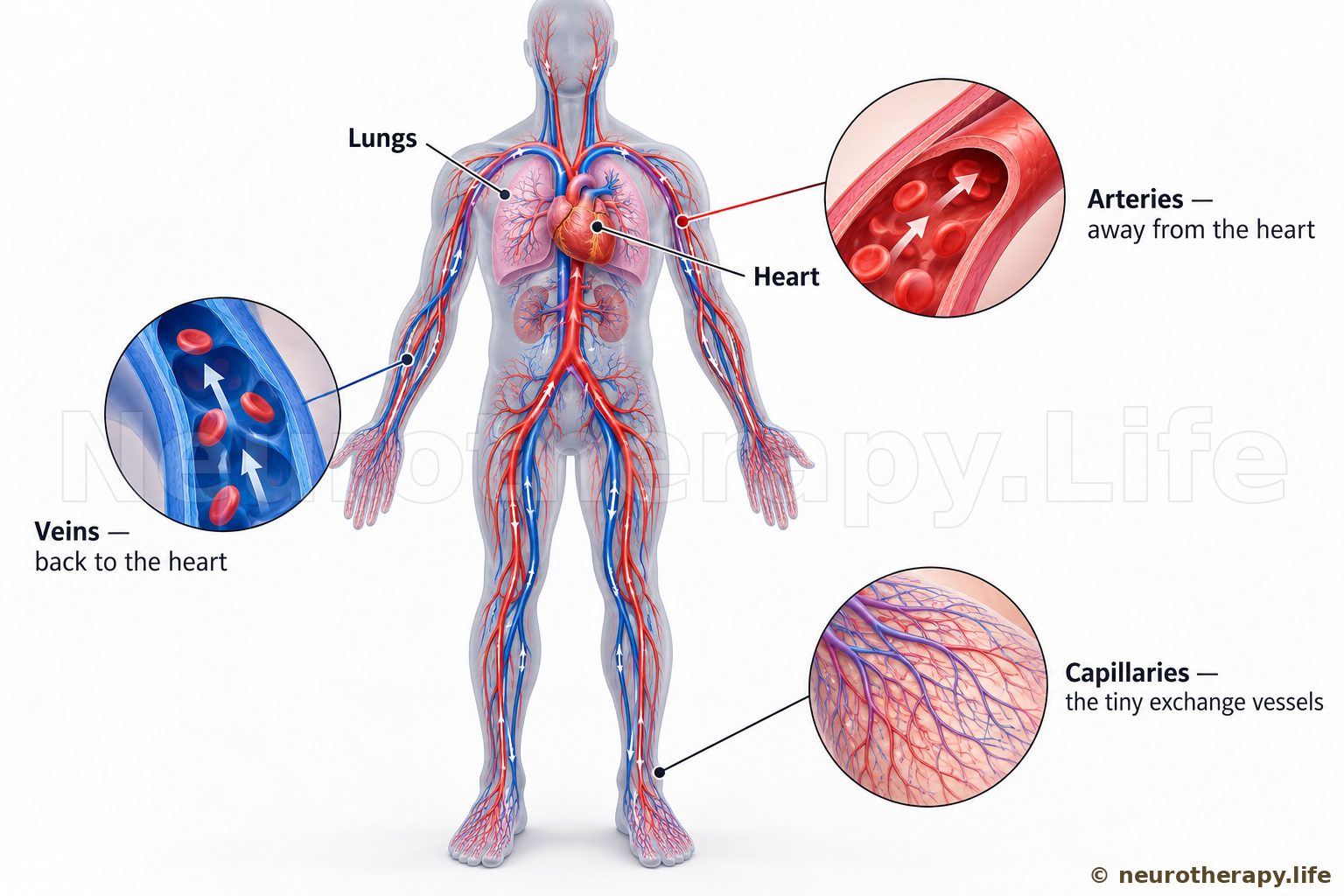
One pump, about five litres of blood and a network of pipes long enough to reach every living cell. Your blood makes a full round of the body in about a minute at rest — and in Guruji's teaching, an organ stays healthy only as long as its share of that flow keeps arriving.
Overview
What is the circulatory system?
Your circulatory system is the body's delivery and collection service. It is made of three parts working as one: the heart, which pumps; the blood, which carries; and the blood vessels — arteries, veins and tiny capillaries — which are the roads.
Every minute it takes oxygen from the lungs and food from the gut to every cell, and carries carbon dioxide and waste away to the lungs, kidneys and liver. It also carries hormones, heat and the body's defence cells.
Beside it runs a quieter second stream, the lymph, which drains the extra fluid from the tissues and returns it to the blood near the base of the neck. In Neurotherapy (LMNT), restoring the flow of both blood and lymph is the heart of the method.
The circulatory system: one pump, one fluid and one network of vessels reaching every part of the body.
Function
What does the circulatory system do?
It runs two loops at the same time. The short loop takes blood from the right side of the heart through the lungs and back, to pick up oxygen. The long loop takes that fresh blood from the left side of the heart to the whole body and back again.
Carries oxygen from the lungs to every cell, and carbon dioxide back to the lungs.
Carries food (nutrients) from the gut, first to the liver and then to the whole body.
Takes waste to the kidneys and liver to be cleared.
Carries hormones — the body's chemical messages — from the glands to the organs they control.
Spreads heat and helps keep body temperature steady, sending more blood to the skin when you are hot.
Carries white cells and antibodies to fight germs, and seals wounds by clotting.
Keeps the body's water, salt and acid–alkali balance steady, working with the kidneys and lungs.
The push
The left ventricle squeezes and pushes fresh blood into the aorta, the body's main artery.
Out along the arteries
Arteries branch again and again, becoming smaller arterioles that act like taps, opening or closing to send more blood where it is needed.
The exchange
In the capillaries, walls only one cell thick let oxygen and food pass out to the cells, and carbon dioxide and waste pass in.
Home through the veins
Used blood gathers into veins. One-way valves and the squeeze of the leg muscles help it climb back up to the heart.
Through the lungs
The right side of the heart sends this blood to the lungs, where it drops carbon dioxide and loads oxygen.
Back to the start
Fresh blood returns to the left side of the heart, ready for the next lap — about a minute for the whole round at rest.
How does the circulatory system work with other systems?
Lungs and breathing — The lungs load oxygen into the blood and take carbon dioxide out of it, every single lap.
Digestive system — The gut hands nutrients to the blood, and the liver sorts them before they go on.
Kidneys and urinary system — The kidneys filter the blood, remove waste and control blood pressure through salt and water.
Nervous system and brain — Centres in the medulla, at the base of the brain, set the heart rate and the tightness of the vessels from moment to moment.
Glands and hormones — Hormones such as adrenaline travel in the blood, and some of them tighten or relax the vessels.
Lymph and immunity — Lymph vessels collect the fluid that leaks out of the capillaries and return it to the blood.
Muscular system — Every step you take squeezes the leg veins, pumping blood back towards the heart.
Skin — Blood flow to the skin rises to lose heat and falls to keep it in.
A pump, the fluid it moves, the vessels that carry it, two loops, and a few helpers.
The pump — the heart
Right side — Receives used blood from the body and sends it to the lungs.
Left side — Receives fresh blood from the lungs and pumps it to the whole body. Its wall is the thickest, because its job is the hardest.
Valves — Four one-way doors that keep blood moving forward.
The pipes — blood vessels
Five kinds of vessel, from the widest to the finest and back again.
Arteries — Thick, springy tubes that carry blood away from the heart under high pressure. The aorta is the largest.
Arterioles — The smallest arteries, with muscle rings that act like taps and control how much blood each organ gets.
Capillaries — Tubes finer than a hair with walls one cell thick, where the real exchange with the cells takes place.
Venules — Small veins that collect blood from the capillaries.
Veins — Thinner-walled, low-pressure tubes that bring blood back to the heart, many with one-way valves.
The fluid — blood
Plasma — The straw-coloured liquid part, a little over half the blood, carrying food, salts, hormones and proteins.
Red blood cells — Carry oxygen on haemoglobin, the iron-containing protein that makes blood red.
White blood cells — The body's defence force against germs.
Platelets — Tiny cell pieces that start a clot to seal a cut.
The two loops
Pulmonary circulation (the lung loop) — Right heart → lungs → left heart. Short, and at low pressure.
Systemic circulation (the body loop) — Left heart → every organ → right heart. Long, and at high pressure.
Coronary circulation — The heart's own small loop that feeds the heart muscle.
Portal circulation — Blood from the stomach and intestines goes first to the liver, not straight back to the heart.
The helpers
Bone marrow — The soft tissue inside bones where new blood cells are made.
Spleen — Filters the blood and removes worn-out red cells.
Lymph vessels and nodes — A second, pump-less set of channels that drains the tissues and returns fluid to the blood.
The journey
Left heartLess than a second
One squeeze sends about 70 mL of fresh blood into the aorta.
ArteriesA few seconds
Blood races out fastest in the aorta and slows as the vessels branch.
CapillariesAbout 1–3 seconds
Blood crawls through, slowly enough for oxygen and food to pass out and waste to pass in.
VeinsSeveral seconds to about a minute
Blood gathers and climbs back to the heart, helped by valves and working muscles.
Right heart and lungsA few seconds
In the lung capillaries, each red cell unloads carbon dioxide and loads oxygen in less than a second.
Full roundAbout 1 minute at rest
Faster during exercise, when the heart may pump four or five times as much.
Where is the circulatory system located?
Everywhere. The heart sits in the middle of the chest, behind the breastbone, between the two lungs. From it the aorta arches up and then runs down in front of the spine, through the chest and belly, before splitting into the arteries of the two legs. The largest vein, the inferior vena cava, runs beside it back up to the heart.
Arteries mostly run deep and protected, close to bones. They come near the surface in a few places where you can feel a pulse: the wrist, the side of the neck, the inside of the elbow, the groin and the top of the foot. Many veins run just under the skin, which is why you can see them.
These pulse places matter in LMNT teaching too. At the front of the neck lies the great artery to the brain, and at the hollow of the elbow the main artery of the arm; the therapist's contact is placed away from them, broad and flat, never on them.
Blood is always red. Blood leaving the lungs is bright scarlet; blood returning from the body is a darker, deeper red. Veins look blue or green through the skin only because of the way skin scatters light.
Arteries are round, firm and springy, and pulse under the finger. Veins are softer and flatter and collapse when empty. Capillaries are too fine to see with the naked eye; together they give tissues their pink colour.
How big is the circulatory system?
An adult has about 5 litres of blood — roughly 7% of body weight. The heart that moves it weighs only about 250–350 grams and pumps about 5 litres a minute at rest, so the whole blood supply goes round about once a minute.
The aorta is about 2.5 cm across — as wide as a thumb. A capillary is about 5–10 thousandths of a millimetre wide, about ten times thinner than a hair, and there are some 10 billion of them.
At any moment most of your blood is not in the heart or arteries but in the veins — about two-thirds of it — which act as the body's blood store.
Conditions and disorders
What conditions and disorders affect the circulatory system?
Trouble can start in the pump, in the pipes, in the blood itself, or in the pressure that drives it all. Many of these problems grow quietly for years.
Chest pain, pressure or heaviness, especially on effort
Breathlessness on walking or on lying flat
Swelling of the feet, ankles or legs
Cold, pale, numb or bluish hands or feet
Calf pain on walking that eases on resting
Dizziness or fainting, especially on standing up
Sudden face droop, arm weakness or slurred speech — a stroke until proved otherwise
What tests check the circulatory system?
Blood pressure and pulse — The simplest and most useful checks, taken on more than one day.
Complete blood count (CBC) — Counts red cells, white cells and platelets, and measures haemoglobin.
Lipid profile and blood sugar — Cholesterol, triglycerides and sugar — the quiet drivers of artery disease.
ECG and echocardiogram — Record the heart's electrical signal and show how well it pumps.
Doppler ultrasound — Shows blood flowing in the arteries and veins, and finds narrowing, leaky valves or clots.
Ankle–brachial index — Compares the blood pressure at the ankle with the arm, to find narrowed leg arteries.
Angiography — Dye and X-rays or CT show the inside of the arteries.
How are circulation problems treated?
Lifestyle — Regular walking, no tobacco, less salt, and control of weight, sugar and cholesterol — the base of every plan.
Medicines — To lower blood pressure or cholesterol, thin the blood, or treat anaemia — prescribed and adjusted by a doctor.
Procedures — Angioplasty and stents or bypass surgery for blocked arteries; treatment of varicose veins; removal of clots.
Compression stockings — Firm stockings that help leg veins push blood upward.
Blood transfusion — For serious blood loss or severe anaemia.
Neurotherapy (LMNT)
Guruji's teaching starts from a plain piece of arithmetic. The quantity of blood in a body is fixed and always moving, shared out among all the organs at once. So a shortage of blood in one region must be matched by an excess somewhere else — like one water tank on a roof feeding many taps: open one wide and another runs thin. Every organ is made to work normally unless its blood supply is compromised for a long time, and an organ kept short for long enough drifts into disease. The method therefore aims to divert the flow from where there is excess to where there is shortage — and, alongside the blood, to keep the lymph moving, since lymph has no pump and moves only when the body moves. Two more rules follow from circulation. Blood that slows begins to set, so the body makes heparin, its own anti-clotting chemical — about 85% of it in the liver and lungs, which is why LMNT's Heparin formulas work on those organs. And every pressure is held for six seconds, because a longer hold presses the vessels shut and uses up the oxygen and glucose in the blood trapped around the point. This is support alongside medical care, never instead of it.
Points
Back Arrow — Also called Blood supply to lungs — light rubbing with the soft sole from mid-back to shoulder and down the upper arm, left side first. Given in breathing-related diseases.
Blood Supply to Legs — Prone, the soft middle of the therapist's sole rubbing the back of each thigh from hip to knee, 30 times; taught for weakness in the legs and polio.
On the Spine — With Beside the Spine and the Round Arrow, given twenty times each in the Oxygen formula 'to set right the circulation of blood in the whole body'.
(6) Left Swt — Pressure on the left side of the spine near the sixth thoracic bead opens — it is used where arteries or ring-shaped closing muscles have narrowed.
(6) Right Swt — The same pressure on the right side closes — it has been used for the swelling in the legs from varicose veins. Same bead, two sides, opposite results.
Gas 'I' — Soles and heels on both calves at six places — increases blood circulation in the intestines. A calf that is swollen on one side is never pressed.
Ch. Only — The chest point that stimulates both lungs; the last step of P. Heparin. Not given in lung cancer.
Mu° — The left kidney point; in chronic disease it is given to make erythropoietin, the kidney messenger that tells the bone marrow to make red cells.
(8) Pan (7) Liv (8) Ch. Only — pancreas, liver and lungs, in that order. The pancreas to digest the fibrin of an old clot; the liver and lungs to make heparin so no new clot forms.
“Whenever there is an obstruction or blockage in the blood circulation of any part of the body, then pain or numbness is felt in that part.”
— Dr. Lajpatrai Mehra
“No other drink can be a substitute for water.”
— Dr. Lajpatrai Mehra
“In this therapy we do not treat the disease; rather, we improve the body.”
— Dr. Lajpatrai Mehra
Never do this
Emergency: chest pain or pressure lasting more than a few minutes, sudden breathlessness, coughing up blood, or a sudden drooping face, weak arm or slurred speech — call 108/112 at once. No Neurotherapy (LMNT) is given instead of this.
A calf that is swollen on one side, warm and tender is a clot until proved otherwise. It is never pressed or rubbed — the person is sent to a doctor the same day. Gas 'I'
Lu + Sh raises blood pressure: it is not given in high blood pressure or in heart disease. Lu + Sh
The two kinds of low pressure are never mixed: low BP of many years is not given Angiotensin No. 2; pressure that fell suddenly after blood loss is not given the Vasopressin formula. A person who is still bleeding goes to hospital first. Vasopressin formula
Where feeling has gone from the feet and legs — long-standing diabetes above all — firm pressure on the calves and feet is not given: the person cannot say when it hurts. Diabetes
Cancer: if the person has cancer, (10) Pan, Thymus, Pit, Lu + Sh, Rt. Ov / Lt. Ov and (30) Medulla are never given — the therapist changes the plan.
Keep taking the medicines your doctor prescribed, and never stop or change a blood-pressure medicine or blood thinner on your own. Neurotherapy (LMNT) works alongside your medical care, never instead of it.
Care
How can I keep my circulation healthy?
Blood moves best in a body that moves, drinks water, and does not smoke.
Walk most days
At least 150 minutes a week of brisk walking or similar activity, as the WHO advises. Each step works the calf pump that sends blood back to the heart.
Break up long sitting
On long journeys or at a desk, stand, stretch or rise on your toes every 30–60 minutes.
Drink water through the day
Guruji advised water more than any other drink. LMNT teaching links too little water with a low blood volume and low pressure. People with heart or kidney disease should follow their doctor's fluid advice.
Go easy on salt
Less than 5 grams a day, about one level teaspoon, counting pickles, papad and packaged food (WHO).
Sleep with your arms down
Guruji's teaching: do not sleep with the hands under or above the head, or with an arm over the eyes. The collarbone presses on the artery to the arm, and the hands or fingers may go numb.
Give up tobacco
Cigarettes, bidi and chewing tobacco all damage the lining of the arteries. Stopping helps at any age.
Know your numbers
Check blood pressure, sugar and cholesterol regularly — high numbers often cause no symptoms for years.
Common questions
If blood is red, why do my veins look blue?
Blood in veins is dark red, not blue. Skin lets red light pass deeper and bounces back more blue light from vessels near the surface, so the vein looks blue or green from outside.
How much blood do I have?
About 5 litres in an average adult — roughly 7% of body weight. A larger person has a little more, a smaller person a little less.
What is a normal blood pressure?
Below about 120/80 is ideal for most adults. Readings of 140/90 or more on repeated checks are usually treated as high blood pressure. Your doctor sets the target that is right for you.
Why do my feet swell after a long journey?
Sitting still switches off the calf pump, so fluid gathers in the feet. It usually settles after walking and raising the legs. Swelling in one leg only, with pain or warmth, needs a doctor the same day.
Can Neurotherapy (LMNT) improve blood circulation?
LMNT teaching aims to divert the flow of blood and lymph towards organs that are going short, and reports improvement in many conditions. It is given alongside medical care — it does not replace medicines, tests or emergency help.
Why do my fingers go numb when I sleep with my arm under my head?
The artery and nerves to the arm pass under the collarbone. With the arm raised for hours they get squeezed. Guruji's teaching is to sleep with the arms down. Numbness that stays, or comes in both hands often, is worth checking — including vitamin B₁₂.
What should I ask my doctor or therapist?
What are my blood pressure, sugar, cholesterol and haemoglobin numbers, and what should they be?
Is my leg swelling or numbness from the veins, the arteries, the heart or the nerves?
Which warning signs mean I should call 108/112 straight away?
Do I need compression stockings, and how long should I wear them?
(To the therapist) Which points are blocked for me because of my blood pressure, heart or blood thinners?
Surprising facts
1Your blood goes round in about a minute
You have about 5 litres of blood, and at rest your heart pumps about 5 litres a minute. So, on average, your whole blood supply makes a full round of the body about once every minute — around 1,400 times a day.
Source: Guyton & Hall, Textbook of Medical Physiology — blood volume about 5 L; resting cardiac output about 5 L/min. Laps per day is arithmetic (1,440 minutes).
2About 10 billion capillaries
The finest vessels are so many that their combined surface is about 500–700 square metres — larger than a basketball court. Almost no cell in your body is more than a hair's breadth from one.
Source: Guyton & Hall, Textbook of Medical Physiology — 'about 10 billion capillaries with a total surface area of 500–700 square metres'. Basketball court ≈ 420–436 m².
3Red cells travel in single file
A red blood cell is about 7.5 thousandths of a millimetre across, but many capillaries are narrower than that. So red cells bend and squeeze through one at a time, like people through a turnstile — which brings each one right up against the capillary wall for the exchange.
Source: Guyton & Hall — capillary diameter about 4–9 µm; red cell about 7.5–8 µm, deforms to pass.
4Most of your blood is in your veins
At any moment about two-thirds of your blood sits in the veins, only about one-eighth in the arteries, and less than a tenth in the heart. The veins are the body's blood store: when you bleed or stand up suddenly, they tighten and push stored blood back into use.
Source: Guyton & Hall — distribution of blood volume: systemic veins about 64%, arteries about 13%, heart about 7%, lungs about 9%.
5Your calf is a second heart
The deep veins of the calf run inside the muscle. Each time the muscle tightens, it squeezes them flat and drives blood upward, and one-way valves stop it falling back. That is why walking keeps ankles slim and long sitting makes them swell.
Source: Guyton & Hall — the 'venous pump' or 'muscle pump'. LMNT teaching on the calf pump: circulatory.md §3.3.
6The pressure falls almost to zero on the way home
Blood leaves the heart with an average push of about 100 mmHg. By the capillaries it is down to about 17, and by the time it reaches the heart again it is close to zero. The arterioles — the body's taps — take most of that drop.
Source: Guyton & Hall — mean pressures: aorta about 100 mmHg, capillaries about 17 mmHg, right atrium about 0 mmHg.
7A leak that is collected every day
Fluid seeps out of the capillaries all day. Most soaks back, but about 2–3 litres a day would be lost in the tissues if the lymph did not collect it and return it to the blood near the base of the neck. Lymph has no pump — it moves when you move.
Source: Guyton & Hall — total lymph flow about 120 mL/hour (about 2–3 L/day). LMNT teaching 'the second river, which has no pump': circulatory.md / blood-vessels.md §3.3.
8We have known it goes round for less than 400 years
For over a thousand years, learned doctors believed blood was made fresh in the liver and used up in the body. In 1628 the English physician William Harvey showed by measurement that the heart pumps far more blood than the body could ever make — so the same blood must go round and round.
Source: Harvey W. Exercitatio anatomica de motu cordis et sanguinis in animalibus, 1628; Aird WC, J Thromb Haemost 2011;9 Suppl 1:118–129.
A day in the life of your circulation
~100,000heartbeats
~7,000 Lof blood pumped
~1,400full rounds of the body, at rest
~2–3 Lof fluid returned by the lymph
~5 Lof blood in an adult — used again and again
0days off
Yoga
Standing tall with heel raises Tāḍāsana
Benefits
Works the calf muscle pump that sends blood from the legs back to the heart.
A quick break for anyone who sits or stands still for long hours.
Improves balance and ankle strength.
How to do it
Stand with feet hip-width apart, near a wall or chair you can touch for balance.
Keep the spine tall and the shoulders relaxed.
Breathe in and slowly rise onto your toes.
Hold for 2–3 seconds, then breathe out and lower the heels slowly.
Repeat 10–15 times; do a set every hour on long sitting days.
Take care
Hold on to support if your balance is poor or you feel dizzy. Skip it with a fresh ankle or foot injury. A calf that is painful, hot or swollen on one side needs a doctor, not exercise.
Resting pose with slow breathing Śavāsana
Benefits
Deep rest lowers the stress response that tightens the blood vessels.
Slow, easy breathing calms the heart rate.
A good way to end any exercise session.
How to do it
Lie on your back on a mat, with a thin pillow or folded blanket under the head if needed.
Let the feet fall outward and rest the arms a little away from the body, palms up.
Close your eyes and breathe slowly through the nose, letting the out-breath be a little longer.
Stay for 5–10 minutes.
To get up, roll onto your side first and push up slowly with your hands.
Take care
If lying flat makes you breathless, raise the head and chest on pillows and tell your doctor — that can be a heart sign. In late pregnancy lie on the left side instead. Always get up slowly.
Watch
P HAPARIN FORMULA
Shows the P. Heparin formula: (8) Pan at the top of the thighs, (7) Liv on the thigh and forearm, and (8) Chest Only with the palms on the chest. In the video it is given as the last part of the Angina treatment, to support circulation.
LOW BP DUE TO HEADY BLEEDING DURING PERIODS
A demonstration of the Angiotensin No. 2 formula — (7) Liv, (7) Mu° and (6) Lu + Sh — for low blood pressure that comes on suddenly after very heavy bleeding in a period.
The video suggests using the formula at the moment of fainting. In LMNT teaching, a person who is still bleeding, cold, pale or fainting is taken to hospital first; this formula is for after the bleeding has been stopped. Lu + Sh is not given in cancer.
LMNT Oxygen Formula — Drugless Support for Asthma & Low Oxygen
This video shows the LMNT Oxygen formula, shared as support alongside medical care for asthma, breathlessness and low oxygen.
Note: keep your inhaler with you and use it as your doctor advised.
Test yourself
Research
Strong evidence
The WHO reviewed the evidence and advises adults to do at least 150–300 minutes a week of moderate activity, such as brisk walking, and to cut down long sitting — for heart, vessels and overall health.
Pooling many trials showed that eating less salt for four weeks or more lowers blood pressure, both in people with high blood pressure and in people with normal pressure.
In a small study, three hours of unbroken sitting reduced the ability of the leg artery to widen, while short walking breaks every 30 minutes prevented the fall.
This page explains how the body works; it does not diagnose. Neurotherapy (LMNT) works alongside your medical care — keep taking the medicines your doctor prescribed, and see a doctor for any new or severe symptom.
Ready to begin?
Send COURSE for course details, or your name, age and health issue for a consultation.