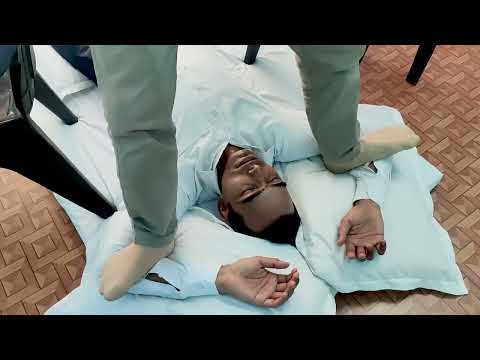
Round Arrow is a Neurotherapy (LMNT) treatment worked along both sides of the spine, from the base of the neck to the lower back and back up again, while you lie face down. It is the partner of Chest Only: Chest Only lowers alkali, Round Arrow lowers acid, and given together they keep the body's acid–alkali balance where the formula has set it.
Overview
What is Round Arrow?
Round Arrow is one of the arrow family — six treatments worked along or beside the spine, each differing in tool, path, direction and count. Its name describes its journey: down one side of the spine, round at the lower back, and up the other side, without a break. On a card it is drawn as an upward arrow, a bar and a downward arrow.
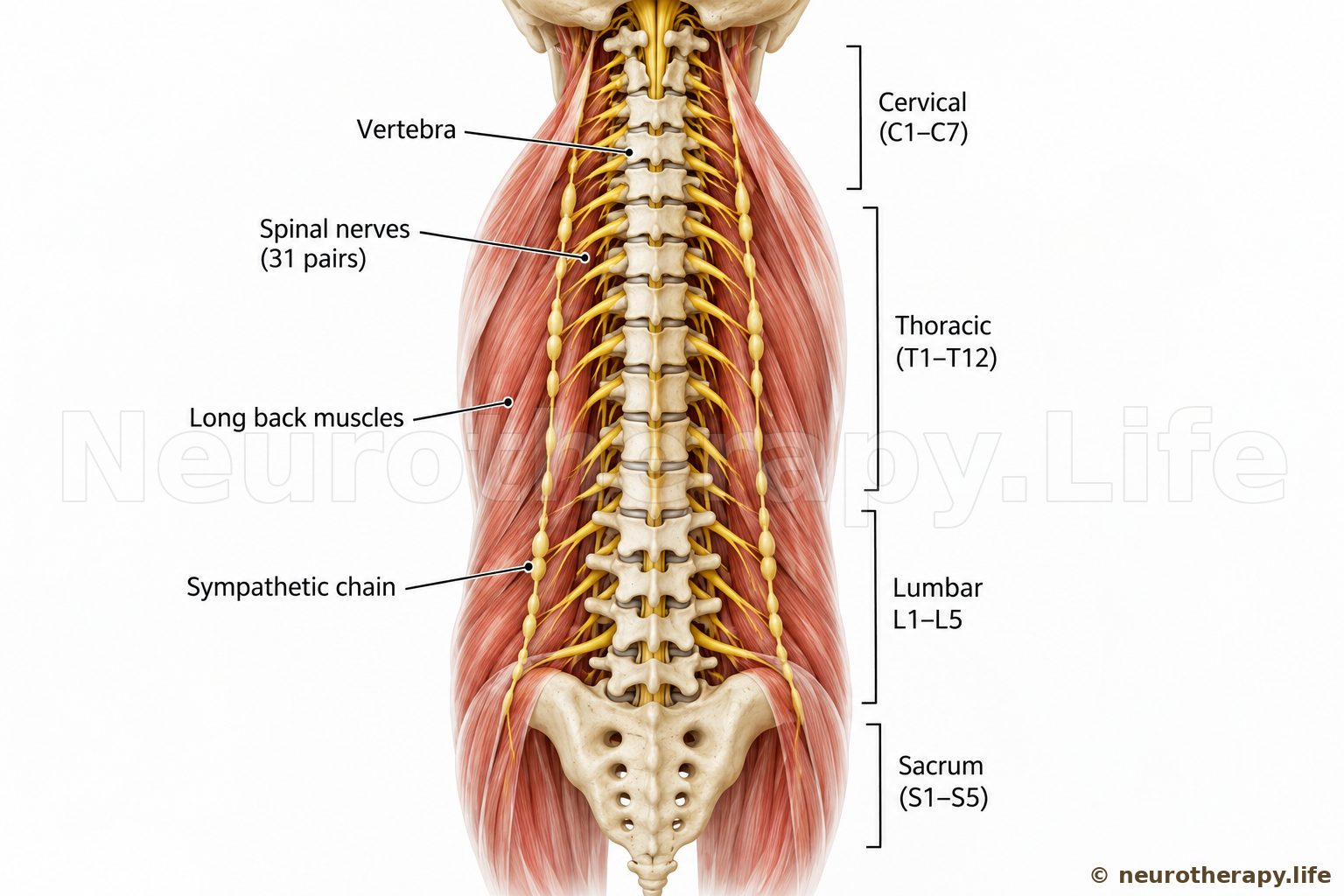
Your spine is a column of bones (vertebrae) stacked like beads, with the spinal cord inside. Between each pair of beads, a spinal nerve leaves on each side — 31 pairs in all — and runs out to the skin, muscles and organs. Beside the column lie long muscles and, deeper, a chain of nerve knots that helps run the organs automatically.
In LMNT teaching, Round Arrow stimulates the 31 pairs of nerves of the spine, and from it acid is also reduced. Its chief job is balance. It almost always comes at the end of a formula, straight after Chest Only, so that the formula does not leave the patient tipped too far to the acid side.
A spinal nerve leaves between every pair of vertebrae on both sides. Round Arrow works the strip beside the column where they run.
Where it is given
Where is Round Arrow given?
PositionLying face down
Body areaBoth sides of the spine, from below the neck to the lower back (L5); in diabetes and chronic illness, the lower back (L1–L5) only
You lie face down, with pillows arranged under the chest so that the chin rests on the pillow and the head stays straight, not turned to one side. This pillow arrangement is compulsory for every face-down treatment.
It is given along both sides of the spine, from just below the neck down to the lowest bone of the lower back (L5), on the soft muscle strip right beside the bony bumps — never on the bumps themselves.
In some patients it is given only over the lower back, from L1 to L5. This shortened form is written (L1–L5) after the arrow, and is the rule in diabetes and in chronic illness.
How it is given
How is Round Arrow given?
How this point is given — the tool, the pressure, the count and the exact movement — is deliberately not described here. Watch the demonstration video on this page, and learn the method hands-on from a trained Neurotherapist before giving it. Please do not give any point from a written description alone: a point given in the wrong place or the wrong way can do harm.
The number written before a point's name is not a strength setting. Each numbered form is a separate named treatment with its own method and timing, taught hands-on in the course.
Its partnerChest Only — the two are given as a matched pair
The exact technique is taught hands-on in the Neurotherapy (LMNT) course. See the course →
What it does
What does Round Arrow do in the body?
Guruji's observation is simple: Chest Only reduces alkali, so the signs of acid rise; Round Arrow reduces acid, so the signs of alkali rise. Matched by their counts, the two hold the balance. Because the therapy treats the condition of the body rather than the disease, the pair can also be deliberately tipped one way or the other to suit what the patient's body needs that day.
Stimulates the 31 pairs of spinal nerves along the column, in LMNT teaching.
Reduces acid, balancing the alkali-lowering effect of Chest Only.
Helps patients whose disease is one of acid, such as constipation and piles, where it is named among the treatments that benefit them.
Clears leftover pain at Mu° (the left kidney point): when Mu° is still sore after Ku, Round Arrow is given until that soreness clears.
Closes formulas for the kidneys, the lower belly and the joints, so they end in balance.
Organs it reaches
Spine — The column of bones whose sides the arrow travels.
Spinal cord — Sends out the 31 pairs of spinal nerves the treatment aims at.
Kidneys — Round Arrow closes the Kidney Clear formulas and settles pain at Mu°.
Low back — The lower back, where the shortened form is given.
Adrenal glands — The full arrow is held to provoke the adrenals and the thymus — the reason for the shortened form in diabetes.
Its family
Which points are related to Round Arrow?
Round Arrow belongs to the arrow family of the back, and to one of the inseparable pairs of the therapy, with Chest Only.
Ch. Only — Its partner. Chest Only lowers alkali; Round Arrow lowers acid. Neither half is given without the other.
On the Spine — A sister arrow worked on the spinal bones themselves.
Beside the Spine — A sister arrow worked with two fingers straddling the spine.
Three Arrows — A shorthand for On the spine, Beside the spine and Round Arrow together.
Back Arrow — The arrow from the mid-back out to the shoulder and arm.
H Arrow — The short upward arrow at the base of the neck.
Organ Clearance — Another back treatment worked along the spine.
(4) Ku — If Mu° pain remains after Ku, Round Arrow follows until it clears.
What it is used for
What is Round Arrow used for?
Round Arrow is rarely given alone. It is used through the formulas it closes, and is named directly for a few acid-side problems.
Bowel and the back passage
ConstipationConstipation is a disease of acid; Round Arrow is among the treatments that benefit it.
Replaces the thymus work, in its lower-back form, when there is diabetes, arthritis or an auto-immune disorder.
Safety: when it is held back
Diabetes and chronic illness: the full Round Arrow is held to provoke both the thymus and the adrenal glands, and some chronic patients can be harmed by one or the other. In these patients every arrow is given only over the lower back, from L1 to L5. Diabetes
Never break the pair. Chest Only given without Round Arrow is not a shorter treatment — it is an acid-raising treatment the patient was not diagnosed to need. If a session must be shortened, a smaller matched pair is given, never one half alone. Four pairs of treatments that must always be given together
Kidney stone with pain: Thymus + Chest is given in place of Chest Only and Round Arrow. That swap brings in the thymus, with its own long list of bars — not in pregnancy, heart disease, diabetes, auto-immune or kidney disease. Kidney stones
Formulas that run the arrow in reverse order (the Ulta formulas) are given for a limited time only, and then the Normal formula brings the body back. Ulta Kidney Clear
Pressure goes beside the spinal bones, never on them. Thin bones (osteoporosis) or long-term steroid use call for extra care and a gentle hand. Osteoporosis
Stop and send to hospital the same hour: numbness in the saddle area, new trouble passing or holding urine, loss of bowel control, or weakness in both legs. See a doctor before any spinal pressure if back pain comes with fever, a cancer history, unexplained weight loss, night pain, or a new sharp pain in thin bones. How to tell a patient to see a doctor
“During sixty years of tapasya it was found that one and the same formula does not apply to all patients. Changing the treatment according to the condition of the patient will give greater benefit.”
— Dr. Lajpatrai Mehra
“If the blood circulation is increased above the navel, below it, in front of it and behind it — on all sides — then the pain will come out of itself.”
— Dr. Lajpatrai Mehra
A teaching case
Teaching case: the Mu° that would not settle
A teaching case, put together from several patients: a schoolteacher in her forties with morning stiffness in both hands and knees was given Ku for stiffness, after her blood pressure had been checked lying and standing. After a few sessions her left flank ached and Mu° was sorer than before — exactly what the teaching expects. Round Arrow was added and given until that tenderness cleared over the next sessions, and her stiffness kept improving while she continued her own doctor's tablets.
A composite case written to teach the reasoning — not one patient’s file.
Common questions
Why is it called Round Arrow?
Because of its path: it goes down one side of the spine, turns round at the lower back, and comes up the other side in one unbroken journey. On a card it is drawn with an up arrow, a bar and a down arrow.
Is Round Arrow a spinal adjustment, like a chiropractor's?
No. Nothing is cracked or pushed into place. It is a travelling pressure in the soft muscle beside the spine, given to balance acid and alkali and to stir the spinal nerves.
Why is it always given after Chest Only?
Because the two are a balanced pair. Chest Only lowers alkali and Round Arrow lowers acid; together, matched by their counts, they keep the balance the formula has set. In a few reversed formulas the order is swapped on purpose.
I have diabetes. Can I receive it?
Yes, in its shortened form, over the lower back only (L1–L5). The full arrow is held to provoke the thymus and adrenal glands, so it is not used in diabetes or chronic illness.
Should it hurt?
It should feel firm but bearable. Sharp pain usually means the pressure has drifted onto the bone; tell the therapist at once. New back pain that starts with treatment and eases between sessions should also be reported.
Surprising facts
131 pairs of spinal nerves
Your spinal cord sends out 31 pairs of nerves: 8 in the neck, 12 in the chest, 5 in the lower back, 5 from the sacrum and 1 from the tailbone. Each pair supplies its own strip of skin and muscle.
Source: Gray's Anatomy (41st ed.), spinal nerves.
2The cord stops before the spine does
In adults the spinal cord ends at about the first or second lumbar bone. Below that, the canal holds a bundle of loose nerve roots that looks like a horse's tail — its Latin name, cauda equina, means exactly that.
Source: Gray's Anatomy (41st ed.), spinal cord.
3A string of beads beside the spine
On each side of the spinal column runs the sympathetic chain, a line of small nerve knots joined like beads. It helps run the heart, gut, sweat glands and blood vessels without you thinking about it.
A baby has about 33 separate vertebrae. As we grow, the five at the base fuse into one sacrum and the last few fuse into the tailbone, so an adult spine has about 26 separate bones.
The erector spinae muscles run in long columns beside the spine, from the pelvis all the way up to the base of the skull. They hold you upright all day — and they are the soft strip a back treatment like Round Arrow works on.
Source: Gray's Anatomy (41st ed.), muscles of the back.
Watch
NEW GENES FORMULA - LMNT Neurotherapy
A step-by-step demonstration, in Hindi, of the New Genes formula: (8) Pan at the thigh–hip crease, (6) WD on both forearms, (8) Ch. Only and the Round Arrow, with the patient's position and how each count is kept.
UTI PROLONGED - WITH INFLAMATION - LMNT Neurotherapy
A Hindi demonstration of the treatment given when a urine infection has gone on long enough to become inflamed: Liv° and Mu°, Chest Only, 20 Round Arrow along the spine, then (6) Adr on the back.
A urine infection — especially with fever, loin pain or blood in the urine — needs a doctor first. (6) Adr is not given with high blood pressure or when immunity is already low; the video does not say this.
Test yourself
Research
Emerging evidence
A Cochrane review of 25 trials found that massage of the back eased pain and improved function in low back pain in the short term, but the quality of the evidence was low, and long-term benefit is uncertain. It tells us hands-on back work can help for a while — not how Round Arrow works.
This page explains what a Neurotherapy (LMNT) treatment is for; it is not a self-treatment guide and does not diagnose. Neurotherapy (LMNT) works alongside your medical care — keep taking the medicines your doctor prescribed.
Ready to begin?
Send COURSE for course details, or your name, age and health issue for a consultation.