The thymus is a small gland behind your breastbone that runs the strictest school in your body. Young defence cells arrive from the bone marrow, and only a few in every hundred pass its tests — learning to attack germs but leave your own body alone. Its work is largely done in childhood, and then, unlike almost every other organ, it slowly fades away.
Overview
What is the thymus?
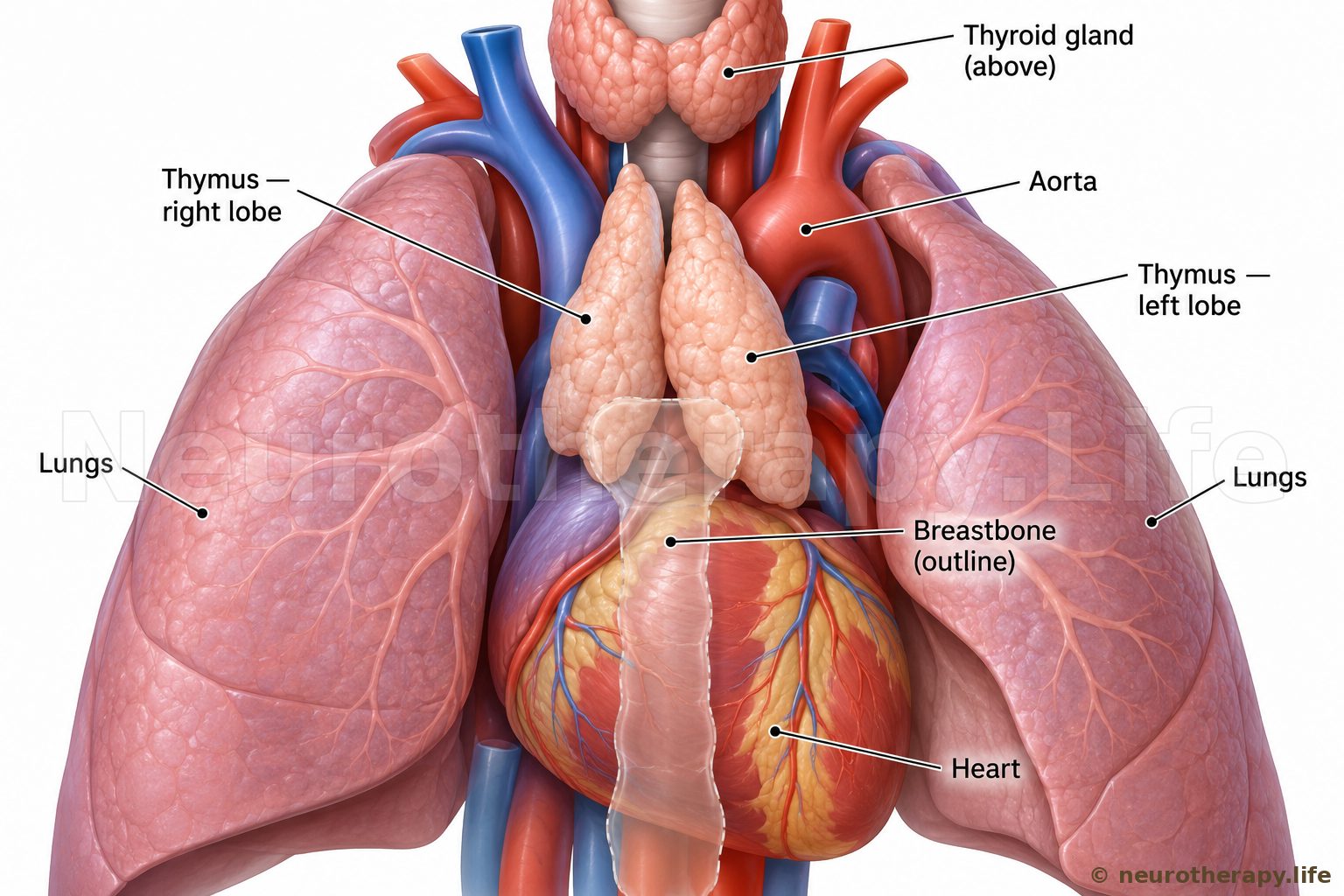
The thymus is a soft, two-lobed gland in the upper chest, behind the breastbone and in front of the heart. It is part of both the immune system and the glands (endocrine) system.
Its main job is to train T cells — the white blood cells that direct the body's defence and destroy infected cells. The 'T' in T cell stands for thymus. It also makes small hormones, such as thymosin, that help T cells grow up.
The thymus is largest and busiest in childhood. After puberty it slowly shrinks and is replaced by fat, but by then it has trained a supply of T cells that lasts for life. In LMNT, 'Thymus' is also the name of a point on the breastbone, one of the six points of immunity.
The thymus sits behind the breastbone, lying on the heart and its great vessels — shown here as it looks in a child.
Function
What does the thymus do?
Young T cells are born in the bone marrow but cannot yet tell friend from foe. They travel to the thymus, where they are tested twice: first, can they recognise danger at all? Second, do they leave the body's own cells alone? Those that fail are removed. The few that pass leave as trained helper and killer T cells.
Trains T cells to recognise germs and infected cells.
Removes T cells that would attack the body's own tissues — the first guard against autoimmune disease.
Sends out two main kinds: helper T cells, which direct the defence, and killer T cells, which destroy infected cells.
Also trains 'regulatory' T cells that calm the defence down when the job is done.
Makes hormones such as thymosin and thymulin that help T cells mature.
Arrival from the bone marrow
Young, untrained cells travel in the blood to the thymus and settle in its outer layer, the cortex.
First test: can you see danger?
Each cell must be able to recognise the body's 'ID tags' on which germs are shown. Cells that cannot are left to die.
Second test: do you spare the body?
In the inner layer, the medulla, cells are shown samples of proteins from all over the body. Any cell that reacts strongly against them is removed.
Graduation
Only a few in every hundred pass both tests. They leave as helper, killer or regulatory T cells.
Out to the posts
The new T cells travel to the lymph nodes, the spleen and the gut, where they wait to meet germs.
How does the thymus work with other organs?
Blood — The bone marrow sends the thymus its young cells, and the trained T cells travel out in the blood.
Lymph nodes — The graduates are posted to the lymph nodes, where they meet germs brought in with the lymph.
Spleen — The spleen also receives trained T cells and uses them to guard the blood.
Glands and hormones — The thymus makes its own hormones, and the sex hormones of puberty help drive its shrinking. In LMNT teaching, (6) Adr and the thymus pull in opposite directions on immunity.
Heart — The thymus lies directly on the front of the heart. LMNT teaching therefore does not give Thymus to heart patients.
Lymph and immunity — The thymus is one of the organs of the lymph and immune system, with the nodes, the spleen and the bone marrow.
Anatomy
What are the parts of the thymus?
The thymus has two lobes wrapped in a thin capsule. Each lobe is divided into many small lobules, and each lobule has an outer cortex and an inner medulla.
Structure
Two lobes — A right and a left lobe, joined in the middle, lying side by side on the heart.
Capsule — A thin coat of connective tissue that sends walls inward, dividing each lobe into lobules.
Cortex — The dark outer layer of each lobule, packed with young T cells taking their first test.
Medulla — The paler inner layer, where the second test takes place and the graduates leave.
Hassall's corpuscles — Small onion-like whorls of cells in the medulla, found only in the thymus; they help guide the training.
The cells it trains
Helper T cells (CD4) — The commanders: they switch on B cells and killer cells. HIV destroys these cells.
Killer T cells (CD8) — Destroy cells infected with viruses, and some cancer cells.
Regulatory T cells — The peace-keepers: they calm the defence down and help stop it turning on the body.
Its hormones
Thymosin and thymopoietin — Help young T cells develop and mature.
Thymulin — A zinc-dependent hormone that supports T-cell function.
Where is the thymus located?
The thymus lies in the upper front of the chest, just behind the breastbone (sternum), in the space between the two lungs. It rests on the top of the heart and on the large blood vessels that leave it. In babies and young children it can reach up into the lower neck, towards the thyroid.
Do not confuse it with the thyroid: the thyroid is a butterfly-shaped gland in the front of the neck; the thymus is lower down, inside the chest.
This position matters in LMNT. The Thymus point is given on the breastbone itself — directly over the gland and very close to the heart. That is why Guruji's teaching does not give Thymus or Loveleen to heart patients.
In a child the thymus is a soft, pinkish-grey organ with two lobes, often compared to a small bow tie or two flat leaves lying on the heart. On a baby's chest X-ray it can even look like a triangular sail beside the heart.
With age it becomes yellowish as fat replaces most of the gland tissue. In an older adult a surgeon often finds mostly fat, with small islands of working thymus left inside.
How big is the thymus?
At birth the thymus weighs about 10 to 15 grams — large for the size of a baby. It keeps growing through childhood and reaches its greatest weight, about 30 to 40 grams, around puberty.
After that its working tissue shrinks year by year. The organ may keep some of its outer size because fat fills the space, but by old age only a small fraction of active thymus remains.
Conditions and disorders
What conditions and disorders affect the thymus?
Thymus problems are uncommon, but when its training fails, the effects can reach the whole body: too few T cells leave the body open to infection, and poorly trained ones can attack the body itself.
When the training of T cells fails
Autoimmune disordersT cells that should have been removed in the thymus escape and attack the body's own tissue.
Myasthenia gravisAn autoimmune muscle weakness closely linked to the thymus; many patients have an enlarged thymus or a thymus tumour, and removing it helps many.
DiabetesType 1 diabetes is an autoimmune attack on the insulin-making cells. LMNT teaching groups diabetes with the autoimmune disorders and does not give Thymus in it.
When T cells are too few
HIV/AIDSHIV destroys the helper T cells that the thymus trains.
Genetic disordersSome babies are born with a very small thymus or none at all (for example in DiGeorge syndrome) and suffer severe infections.
InfectionsWeak T-cell defence lets viral and other infections take hold more easily.
Shingles (herpes zoster)The chickenpox virus wakes up when T-cell control weakens with age or illness.
Often none — many thymus problems are found by chance on a chest scan
Drooping eyelids, double vision, or muscle weakness that gets worse with use and better with rest (myasthenia gravis)
A cough, chest pain or pressure, or breathlessness from a growth pressing on the airways
Swelling of the face, neck and upper arms with visible veins on the chest (pressure on a large vein)
In a baby or child, repeated severe infections that are hard to clear
What tests check the thymus?
Chest X-ray — May show a widened area in the middle of the chest.
CT or MRI scan of the chest — Shows the thymus's size and any growth clearly.
Antibody tests for myasthenia gravis — Blood tests for antibodies (such as acetylcholine-receptor antibodies) that block the nerve signal to muscles.
T-cell counts — For example the CD4 count, which shows how many helper T cells there are — used in HIV care.
Biopsy — A small sample of a growth is taken to find out what it is.
How are thymus conditions treated?
Thymectomy — Surgery to remove the thymus — for a thymoma, and for many people with myasthenia gravis.
Medicines for myasthenia gravis — Medicines that help nerve signals reach the muscles, and others that calm the immune system — prescribed by a neurologist.
Cancer treatment — Surgery, radiotherapy or chemotherapy for thymic tumours, led by a cancer specialist.
HIV treatment — Antiretroviral medicines let the helper T-cell count recover.
Specialist care for babies born without a thymus — Protection from infection and, in rare cases, thymus tissue transplant in specialist centres.
Neurotherapy (LMNT)
In LMNT teaching the thymus is worked on the breastbone, and it comes in three named forms: Th. Only (the breastbone alone), Thymus + Chest (breastbone, chest and armpit), and Ch. Only (the chest without the thymus). Thymus is given to raise the body's disease-resisting power; Thymus + Chest is taught as a pain-reliever after a blow and to help wounds fill. Because it raises immunity, it has one of the longest lists of people who must not have it — pregnancy, heart disease, diabetes, kidney disease, rheumatoid arthritis, inflammation and every autoimmune disorder. The word 'Only' in Ch. Only exists precisely so that chest work can be given to these patients with the thymus taken out.
Points
Th. Only — The breastbone alone: three rubs a side, with no pressure at all and no rub on the way back. Used inside the viral formulas.
Th + Ch — Three rubs in the middle of the left chest, three from chest to shoulder, two through the armpit to the middle of the upper arm; then the same on the right. The patient's face is turned away from the side being treated, and the armpits must always be included. (2), (3), (4) mean 6, 9, 12 rubs a side.
Ch. Only — The chest without the thymus and without the armpits. It is not barred in inflammation or autoimmune disease, so it replaces Thymus + Chest in those patients.
Armpit — Given without fail whenever Thymus + Chest is written.
(6) Adr — Pulls the other way: giving Adr makes the thymus work less. In the Anil Sharma treatment, after every four treatments one treatment gives (4) Thymus + Chest in place of (6) Adr so that immunity does not fall.
Loveleen — Like Thymus, not given to heart patients, because it is given very close to the heart.
Built as a ramp: part II gives (4) Ch. Only, part III (4) Thymus + Chest, part IV (8) Thymus + Chest — the chest is opened before the thymus is asked for anything. In diabetes, arthritis or any autoimmune disorder, Ch. Only with the Round arrow at L1–L5 replaces Thymus + Chest.
An acid-reducing treatment ending in (6) Adr, with the rule that after every four treatments, one treatment gives (4) Thymus + Chest in place of (6) Adr to protect immunity.
“Whether or not the patient gets immediate benefit from our treatment, let no harm reach him through our carelessness — attend to this.”
— Dr. Lajpatrai Mehra
“The research is still to be done.”
— Dr. Lajpatrai Mehra
“We cannot provoke the organs in an order of our own choosing.”
— Dr. Lajpatrai Mehra
Never do this
Thymus and Thymus + Chest are not given in pregnancy (the teaching observed the baby moving about vigorously afterwards), nor in polio, inflammatory disease, heart disease, diabetes, rheumatoid arthritis, any autoimmune disorder or kidney disease. Th + Ch
Whenever Thymus + Chest is written, the armpits are given too; Th. Only is a rub with no pressure at all, and no rub is given on the return stroke. Th. Only
In diabetes, arthritis or any autoimmune disorder, Ch. Only (with the Round arrow at L1–L5 only) replaces Thymus + Chest — in diabetes the full Round arrow is held to provoke the thymus and the adrenal too. Injury treatment formula
Emergency: chest pain or pressure, sudden breathlessness, or trouble breathing or swallowing in someone with myasthenia gravis — call 108/112. Neurotherapy (LMNT) is never first aid for these. Myasthenia gravis
Swelling of the face and neck with swollen veins on the chest, or a growth found on a chest scan, needs a doctor promptly — it is never treated on the mat. How to tell a patient to see a doctor
Cancer: if the person has cancer, (10) Pan, Thymus, Pit, Lu + Sh, Rt. Ov / Lt. Ov and (30) Medulla are never given — the therapist changes the plan. Cancer care: Neurotherapy (LMNT) support
Keep taking the medicines your doctor prescribed — including medicines for myasthenia gravis, HIV or diabetes. Neurotherapy (LMNT) works alongside your medical care, never instead of it.
Care
How can I keep my thymus and T cells healthy?
You cannot stop the thymus shrinking with age — that is normal. But you can look after the T cells it has already trained.
Eat enough protein and a varied diet
Defence cells are built from protein, and zinc is needed for the thymus hormone thymulin. Pulses, milk, curd, nuts and seeds help — and in LMNT teaching it matters just as much that the food is digested.
Sleep and rest
Most adults need 7 to 9 hours. Poor sleep and long-lasting stress both damp down the immune response.
Stay active
Regular moderate activity supports the immune system at every age.
Take the vaccines you are advised
Vaccines give your trained T cells and B cells a safe rehearsal.
Avoid tobacco and excess alcohol
Both weaken the body's defences.
Tell every therapist about pregnancy and heart disease
These change which chest points can be given to you.
Common questions
Does an adult still have a thymus?
Yes, but much of it has turned to fat. Small islands of working tissue remain and keep making some new T cells, though far fewer than in childhood. The T cells trained earlier in life keep the body protected.
Can you live without a thymus?
Yes. Part of the thymus is often removed in children during heart surgery, and adults have it removed for a thymoma or myasthenia gravis. A large 2023 study found that adults who had it removed had somewhat higher long-term risks of infection-related problems and cancer, so doctors weigh the reasons carefully.
Is the thymus the same as the thyroid?
No. They sound alike but are different glands. The thyroid sits in the front of the neck and controls the body's speed of working (metabolism). The thymus sits lower, behind the breastbone, and trains T cells. LMNT has separate points for each — Thrd and Thymus.
Why is Thymus not given in pregnancy?
LMNT teaching records that after Thymus or Thymus + Chest the baby begins to move about vigorously, from which it judged that the baby may be uncomfortable. So both are withheld throughout pregnancy.
What is the difference between Th. Only, Ch. Only and Thymus + Chest?
Th. Only is the breastbone alone. Ch. Only is the chest without the thymus and without the armpits. Thymus + Chest is all three — breastbone, chest and armpit. Ch. Only exists so that a patient in whom the thymus is barred can still receive chest work.
Why is Thymus not given in autoimmune disease?
In autoimmune disease the defence is already attacking the body. The thymus point is given to raise immunity, which is the last thing wanted then. LMNT teaching blocks it — and the other immunity points — for as long as the chief symptoms last.
What should I ask my doctor or therapist?
Was anything seen near my thymus on my chest scan, and does it need follow-up?
Could my muscle weakness or drooping eyelids be myasthenia gravis?
Is my condition autoimmune, and what does that mean for my treatment?
If my thymus was removed, is there anything I should watch for?
(To the therapist) Is Thymus or Thymus + Chest blocked for me, and what is given instead?
Surprising facts
1The gland that is meant to disappear
Almost every organ is built to last you a lifetime. The thymus is not. It is at its largest around puberty and then shrinks on a schedule — not from disease — until in later life a surgeon finds mostly fat where it used to be.
Source: Gray's Anatomy — thymic involution; Palmer DB, Front Immunol 2013;4:316; LMNT source 17.8-4 DID YOU KNOW.
2The 'T' in T cell stands for thymus
Scientists named the body's commanding defence cells after the school that trains them. Their partners, the B cells, were first named after a bird organ called the bursa — and the letter happily fits 'bone marrow', where human B cells mature.
Source: Janeway's Immunobiology — origin of the terms T cell and B cell.
3One of the last organs to have its job discovered
For centuries the thymus was thought to be a useless leftover. Only in 1961 did Jacques Miller show that mice without a thymus from birth could not defend themselves against infection — revealing what it was for.
Source: Miller JFAP, 'Immunological function of the thymus', Lancet 1961; Miller JFAP, Science 2020;369:eaba2429.
4The strictest school in the body
Of all the young T cells that enter the thymus, only a few in every hundred pass both tests and leave. The rest are removed because they either cannot recognise danger or would attack the body itself.
Source: Janeway's Immunobiology — positive and negative selection; most thymocytes die in the thymus.
5It keeps a photo album of your whole body
How can a gland in the chest teach T cells not to attack the pancreas or the eye? A special switch in the thymus (a gene called AIRE) makes its cells display small samples of proteins from all over the body — even insulin — so that dangerous T cells can be caught before they leave.
Source: Anderson MS et al., Science 2002;298:1395–1401 (AIRE and the 'self shadow' in the thymus).
6A baby's thymus can look like a sail
In infants the thymus is so large that on a chest X-ray it can stick out beside the heart in a triangle shape. Doctors call this the 'sail sign' — a normal finding, not a disease.
For decades an adult thymus was thought to be unimportant. In 2023 a study of over a thousand adults who had it removed found higher long-term rates of death, cancer and some autoimmune problems than in similar patients who kept it.
Source: Kooshesh KA et al., N Engl J Med 2023;389:406–417.
Yoga
Cobra pose Bhujaṅgāsana
Benefits
Opens the front of the chest and shoulders, which get closed and rounded from long sitting.
Strengthens the muscles of the back and improves posture.
Helps a fuller, easier breath.
How to do it
Lie face down, legs together, forehead on the mat.
Place the palms flat beside the chest, elbows close to the body.
Breathing in, slowly lift the head and upper chest, using the back muscles more than the arms.
Keep the hips and legs on the mat and the elbows a little bent. Hold for a few breaths.
Breathing out, come down slowly. Repeat 3 to 5 times.
Take care
Do not do it in pregnancy, with a hernia, after recent abdominal surgery, or with a back injury or back pain that shoots down the leg. Lift only as far as is comfortable.
Gently opens the chest and front of the shoulders without any effort.
Deeply restful; helps the body shift out of stress mode.
Suitable for older people and those who find backbends hard.
How to do it
Roll a blanket firmly and place it lengthwise on the mat.
Sit at one end and lie back so the roll runs along your spine from the lower back to the head; put a small towel under the head.
Let the arms rest out to the sides, palms up, and the legs relax.
Breathe slowly for 3 to 5 minutes.
To come out, bend the knees, roll onto one side and get up slowly.
Take care
Use a thinner roll if you feel strain in the lower back or neck. Skip it in late pregnancy or if lying on the back makes you dizzy or breathless.
Humming bee breath Bhrāmarī
Benefits
Slows the breath and calms the mind — long-lasting stress weakens the body's defences.
Easy for all ages, including children.
Can be done anywhere in a few minutes.
How to do it
Sit comfortably with a straight back and close your eyes.
Gently press the small flaps in front of the ears with your index fingers.
Breathe in through the nose.
Breathing out slowly, make a steady, low humming sound like a bee, with the mouth closed.
Repeat 5 to 7 rounds, then sit quietly for a minute.
Take care
Never force the breath or press hard on the ears. Skip it with an active ear infection. Stop if you feel dizzy.
Watch
Injury Treatment in Neurotherapy | LMNT Formula for Sprains, Bruises & Ligament Healing
A full Hindi demonstration of the Injury formula: 60 Toe-Finger twists on the third and fourth toes of the left foot, three rounds; then Gal, Liv and Chest Only; then Gal, Liv, Thymus and Chest with the armpits, at four and at eight — a minute's gap between parts, and only as much weight as the patient can bear.
Treatment for Pain Due to Fibroid in Uterus | LMNT Neurotherapy
A demonstration, in Hindi, for period pain where a fibroid is present: (30) Medulla, then (3) WD on both forearms, and Thymus + Chest.
A fibroid must be followed by a doctor. (30) Medulla is not given to heart patients; Thymus + Chest is not given in pregnancy, diabetes, heart, kidney or autoimmune disease; WD is not given in cancer.
Test yourself
Research
Strong evidence
Comparing 1,146 adults who had their thymus removed during surgery with similar patients who kept it, researchers found higher death rates and more cancer after five years in the thymus-removed group, and in some patients more autoimmune disease.
In a randomised trial of people with myasthenia gravis, those who had their thymus removed plus medicine had better muscle strength and needed less steroid medicine over three years than those who had medicine alone.
Researchers showed that a gene called AIRE makes thymus cells display proteins normally found only in other organs, so that T cells that would attack those organs are removed; without it, mice developed autoimmune disease in many organs.
This page explains how the body works; it does not diagnose. Neurotherapy (LMNT) works alongside your medical care — keep taking the medicines your doctor prescribed, and see a doctor for any new or severe symptom.
Ready to begin?
Send COURSE for course details, or your name, age and health issue for a consultation.