1You can live without it
People can live without a spleen — other organs take over much of its filtering — but they are more open to certain serious infections and are offered extra vaccines.
Source: NHS, Living without a spleen.
Also called: Spleen, Spleen point, तिल्ली, स्प्लीन पॉइंट
Spl is the Neurotherapy (LMNT) point named for the spleen. It is given on the front of the right thigh while you lie on your back, and it works on the region above and to the left of the navel — the spleen and two stretches of the large bowel. It is part of the Normal formula, and it is deliberately left out for people with autoimmune disease, asthma, allergy, diabetes or cancer.
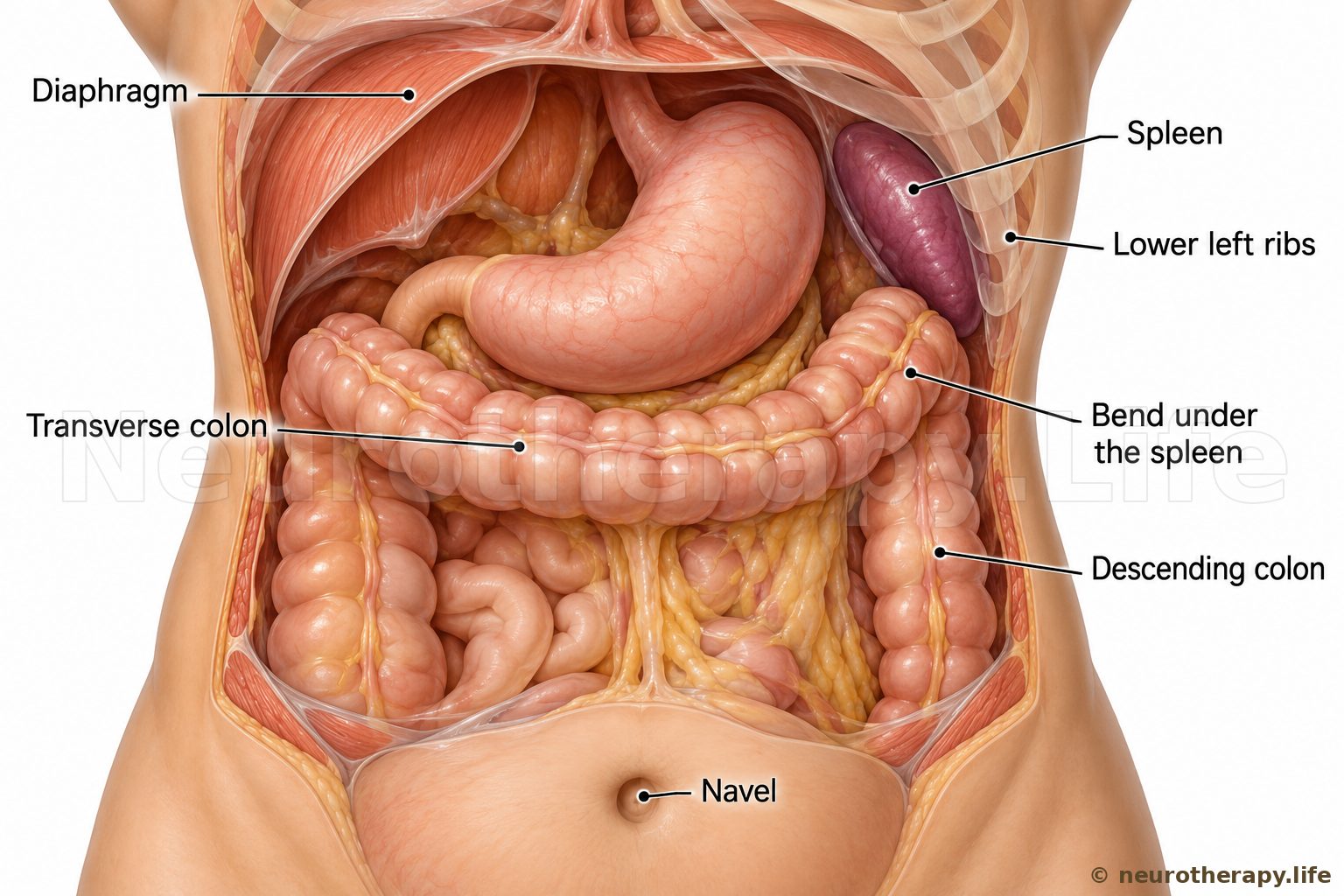
Spl is short for spleen. The spleen is a soft organ about the size of a fist, tucked high on the left side of the belly behind the lower ribs and under the diaphragm. It filters the blood, removes worn-out red cells, and houses many white cells — the cells that make antibodies and fight infection.
In Neurotherapy (LMNT), a point's name is like a postal address, not a description of the parcel. Spl is named after the chief organ of its region — above and to the left of the navel — but when it is given, blood flow increases in everything in that region: the spleen, the left end of the transverse colon and the start of the descending colon (parts of the large bowel).
So Spl has two lives. In digestive formulas it is used for the bowel — for constipation. In defence formulas it is used for the spleen's white cells and antibodies — for viral fever and infections. And because it raises the activity of white cells, it is kept away from people whose defences are already overactive.
You lie on your back with one pillow under both thighs. If the legs tend to roll outward, a pillow is placed against the outer side of the legs to support them, so the muscles can stay relaxed.
Spl is given on the front of the right thigh, along a line from just below the hip to just above the knee. Why the right thigh, when the spleen is on the left? LMNT's map crosses: pressure on the legs answers pains above the navel, and Spl is the mirror partner of Gal, which is given on the left thigh.
During examination the therapist also feels for tenderness at the Spl area of the belly, above and to the left of the navel. A firm, tender fullness under the left ribs is not treated — it goes to a doctor.
How this point is given — the tool, the pressure, the count and the exact movement — is deliberately not described here. Watch the demonstration video on this page, and learn the method hands-on from a trained Neurotherapist before giving it. Please do not give any point from a written description alone: a point given in the wrong place or the wrong way can do harm.
The exact technique is taught hands-on in the Neurotherapy (LMNT) course. See the course →
Neurotherapy (LMNT) teaching gives Spl two kinds of work: stimulating the upper part of the descending colon, and making white cells and antibodies through the spleen. Body science confirms the spleen really is a store of white cells and a filter of the blood; how a press on the thigh reaches it is the therapy's own explanation, from long clinical experience.
Spl belongs to the supine digestive points and works as a pair with Gal.
Spl is chosen by findings, not by disease name alone — and the blocked list is checked first, because Spl has more bars than most digestive points.
The first formula ever made: Spl is one stop on its route along the large bowel.
The Normal formula with Spl deliberately left out — for absorption, and safe in autoimmune disorders.
The Normal points given in a deliberately changed order, to firm up loose motions.
The Left Side Treatment Formula for long-standing constipation; Spl works the top of the left-side run.
The light viral formula for staying well, with a single point of Spl.
Spl is left out — and brought back only if the Spl point is tender.
The Normal territory swept quickly, including the Spl ground.
The lighter balance formula for ordinary constipation.
“In this formula the point Spl has not been given in order to stimulate the spleen, but rather for that part of the large intestine.”
“In cold, allergy, asthma and the like this does harm — so do not give it to asthma patients.”
No. It is given on the right thigh; nothing touches the spleen, which lies behind the left ribs. The name is an address for a region of the belly, not the place of pressure.
Probably because you have asthma, allergy, diabetes, an autoimmune disorder or cancer — or your therapist chose Ajay Normal, which leaves Spl out on purpose. The blank space is part of the prescription.
The large bowel bends right under the spleen. Spl increases blood flow in that whole region, so in constipation work it is given for that part of the bowel, not for the spleen.
No. In asthma Spl does harm, whatever the other reason. Your therapist will choose other points, and fever with breathlessness needs a doctor.
People can live without a spleen — other organs take over much of its filtering — but they are more open to certain serious infections and are offered extra vaccines.
Source: NHS, Living without a spleen.
Red blood cells live about 120 days. Old, stiff ones get caught in the spleen's narrow passages and are broken down there.
Source: Mebius RE, Kraal G. Structure and function of the spleen. Nat Rev Immunol. 2005;5:606–616.
A normal spleen hides under the left ribs and cannot be felt by a doctor's hand. If it can be felt below the ribs, it is enlarged.
Source: Gray's Anatomy, 41st ed., Spleen.
The large bowel makes a high, sharp turn under the spleen — the splenic flexure — where gas often gathers and causes pain felt under the left ribs.
Source: Gray's Anatomy, 41st ed., Large intestine.

A short Hindi practical demo by Dr. Diwakar Shukla of the Spl (spleen) point: the patient lies on the back with a pillow under the thighs, three stations are marked down the side of the thigh starting about three finger-breadths below the groin, and each is pressed for six seconds without long gaps. One pass is (1) Spl; the pass is repeated for (2) and (3) Spl.

Shows the Normal treatment given with the feet: (8) Pan at the top of the thighs, then (3) Gal, (3) Spleen, (7) Liv and (5) Mucus on the thighs and forearms, without breaks. It is used to support digestion.
This page explains what a Neurotherapy (LMNT) treatment is for; it is not a self-treatment guide and does not diagnose. Neurotherapy (LMNT) works alongside your medical care — keep taking the medicines your doctor prescribed.
Send COURSE for course details, or your name, age and health issue for a consultation.