Also called: Gal-Spl ghisai, Gal Spl Ghisai, गॉल–स्प्लीन घिसाई
Gal–Spl Ghisai is a gentle Neurotherapy (LMNT) rubbing treatment given at the outer rim of both hip bones while you lie on your back. The teaching uses it to correct blockage in the lymph nodes and to reduce swelling in the leg — especially in people who wear tight trousers.
Overview
What is Gal–Spl Ghisai?
The name records where the method came from. Gal and Spl are the gall bladder and spleen points of the front of the body, and ghisai is the therapy's word for a rubbing, sliding action rather than a still press. Gal–Spl Ghisai is that pair of actions carried out at the rim of the pelvis.
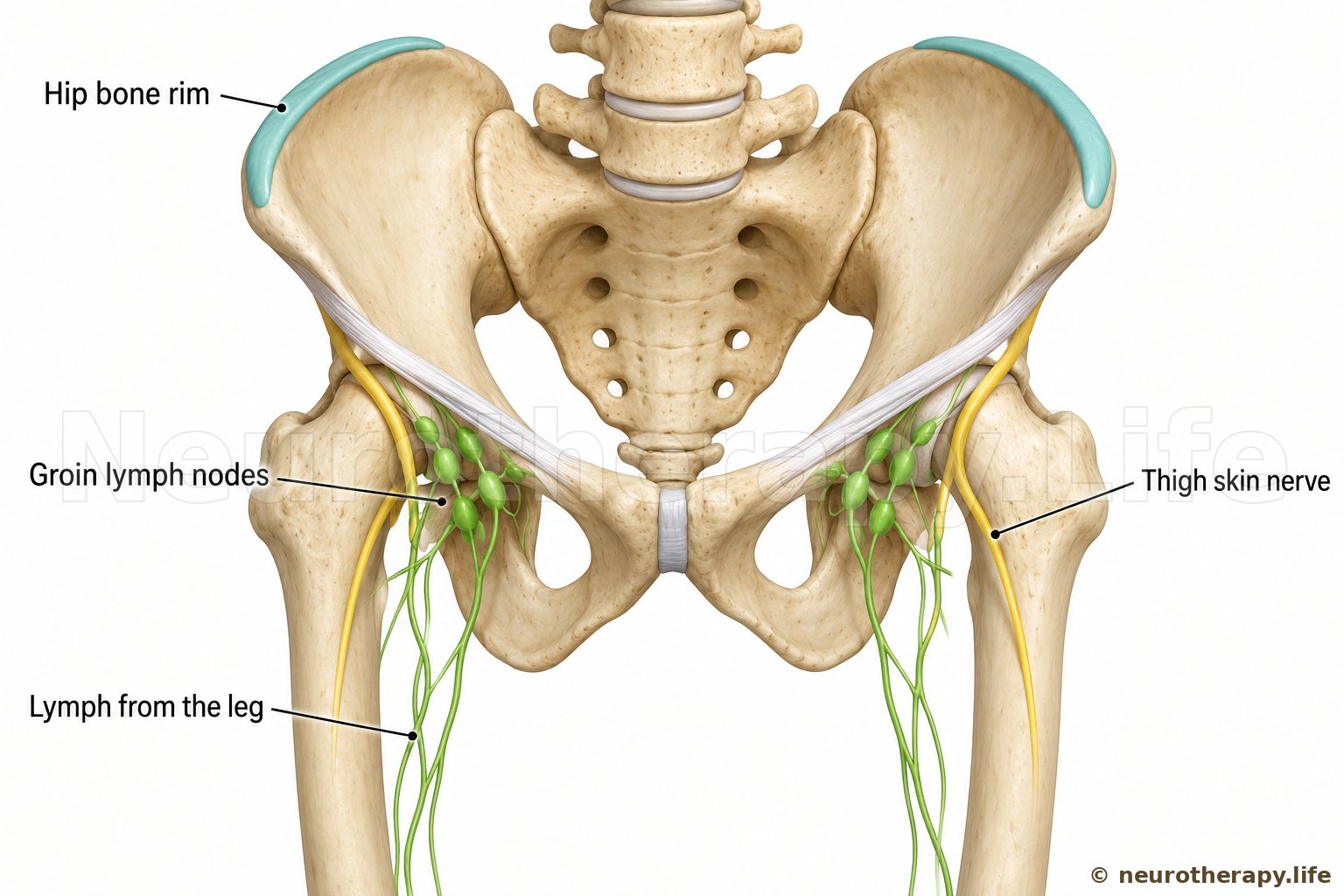
It is a physical treatment, not a chemical one: named for a place and an action. Its stated purpose is to correct blockage in the lymph nodes and reduce swelling in the leg. The lymph nodes of the groin lie just below this rim; through them drains much of the fluid returning from the leg.
The teaching singles out one kind of patient: those who wear tight trousers. A body gripped in one place all day, it observes, will complain somewhere else.
Gal–Spl Ghisai works across the outer rim of the hip bones, just above the lymph nodes of the groin.
Where it is given
Where is Gal–Spl Ghisai given?
PositionLying on the back
Body areaOuter side of both hip bones, at the rim of the pelvis
You lie straight on your back. The rub is given on the outer side of the pelvic bone — the hip bone — on both sides at the same time.
The front rim of the hip bone lies just under the skin and is sharp to a sole, so the stroke crosses it without resting weight on it. The therapist stands over the waist with a chair on each side.
How it is given
How is it given?
How this point is given — the tool, the pressure, the count and the exact movement — is deliberately not described here. A demonstration video for this point is being prepared; until it is on this page, learn the method hands-on from a trained Neurotherapist before giving it. Please do not give any point from a written description alone: a point given in the wrong place or the wrong way can do harm.
The exact technique is taught hands-on in the Neurotherapy (LMNT) course. See the course →
What it does
What does Gal–Spl Ghisai do?
The teaching's stated purpose is about lymph and swelling; anatomy confirms that the area holds the lymph nodes of the groin and a nerve easily squeezed by tight clothing.
Corrects blockage in the lymph nodes.
Reduces swelling in the leg.
Is especially beneficial for people who wear tight trousers and have this kind of trouble.
Varicose veinsHeavy, swollen legs — alongside the doctor's assessment of the veins.
Numbness in the legsBurning or numbness of the outer thigh from a tight waistband belongs to this area.
Safety: when it is held back
A leg that is suddenly swollen on one side, warm and painful may be a clot: it is not rubbed, and the patient is sent to a doctor the same day. Thrombosis (blood clots)
A hard, fixed, painless lump in the groin is investigated, not rubbed. Lymph nodes
Swelling of both legs can come from heart, kidney or liver disease — it is checked by a doctor, and prescribed medicines are never stopped. How to tell a patient to see a doctor
The weight never rests on the hip bone; a hip that has been fractured or replaced is not loaded.
In cancer, swelling and lymph nodes are the oncologist's first; Neurotherapy (LMNT) is support alongside, and the absolute cancer bars apply. Cancer care: Neurotherapy (LMNT) support
Guruji says
“Whenever there is an obstruction or blockage in the blood circulation of any part of the body, then pain or numbness is felt in that part.”
— Dr. Lajpatrai Mehra
Common questions
Does Gal–Spl Ghisai work on my gall bladder or spleen?
No. The name only records which point actions it was built from. Its stated purpose is the lymph nodes and leg swelling.
Will it hurt my hip bones?
It should not. The rub is soft, with the therapist's weight on the chairs and none resting on the bone.
Why does the teaching mention tight trousers?
Because something gripping the waist all day presses exactly this area, and the teaching found such patients benefit especially. Looser clothing helps too.
Surprising facts
1The complaint named after a belt
Just inside the bony point at the front of the hip, a nerve that carries only feeling passes under the groin ligament to the outer thigh. Squeezed by a belt, tight clothing, pregnancy or weight gain, it makes that patch of thigh burn, tingle or go numb — a condition called meralgia paresthetica.
Unlike blood, lymph has no heart to push it. It moves slowly, helped by the squeeze of muscles and by one-way valves, which is why it pools easily in a still or constricted leg.
Source: Moore JE Jr, Bertram CD. Lymphatic System Flows. Annual Review of Fluid Mechanics. 2018;50:459–482.
This page explains what a Neurotherapy (LMNT) treatment is for; it is not a self-treatment guide and does not diagnose. Neurotherapy (LMNT) works alongside your medical care — keep taking the medicines your doctor prescribed.
Ready to begin?
Send COURSE for course details, or your name, age and health issue for a consultation.