Also called: Blood supply to sides, ब्लड सप्लाई टू साइड्स
Blood Supply to Sides is a broad outward sweep at the side of the hip, given while the patient lies face down. It is used to relax the muscles around the hip and to ease numbness in the side of the thighs, and its method is borrowed by a low-back point.
Overview
What is Blood Supply to Sides?
Blood Supply to Sides is a physical point of the low-back group. Guruji's teaching gives it two uses: it relaxes the muscles around the hip, and, for those who have numbness in the side of the thighs, it increases the flow of blood in that region and helps end the numbness.
Its method is so useful that another point borrows it whole. (6) L3,4,5 uses exactly the same sweep, only moved up to the low back, starting from the bone that lies straight behind the navel.
Its name promises a blood supply; its plainest stated purpose is relaxed muscles around the hip. When a patient asks what it does, that is the honest answer.
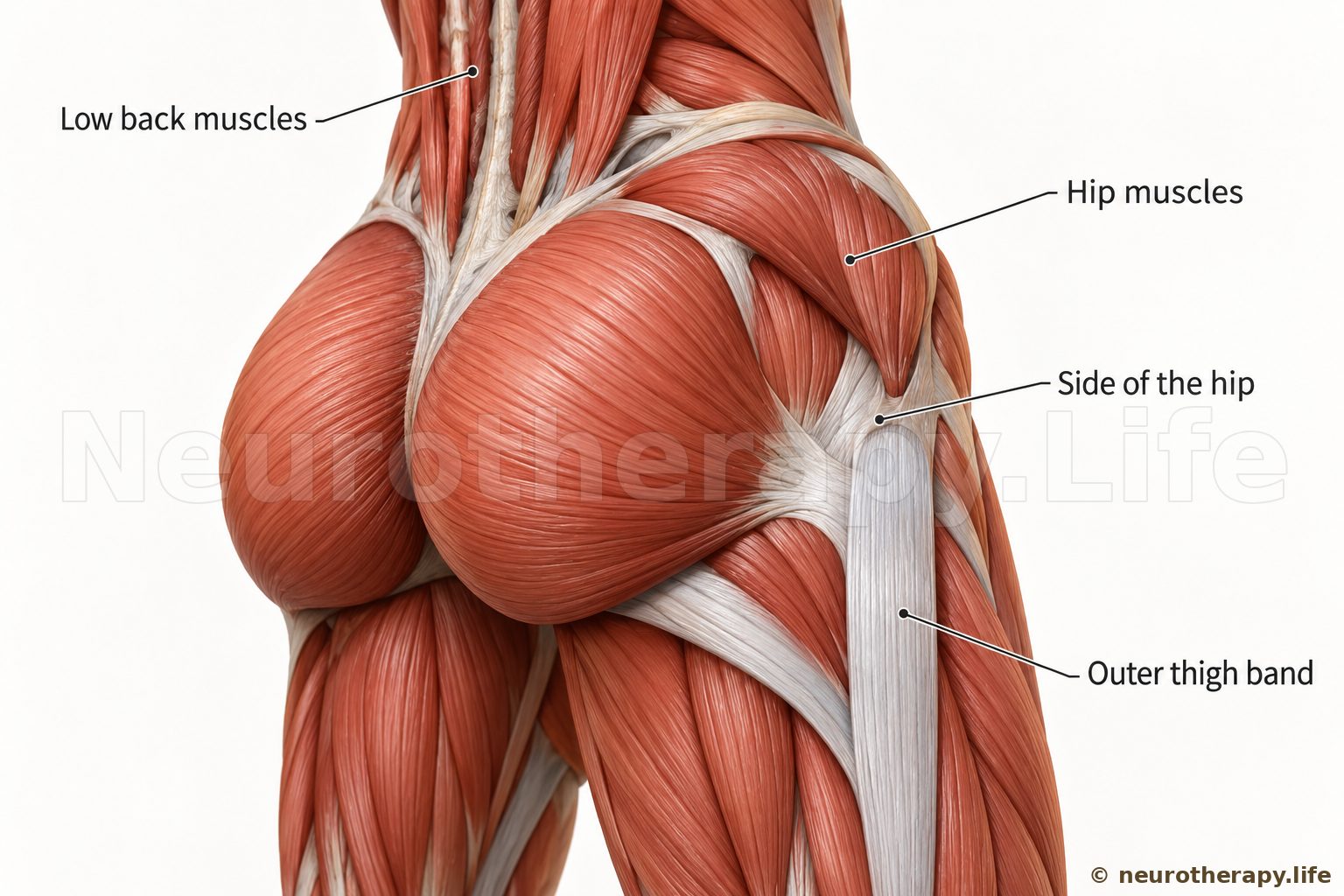
The sweep works the muscles around the hip and the outer side of the thigh.
Where it is given
Where is it given?
PositionLying face down
Body areaThe side of the hip, sweeping outward toward the flank
The patient lies face down with pillows under the chest and the head straight. The therapist works from beside the patient, with the weight held through the chairs.
The area is the side of the hip, worked at several places, with the sweep running from the side outward — away from the middle of the body toward the flank.
How it is given
How is it given?
How this point is given — the tool, the pressure, the count and the exact movement — is deliberately not described here. A demonstration video for this point is being prepared; until it is on this page, learn the method hands-on from a trained Neurotherapist before giving it. Please do not give any point from a written description alone: a point given in the wrong place or the wrong way can do harm.
The number written before a point's name is not a strength setting. Each numbered form is a separate named treatment with its own method and timing, taught hands-on in the course.
The exact technique is taught hands-on in the Neurotherapy (LMNT) course. See the course →
What it does
What does it do in the body?
The sweep crosses the hip muscles and the tough fibrous sheets that wrap them. A broad, slow, repeated sideways sweep lengthens these sheets and makes them less sore to press — a real effect that needs no bigger claim.
Relaxes the muscles around the hip.
Used where there is numbness in the side of the thighs, to increase the flow of blood there.
Lends its method to (6) L3,4,5 for low-back problems.
A leg that cannot feel cannot tell you what the foot is doing to it. Keep the pressure gentle where there is numbness, and check the skin before and after. Numbness in the legs
A leg that is swollen, warm and tender on one side only is not worked — it is sent to a doctor the same day. Thrombosis (blood clots)
“It is given to relax the muscles around the hip.”
— Dr. Lajpatrai Mehra
Common questions
Does it really increase blood supply?
That is what its name and teaching say for numb outer thighs. What can be felt straight away is that the muscles around the hip relax and are less sore.
Is it the same as (6) L3,4,5?
Same method, different place. Blood Supply to Sides is given at the side of the hip; (6) L3,4,5 starts on the low back behind the navel.
Why does the therapist hold the chairs?
The chairs control how much of the therapist's weight reaches you, so it can be lightened in an instant.
Surprising facts
1The body's biggest muscle sits here
The gluteus maximus, the large buttock muscle, is the biggest single muscle in the body. It steadies the hip every time you stand up or climb a step.
Source: Standard anatomy: Gray's Anatomy (41st ed.), gluteal region.
2A strap down the outer thigh
A tough band of fibrous tissue, the iliotibial band, runs from the hip down the outside of the thigh to just below the knee. It helps hold the knee steady when you walk.
Source: Standard anatomy: Gray's Anatomy (41st ed.), fascia lata and iliotibial tract.
3Numb outer thigh has a nerve of its own
The skin of the outer thigh is supplied by a single nerve that passes near the front of the hip bone. When it is squeezed, the outer thigh can tingle or go numb — a condition called meralgia paresthetica.
This page explains what a Neurotherapy (LMNT) treatment is for; it is not a self-treatment guide and does not diagnose. Neurotherapy (LMNT) works alongside your medical care — keep taking the medicines your doctor prescribed.
Ready to begin?
Send COURSE for course details, or your name, age and health issue for a consultation.