1The world's top disabler
Low back pain is the single leading cause of disability worldwide; about 619 million people lived with it in 2020.
Source: World Health Organization. Low back pain — fact sheet. 2023.
Also called: L3 4 5, L3, 4, 5, L3-4-5, एल3 4 5
(6) L3, 4, 5 is a Neurotherapy (LMNT) treatment for the low back, given lying face down. It starts at the L3 bone of the spine — exactly behind the navel — and draws the back muscles toward the sides to relax them from L1 to S1. It is never given when any bone between L1 and S1 is fractured.
The lumbar spine — the five bones of the low back, named L1 to L5 — sits between the ribs and the sacrum. (6) L3, 4, 5 is a physical treatment for this region: it is given to relax both kinds of back muscles from L1 to S1, and it is said to give the patient considerable relief in problems of the low back.
It borrows its method whole from another point, Blood Supply to Sides, and changes only the place. The number in brackets is part of the name as it is written on the card.
Under the skin here lie the long upright muscles beside the spine, the deep square muscle that runs from the last rib to the pelvic rim, and the broad fibrous sheet that wraps them — the place a patient with a 'waist problem' usually puts a flat palm.
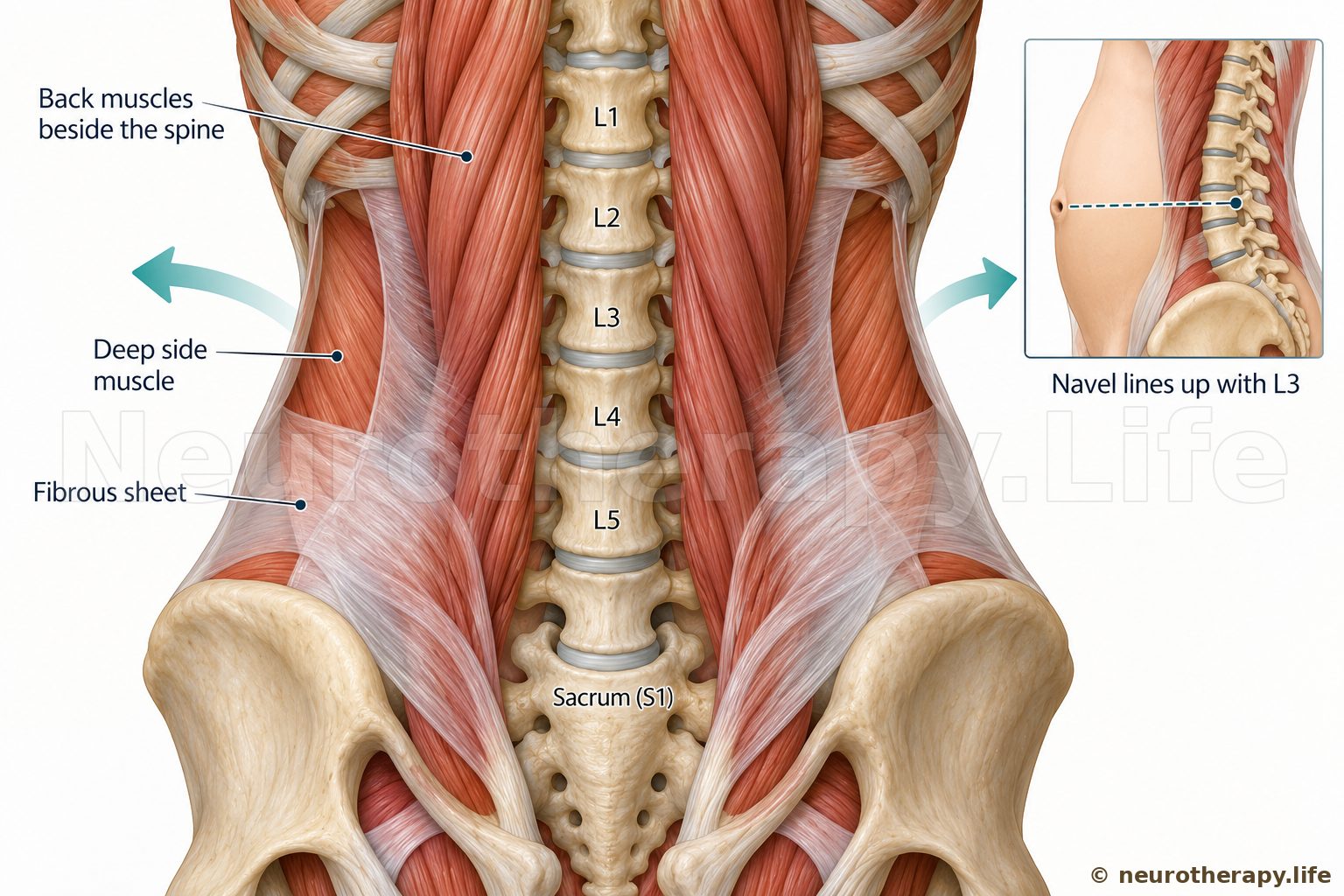
You lie face down with pillows under the chest, head straight. The work starts above the L3 bone of the spine and travels outward toward the sides of the waist, at several levels of the low back.
The landmark is the plainest in the body: the L3 bone lies exactly behind the navel. The therapist notes where your navel is before you turn over, and confirms the level by feel.
How this point is given — the tool, the pressure, the count and the exact movement — is deliberately not described here. A demonstration video for this point is being prepared; until it is on this page, learn the method hands-on from a trained Neurotherapist before giving it. Please do not give any point from a written description alone: a point given in the wrong place or the wrong way can do harm.
The number written before a point's name is not a strength setting. Each numbered form is a separate named treatment with its own method and timing, taught hands-on in the course.
The exact technique is taught hands-on in the Neurotherapy (LMNT) course. See the course →
LMNT gives it to relax the muscles of the low back. The teaching describes it in terms of blood supply; the plainly visible effect is that a broad, slow, repeated sideways sweep lengthens the tissue and makes it less sore to press.
It shares its method with one point and sits beside the other low-back treatments.
It is one of several low-back treatments, chosen inside a plan built from the patient's findings. Neurotherapy (LMNT) works alongside your medical care.
Because it is given over the lower lumbar bones, starting from L3, the bone that lies straight behind the navel.
Not if any bone between L1 and S1 is fractured. After a fall or a sudden severe pain, an X-ray and a doctor come first.
It should feel like a firm, pleasant stretch. Say so at once if it hurts; the therapist controls the weight through the chairs and can ease it instantly.
Low back pain is the single leading cause of disability worldwide; about 619 million people lived with it in 2020.
Source: World Health Organization. Low back pain — fact sheet. 2023.
About nine in ten cases of low back pain are 'non-specific' — no single damaged structure can be named as the cause.
Source: World Health Organization. Low back pain — fact sheet. 2023.
In most adults the navel lies roughly level with the L3–L4 region of the spine, which makes it a handy surface landmark.
Source: Surface anatomy (Gray's Anatomy, 41st ed.)
The World Health Organization's summary of low back pain: how common it is, that most cases have no single identifiable cause, and that care should combine movement, physical therapies and reassurance. It does not test Neurotherapy (LMNT).
World Health Organization. Low back pain — fact sheet. 2023.
This page explains what a Neurotherapy (LMNT) treatment is for; it is not a self-treatment guide and does not diagnose. Neurotherapy (LMNT) works alongside your medical care — keep taking the medicines your doctor prescribed.
Send COURSE for course details, or your name, age and health issue for a consultation.