Report findings that stop a session, and how to record a report on the card
Some findings in a report send the patient to a doctor today, before any treatment. Every other report is written on the card in one line, with its date, value, range and whether it changed the plan.
Overview
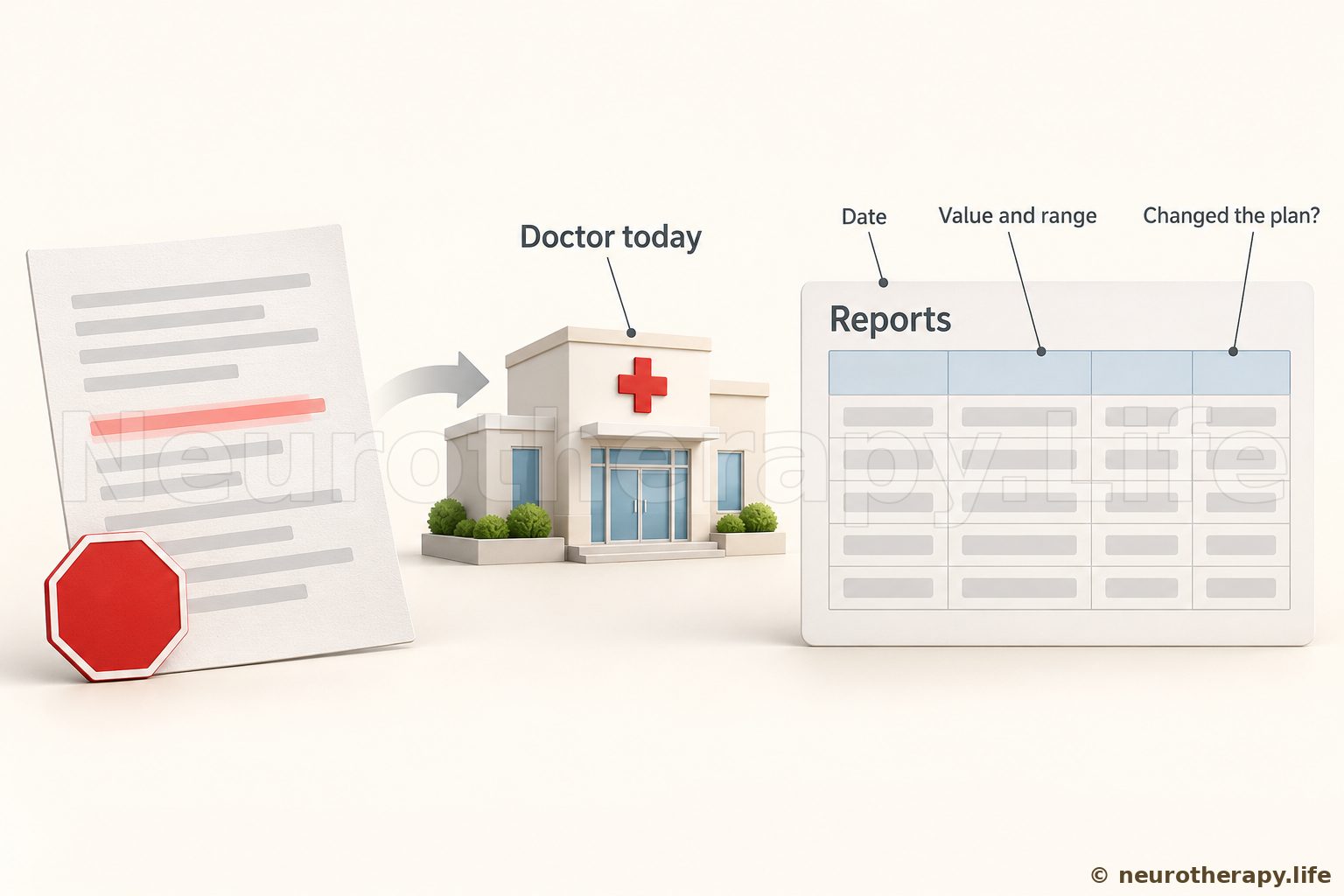
Certain findings mean the patient goes to a doctor today, not after this session and not next week. They are said in the same calm, flat voice used to ask about sleep. Sending a patient to a doctor does not lose a patient; it keeps one.
These include a creatinine or urea that has climbed since the last report, or a first report of kidney failure that nobody has acted on; a haemoglobin so low the patient is breathless sitting still; blood from anywhere, even once; fever with a very high white cell count, a stiff neck or a rash that does not fade when pressed; a very high sugar with drowsiness or deep breathing, or a patient sweating, confused and shaky; chest tightness on effort; a report naming a new growth or cancer; and weight loss without trying.
Every other report is written on the card as one line, never a paragraph. The line holds the date the sample was taken, the test with its value, unit and the laboratory’s printed range, the words changed the plan or changed nothing, and what changed. A report not written down did not happen. Weeks later, the repeat report can then be laid beside it.
Sugar and blood pressure are marked in their own place on the card and the chief therapist is told. Osteoporosis is written where it cannot be missed, with the note hand only. In the gap after each formula, the patient is asked how they feel; if a point makes the trouble worse, the chief therapist is asked and it is written on the card.
Key points
- Red-flag findings go to a doctor today, before any plan.
- One report, one line on the card.
- Use the sample date and copy the laboratory’s own range exactly.
- Only two answers: changed the plan, or changed nothing.
Go deeper
Reading the Reports: Which Tests Change the Treatment
Reading the reports: the full guide
Medical reports that change a Neurotherapy (LMNT) plan
The reports that change a plan
How to tell a patient to see a doctor
How to tell a patient to see a doctor
When the Hand Must Stop: Blocked Points and Safety in Neurotherapy (LMNT)
When the hand must stop
The Neurotherapy (LMNT) diagnosis card: what is written and why
A sample diagnosis card, filled in
Kidney disease
Kidney disease and the kidney report
Read the full guide
This topic is part of: Reading the Reports: Which Tests Change the Treatment
Safety: when it is held back
- Neurotherapy (LMNT) works alongside medical care. Any red-flag finding is the doctor’s matter first; treatment waits. When the Hand Must Stop: Blocked Points and Safety in Neurotherapy (LMNT)
- If any point or formula makes the trouble worse, stop, ask the chief therapist, and record it so that point is not given again. Reactions after treatment
This page explains what a Neurotherapy (LMNT) treatment is for; it is not a self-treatment guide and does not diagnose. Neurotherapy (LMNT) works alongside your medical care — keep taking the medicines your doctor prescribed.