Reading the Reports: Which Tests Change the Treatment
A Neurotherapist reads every blood report, X-ray and scan with one question: does this change what I am going to do? A few reports do — above all kidney function — and most change nothing. A normal report is normal, and it never argues with what the hands find.
Overview
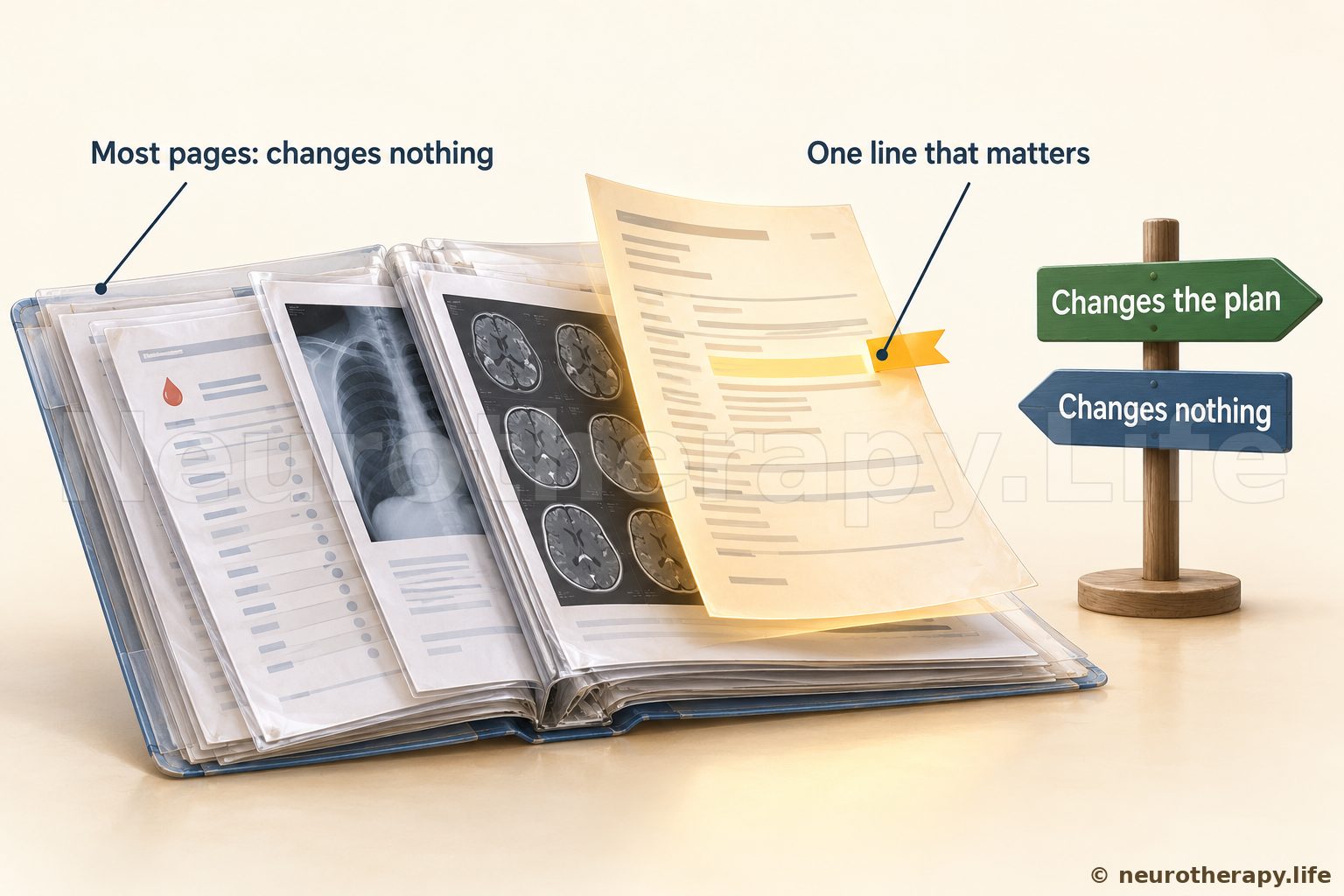
A Neurotherapist reads every blood report, X-ray and scan with one question: does this change what I am going to do? A few reports do — above all kidney function — and most change nothing. A normal report is normal, and it never argues with what the hands find.
One question for every report
Teaching case: a man brought six years of reports in a folder tied with string and said, “Everything is normal.” The therapist read all sixty pages while the man watched. Near the bottom, on an eleven-week-old sheet nobody had mentioned, the kidney value creatinine was raised. That one line changed the plan: a kidney-related pressure was held back until the man's doctor had looked at it.
Every report gets one of two honest answers, said out loud and written on the card: it changed the plan — and how (a point held back, a point replaced, the hand used instead of the foot, a doctor first) — or it changed nothing. There is no third answer. Neurotherapy (LMNT) has its own ways of diagnosis — the pain points, the bowel, the tongue, the history — and it works in step with modern tests, not in obedience to them or in competition with them.
What a report is — and is not
Before any folder is opened, everyone is asked: “Do you have sugar? Do you have BP?” Some people take tablets for these and forget while the card is being made. Sugar matters for a practical reason too: a diabetic's feet may have lost feeling, and a foot that cannot feel cannot warn you.
- A picture of one moment: sugar and values taken during fever or fright can swing within a day.
- It answers only the question it was ordered for — “they checked everything” usually means “they took a lot of blood”.
- The printed range is the range of healthy people, not a target.
- A value inside the normal range is a normal value — not “borderline”, not “secretly low”.
- It is read to guide treatment safely — never to give a diagnosis or to contradict the doctor who ordered it.
The reports that change what is done
Only about ten kinds of result change a Neurotherapy (LMNT) treatment. For each, what matters is not the name of the test but what the therapist does differently because of it.
- Kidney function (creatinine, urea) — the most plan-changing page in any file. In kidney failure the kidney points are held back.
- Thyroid (TSH, T3, T4) — a high TSH is the brain repeating its order to a thyroid that is not answering. It often points back to digestion, and it decides where the thyroid points must not be used.
- Haemoglobin — the oxygen-carrier in blood. A low figure means a slower response, and the cause of any blood loss must be found.
- Blood sugar — the feet are checked before they are pressed, and the day's plan follows the day's bowel.
- Serum calcium — calcium in the blood, not in bone. It decides which direction the calcium work takes.
- Vitamin B12 and folic acid — a low level in someone who eats well is about absorption, not intake. For a child, the mother's B12 and folic acid points are checked too.
- Liver values, cholesterol, uric acid and white cells — they guide the liver work and decide where Liv, Gal or Spl are held back.
- Bone density — where osteoporosis is shown, treatment is given only with the hand, never the foot.
The reports that change nothing
A man of sixty brings an X-ray of his lower back that mentions narrowing between bones and a little new bone growth. Every word is accurate, and almost none of it is news — that is what a sixty-year-old spine looks like, in people with pain and in people without it. A finding present equally in people with and without the complaint does not explain the complaint. So it changes nothing — unless it names a level the fingers had already found, or something on a caution list, such as a spur or bamboo spine.
Saying “this changes nothing” is hard, because the patient paid for the test and believes it explains everything. Say it anyway, kindly, and say which one does matter. Reading a folder silently while frowning frightens people; reading it aloud — “changes nothing, changes nothing, this one matters, and here is why” — calms them.
A normal report is normal
Sometimes the report is normal but the therapist finds four tender points. Never tell the patient the report is “secretly” abnormal. That would be untrue, unkind, and unnecessary — because the two are not measuring the same thing. The laboratory asked: is this value outside the range of healthy people? The therapist asked: which organ is short of blood this morning? Two questions, two instruments, two true answers, and no quarrel between them.
An example from joint pain: a positive RA factor is written on the card with its date. Separately, the therapist has their own finding — tenderness at the middle joint of the ring fingers. The same finding was seen in people with joint pain whose RA test was negative, and they were helped by the same treatment. Both notes are kept side by side, never mixed.
Asking for what is missing, and writing to the doctor
A therapist does not order tests. Before asking for one, the question is: what would I do differently if I had it? If the answer is nothing, it is only curiosity, and curiosity is not a reason to spend a family's money. What is needed is asked for through the patient's own doctor, in a short note, framed as caution — never by putting a new fear like cancer or dialysis into the room.
The one-page letter to the doctor says who the therapist is, two or three plain observations with dates, and one clear question — followed by: “I have not asked her to change any medicine, and I will not.” It never gives a diagnosis, judges a prescription, or uses the word cure.
Key points
- Every report gets one of two answers: it changed the plan, or it changed nothing.
- A report is a picture of one moment and answers only the question it was ordered for.
- A value inside the normal range is normal.
- Kidney function is the report most likely to make a therapist hold a treatment back.
- Ask everyone about sugar and BP before opening the folder.
- Lab values and the therapist's findings answer different questions and never contradict each other.
- Therapists do not order tests or change medicines; they ask the patient's doctor.
Topics in this guide
Go deeper
Taking a Patient's Story: The History That Cannot Mislead
Taking the patient's story in the right order
When the Hand Must Stop: Blocked Points and Safety in Neurotherapy (LMNT)
When the hand must stop — every blocked point
The Educated Hand: How the Pain Points Are Felt
The pain points and how findings are graded
The Record That Shows the Truth: The Patient Card in Neurotherapy (LMNT)
Keeping a record that shows change
The Fire and the Ash: Undigested Food in the Stool
Why a thyroid or B12 report is often about the stomach
Kidney disease
Kidney disease
Osteoporosis
Osteoporosis — hand only
Kidneys
The kidneys — the body's sieve
Thyroid
The thyroid — the master craftsman
Safety: when it is held back
- Go to a doctor today — not after the session — for: a kidney value that has climbed or a first report of kidney failure; haemoglobin so low the person is breathless sitting still; blood from anywhere, even once; fever with a stiff neck or a rash that does not fade when pressed; very high sugar with drowsiness, or a person sweating, confused and shaky; chest tightness on effort that goes with rest; a report naming a new growth or cancer; weight loss without trying. Report findings that stop a session, and how to record a report on the card
- In kidney failure or kidney cancer, the kidney points Liv° and Mu° are not stimulated, and (10) Medulla is not given. Kidney disease
- Where osteoporosis is shown, treatment is given only with the hand, never the foot. Para is not given on its own in osteoporosis. Osteoporosis
- (4) Thrd is not given in bamboo spine, spur or unwanted bone growth, in asthma, or to heart patients. (4) Thrd
- Liv is not given where there is cancer in the liver. Gal is not given in leukaemia, a raised white cell count, or asthma. Spl is not given in diabetes, autoimmune disorders, cold, allergy, asthma or cancer. When the Hand Must Stop: Blocked Points and Safety in Neurotherapy (LMNT)
- In cancer, never (10) Pan, Thymus, Pit, Lu+Sh, Rt.Ov/Lt.Ov or (30) Medulla. Cancer care: Neurotherapy (LMNT) support
- G. Heparin is not given to people with heart disease. G. Heparin ('glandins)
- If any complaint increases after a point or formula, tell the therapist at once; it is noted on the card so that point is not given again.
- Never stop or change a medicine because of Neurotherapy (LMNT); that decision belongs to your doctor. How to tell a patient to see a doctor
Guruji says
“If the stomach, the lungs and the kidneys work properly, then disease simply cannot come.”
Common questions
My doctor says all my tests are normal. So why do I feel like this?
That is good news: what those tests look for has been ruled out. A normal test means nothing that test measures is wrong. Much of what troubles people is organs working sluggishly, which a blood report is not built to show.
You found pain in four places. Are my reports wrong?
No. Your reports are right and so is the finding — they answer two different questions. Nobody has made a mistake.
Should I get more tests done?
Not on the therapist's account. Therapists do not order tests. If something is needed, a short note goes to your own doctor, who decides.
The X-ray says my spine is degenerated. Isn't that the whole problem?
It is an honest picture. But spines of your age look like that in people with pain and without it, so it does not by itself explain the pain. The therapist goes by what your body is doing now — and that can change.
Watch

An overview of LMNT's diagnostic pain points — the places around the navel that the therapist presses to read the body before choosing a treatment.
Test yourself
Explore more
Organs
Body systems
Diseases
Points
Formulas
Topics
Read more
This page explains what a Neurotherapy (LMNT) treatment is for; it is not a self-treatment guide and does not diagnose. Neurotherapy (LMNT) works alongside your medical care — keep taking the medicines your doctor prescribed.