Taking a Patient's Story: The History That Cannot Mislead
In Neurotherapy (LMNT) the patient's story is the larger half of the diagnosis. It is taken in a fixed order — easy, neutral questions first, private ones later and alone — so that people answer truthfully, and nothing important is missed.
Overview
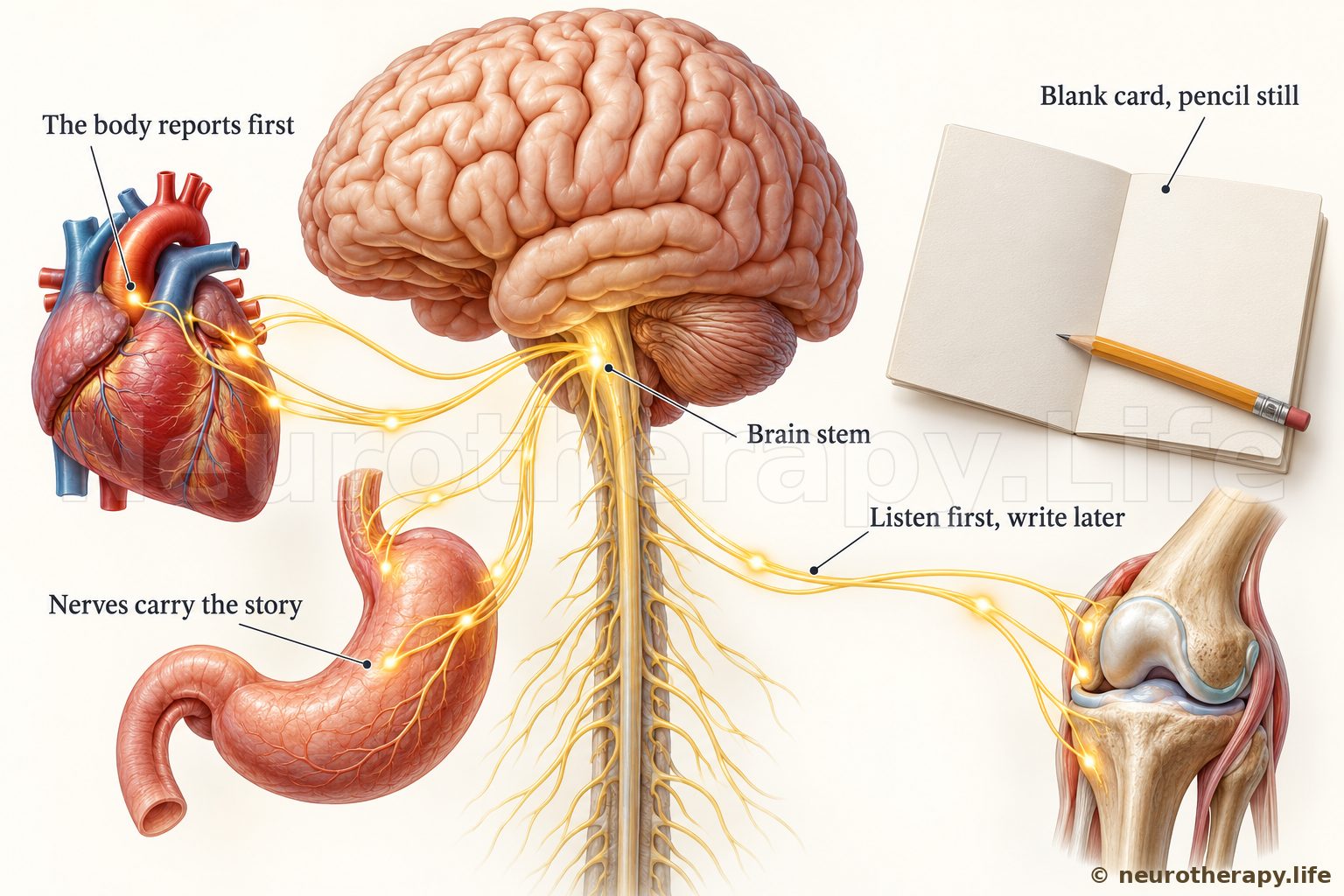
In Neurotherapy (LMNT) the patient's story is the larger half of the diagnosis. It is taken in a fixed order — easy, neutral questions first, private ones later and alone — so that people answer truthfully, and nothing important is missed.
Why “Any complaints?” is the wrong first question
“Do you have any complaints?” sounds polite, but it asks for a judgement, not a fact. A man who has had burning in the stomach for eleven years no longer calls it a complaint — it is just how his stomach is. The question also invites one answer, usually the smallest, and makes a person present himself as broken. Many, especially men and elders, will simply say “I am fine”.
Teaching case: a retired man came only because his wife insisted, and said he was perfectly fine. Instead of asking about complaints, the therapist asked about hunger, sleep, water and evening tiredness. Within ten minutes he mentioned waking at night, burning feet, and a chest tightness on walking uphill that eased with rest. That last sign was sent to a physician the same day — it turned out to be his heart.
The order, and why this order
The answer to a question is changed by the questions that came before it. So a first history follows a fixed road, built on three rules: easy questions before awkward ones; neutral questions before ones that feel like judgement; and never ask a question whose honest answer is a confession until the blame has been taken out of it. The history is taken at length on the first day and re-taken in small pieces at every visit, because the body keeps changing.
- Their own words — “Tell me what brought you, from the beginning”, then a full minute of quiet.
- The complaint mapped — since when, where, worse with, better with, and what they can no longer do.
- The neutral doorway — hunger, sleep, energy by evening, weakness, lightness, and glasses of plain water yesterday.
- Digestion and the bowel, then a head-to-foot checklist read the same for everyone.
- Later, and alone: daily life and work, past illnesses and accidents, everything swallowed, habits, women's health, and a closing question.
Asking so that people answer honestly
The commonest fault is not shyness but a question with its answer already inside it. “You don't get burning in the chest, do you?” can only get a no. “Is it better?” gets a yes, out of kindness. Ask instead for an event, a number, a place or a pointing — never a verdict.
- Ask about yesterday, not “usually” — usually returns a self-portrait, yesterday returns an event.
- Ask the same thing twice, differently — the second answer is usually truer.
- Show, do not ask — a chart or list to point at makes it easy to answer.
- Name the items — nobody calls a churan or isabgol a medicine, so ask for them by name.
- “Bring the whole bag next time” — a strip of tablets cannot be misremembered.
- After an answer, stay quiet and count to five — what fills the silence is often the thing they meant not to say.
What patients hold back, and how it is found
A plan built on a history with a hole in it fails slowly, over weeks. People commonly hold back six things: a habit they are ashamed of, a private home remedy, a medicine they stopped, a symptom they think has nothing to do with it, a symptom they think too small, and a second complaint that may be the real reason they came.
Two simple habits catch most of them. First, the private questions are asked with the patient alone — as routine for everyone, never as suspicion; where a chaperone is needed, the chaperone stays but the audience leaves. Second, before asking about medicines, the therapist says plainly: “We use no medicine here, and we never ask anyone to stop theirs.” That one sentence brings the most honest list.
The parhez — what to keep away from
A parhez is not a diet. It is a short list of things to leave alone for a time, for a stated reason, and it is part of the treatment. The root of illness is a digestion that is not working well, so heavy foods that a tired digestion cannot handle are kept away.
- Non-veg food — meat, chicken, fish — is heavy protein and fat that a weak digestion cannot handle.
- Smoking and alcohol — neither is taken.
- Sour things — tamarind, lemon, tomato, curd, lassi — are kept away by those with joint pain or acidosis until the body is corrected.
What new patients ask
Come with a fairly empty stomach — about an hour after breakfast or two hours after a heavy meal — because you will lie on your back, side and front. Wear loose clothing that keeps the whole body covered. The pressure is spread over a wide area with the soft middle of the sole, so it should not hurt; children, the elderly and the weak are treated with the hands. A common session lasts about half an hour, with short pauses.
How long it takes depends on your build, the disease, how many organs it has reached, how many years you have had it, and how well the parhez is kept. A disease that came over many years needs at least that many months. Many people notice small changes within a day or two — better hunger and sleep, more energy, a lighter body. These are not the cure; they are the first sign that things are moving.
The closing question
At the end of every first visit, while the patient is gathering their things, the therapist asks: “Is there anything I have not asked you about?” Then, without waiting for the no: “Anything you thought was too small to mention? Anything you thought had nothing to do with this? Anything you did not want to say in front of anybody?” Then quiet. These three prompts name the three reasons something is held back, so the patient does not have to admit to any of them.
Key points
- The patient's story is the larger half of the diagnosis.
- “Any complaints?” gets the smallest answer; ask about hunger, sleep, energy and water instead.
- Easy and neutral questions come first; private ones come later, and alone.
- Never put the answer inside the question — ask for events, numbers and places.
- Say “we never ask anyone to stop their medicine” before asking what they take.
- The parhez — no non-veg, no smoking or alcohol, no sour things in joint pain — is part of the treatment.
- End every first visit with the closing question and its three prompts.
Topics in this guide
Go deeper
The Fire and the Ash: Undigested Food in the Stool
The undigested-food questions, asked without embarrassment
What the Bowel Tells You: Constipation, Stool and Water
The bowel questions — form, effort and water
Reading the Reports: Which Tests Change the Treatment
Reading the reports a patient brings
The Record That Shows the Truth: The Patient Card in Neurotherapy (LMNT)
Keeping a record that shows the truth
When the Hand Must Stop: Blocked Points and Safety in Neurotherapy (LMNT)
When the hand must stop
Between Two Sessions: Daily Rules for Patients
Rules of daily living between sessions
Food as Medicine: Eating and Drinking Rules
Food as medicine
Daily food habits for good digestion: breakfast time, chewing and water
The parhez in short
Safety: when it is held back
- Never stop or reduce a medicine because you are taking Neurotherapy (LMNT). When the complaint has fully gone, ask your own doctor whether you still need the same amount — that decision is the doctor's. How to tell a patient to see a doctor
- Some signs are asked of everyone, every time, and go to a doctor the same week or the same day: blood from anywhere, even once; weight loss without trying; a new lasting change in bowel or bladder habit, especially after forty; chest pain or tightness that comes with effort and goes with rest; a new, worst-ever or different headache; any new weakness. When the Hand Must Stop: Blocked Points and Safety in Neurotherapy (LMNT)
- Private questions — about habits, women's health and medicines — are asked with the patient alone. Where a chaperone is needed, the chaperone stays and others step out. Consent, dignity and a chaperone during treatment
- Children, the elderly and the frail get light treatment, given with the hands. The Child, the Elder and the Frail: Neurotherapy (LMNT) for Delicate Bodies
Guruji says
“Neurotherapy (LMNT) treats according to the condition of the body.”
Common questions
Why so many questions? My problem is only my knee.
Because a knee is repaired out of the same stores as the rest of you, and those stores are filled by digestion. Much of what the therapist needs to know about your knee is not in the knee.
Should I stop my tablets?
No. No medicine is used here and nobody is asked to stop theirs. If the complaint goes completely, ask your own doctor whether you still need the same amount.
Are you going to lecture me about food and habits?
No. Everyone is asked the same questions in the same order. The answers change what the therapist does, not what they think of you.
Is this scientific?
It is called scientific because, when its treatments are properly understood and applied, the same kind of results follow each time, on the same person or on different people. It also works in step with modern tests such as blood reports and X-rays.
Test yourself
Explore more
Organs
Body systems
Diseases
Topics
Read more
This page explains what a Neurotherapy (LMNT) treatment is for; it is not a self-treatment guide and does not diagnose. Neurotherapy (LMNT) works alongside your medical care — keep taking the medicines your doctor prescribed.