Consent, dignity and a chaperone during treatment
Before any Neurotherapy (LMNT) treatment, the patient is told in plain words what will be done and where, and agrees out loud. A relative or chaperone is offered as routine, the body stays covered, and the patient may stop at any moment.
Overview
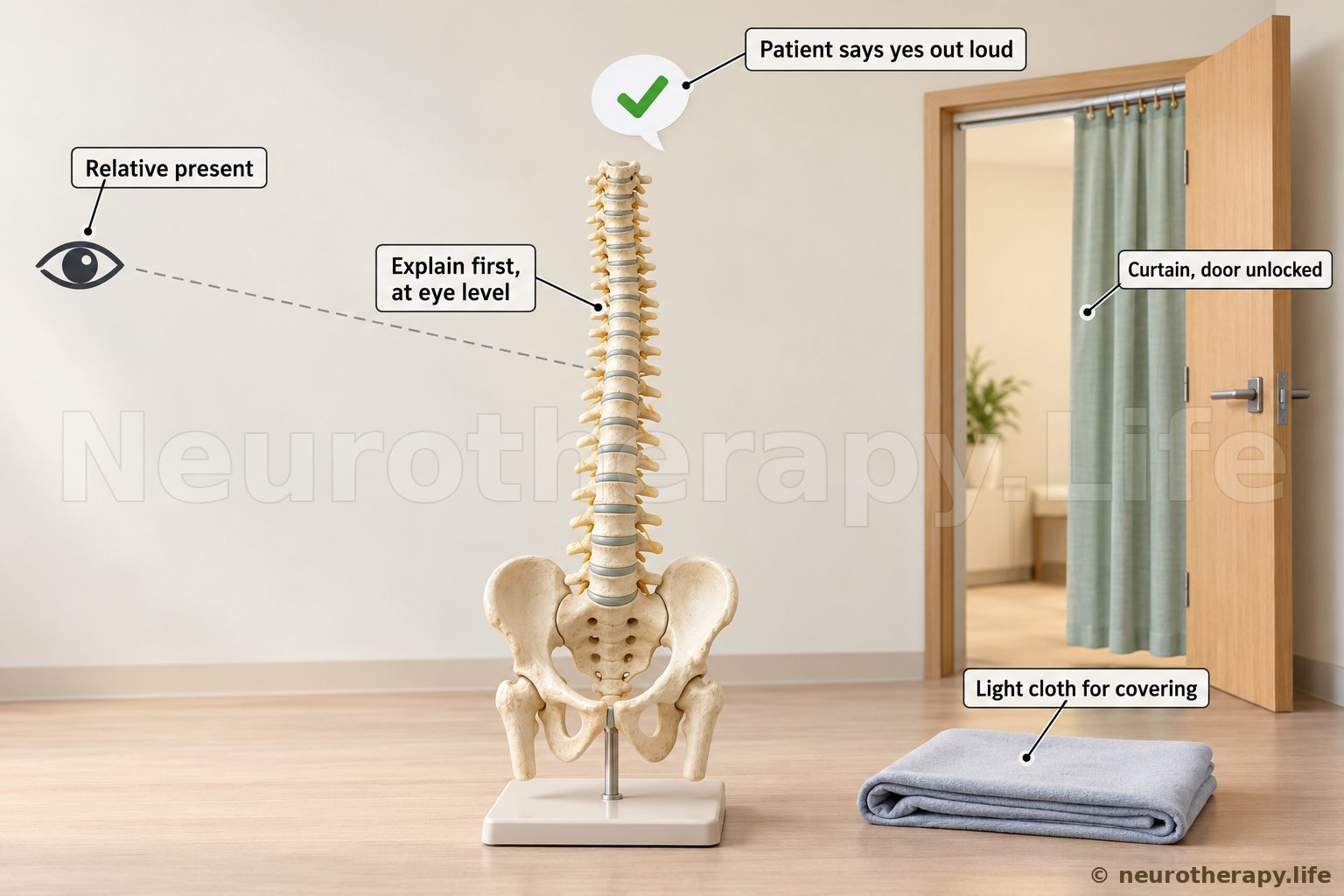
In Neurotherapy (LMNT) the therapist often stands over a patient on the floor and gives pressure with the foot, over the clothes, for about half an hour. That asks a great deal of trust, so consent is asked for every time, in words. Silence, or simply lying down, is not consent.
Consent has five parts. You are told what will be done: the pressure is given with the foot, on which parts of the body, over your clothes, for roughly how long, and that most of the weight is on the chairs. You are told in your own words. You are told it should feel like firm pressure, not pain. You are told you may stop at any moment without a reason. And you say yes out loud. Consent for one area on one day is not consent for another area on another day.
When a male therapist treats girls, women or small children, a mother, husband or other relative is asked to be present, so there is no hesitation on either side. It is offered as routine, so saying yes is never an accusation. Where no relative is available, a woman from the centre sits in.
Nothing is removed. A light cloth covers the parts not being treated, and the cloth is steadied as you turn. The door stays unlocked, with a curtain if needed. No personal remarks are made.
Key points
- Consent is spoken, informed, and asked for every time.
- You may stop the treatment at any moment, without giving a reason.
- A relative or chaperone is offered as routine.
- Treatment is over the clothes, and the body stays covered.
- The door stays unlocked, and no personal remarks are made.
Go deeper
Before You Touch Anyone: Room, Conduct and Consent
Everything done before a hand is laid on anyone
Treating Women: Periods, Pregnancy and Care
Treating women with care and dignity
The Child, the Elder and the Frail: Neurotherapy (LMNT) for Delicate Bodies
Treating children, the elderly and the frail
Placing the Patient: The Four Positions of Neurotherapy (LMNT)
The positions a patient is asked to take
Pregnancy care
Care during pregnancy
Period problems (irregular, heavy or painful)
Period problems
Read the full guide
This topic is part of: Before You Touch Anyone: Room, Conduct and Consent
Safety: when it is held back
- When you say stop, the therapist stops at once, in the middle of the press, and covers you before standing up.
- No treatment is given to a patient who is not fully awake and able to speak.
- The abdomen, groin or chest is never treated without the patient first hearing, out loud, that this area will be treated.
Guruji says
“The patient is a form of God.”
This page explains what a Neurotherapy (LMNT) treatment is for; it is not a self-treatment guide and does not diagnose. Neurotherapy (LMNT) works alongside your medical care — keep taking the medicines your doctor prescribed.