Placing the Patient: The Four Positions of Neurotherapy (LMNT)
Every Neurotherapy (LMNT) point is given in one of four positions — on the back, seated, on the side, or face down. The position is part of the treatment, not preparation for it. This guide explains the four positions, the two chairs, the pillow rules, and who must be treated by hand and not by foot.
Overview
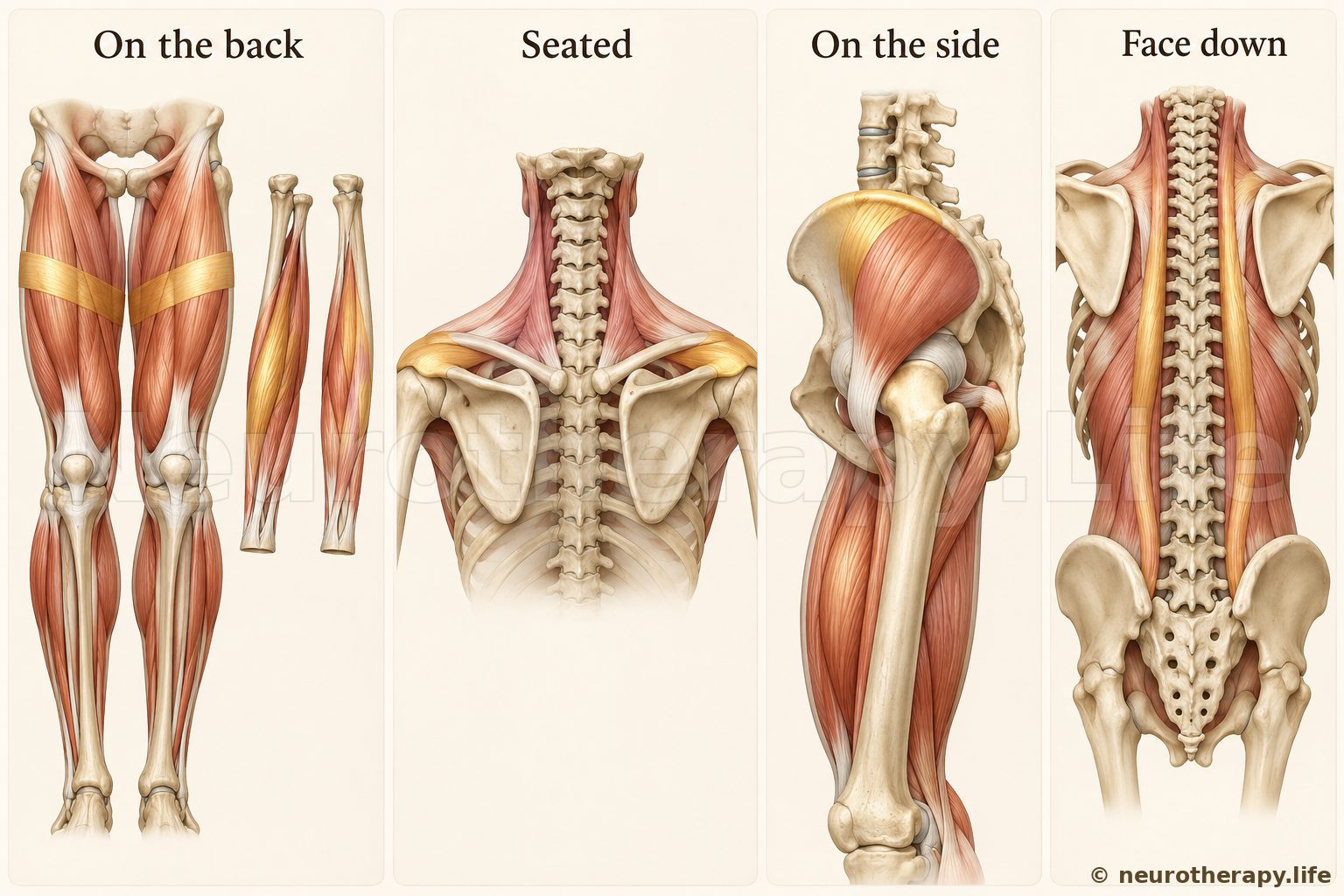
Every Neurotherapy (LMNT) point is given in one of four positions — on the back, seated, on the side, or face down. The position is part of the treatment, not preparation for it. This guide explains the four positions, the two chairs, the pillow rules, and who must be treated by hand and not by foot.
“I am not a chapati”
A teaching case, put together from the first camps of many students: a student gave a correct formula to a small woman in her seventies with stiff knees, exactly in the order the lines were written. That meant rolling her onto her face, onto her back, up onto a chair and down again, many times in one session, each time asking her to help. At the door she said, “The boy is good. But tell him I am not a chapati.”
The next morning the senior therapist gave the same formula, with nothing left out, in less time. He gathered all the work of one position before moving to the next, turned her only twice, and told her each time: “Do not help me; I will move you.”
Why the position is part of the treatment
Every point carries a silent instruction alongside its place, timing, angle and order: the arrangement of the body receiving it. Change the arrangement and you change the angle at which pressure enters, the length and tension of the muscle it enters, and what lies underneath. The result is a different treatment, not a gentler version of the same one.
That is why all the points are filed under four positions and nothing else, and why a session is planned as a route. The therapist reads the whole card first, groups the lines by position — keeping the order inside each formula exactly as written — and moves the patient as few times as possible, always in a gap between formulas, never inside one.
- Supine (on the back): the digestive and gland points of the front of the body — Pan, Gal, Spl, Liv, Mu, Gas, Const, Pit, Thymus and others.
- Seated on a chair: the brain, Medulla, neck, head, face, jaw, ear and sinus points, almost all given by hand.
- Side-lying: Acid and Fluid or Alkali, Parkhoo, and the vitamin points such as Folic and B₁₂.
- Prone (face down): the back, spine, sacrum, the backs of the legs and the soles — Adr, the arrow family, Ku and others.
The two chairs and the soft middle of the sole
When pressure is given with the feet, two ordinary chairs are turned over and set facing each other, so their frames make rails at about hip height. The patient lies between them, and the therapist stands with both hands on the frames, so that most of the body weight rides on the arms. Only as much weight reaches the patient as the therapist chooses to let down, and it can be taken back in an instant. The chairs are kept close and square, and moved as often as needed rather than leaned over.
The working surface is the soft, broad middle of the sole, laid so that the weight spreads over a wide area and the muscle is drawn inward, not outward. The toes cause a pricking feeling; the heel can leave pain for a long time — unless a treatment names the heel. The therapist also lays one foot lightly first, as a signal: a muscle touched without warning grips by reflex, and a gentle first touch lets the patient stay relaxed. The exact method is taught hands-on in the course.
On the back and on the chair
On the back, the patient lies down by rolling onto the side first, with knees bent, and straightens the legs afterwards. The head lies flat, with no pillow unless needed, so the spine stays straight. The legs are long and propped, not held. Where a treatment calls for it, the therapist lifts both knees together and slides a pillow under the thighs, its edge near the hips; the patient is told beforehand not to lift her own legs. Getting up, she bends her knees, rolls onto the side and comes up sideways, never with a jerk, which can bring on giddiness.
On the chair, the patient sits back on a firm, flat chair with the feet flat on the floor and the back supported; if the feet dangle, something solid goes under them, because a patient steadying herself braces all the way up to the neck being treated. If a patient is very ill or very weak, the seated treatments may also be given lying down.
On the side and face down
On the side, three things are arranged: the head, the knees and the shoulder. A pillow always goes under the head, so the neck rests comfortably; for anyone with neck pain or cervical spondylosis this is compulsory. Pillows between or under the knees keep the upper knee from falling below the level of the waist — the rule is the level, not a number of pillows. The patient is turned in one piece, shoulder and hip together, so the trunk does not twist.
Face down carries the strictest pillow rule of all: pillows under the chest are compulsory, arranged so the chest is lifted and the chin rests forward, the face points down and the head stays straight. This keeps pressure from falling on the breastbone and ribs, and the neck from being twisted to breathe. The patient rolls onto the side and then the front, rather than going onto hands and knees. Only the region being worked is uncovered.
Who is treated by hand, not by foot
The foot is the tool for an adult treatment. Small children, very weak people and anyone with osteoporosis (thin, brittle bones) are treated with the hand only — not “with the foot, gently”. For small children the soft part of the palm is laid flat on the thigh, so the pressure is not felt as pressure; a crooked palm, its edge or the fingers make them cry, and the crying is the signal that the contact has become too narrow.
A fourth group is the patient who cannot feel. Long-standing diabetes can take away sensation from the feet and lower legs, and then the therapy's basic safeguard — “if it hurts, say so” — no longer works. Firm pressure there is stopped, and any work below the knee is done gently, by hand. For the elderly and frail, everything is supported, the session is shortened rather than the formula, and the patient is turned as little as possible.
Key points
- Every point is given in one of four positions: on the back, seated, on the side, or face down.
- A different position makes a different treatment, not a gentler one.
- A session is planned as a route, so the patient is turned as few times as possible, and only between formulas.
- The two chairs carry the therapist's weight, so only what is needed reaches the patient.
- No pillow under the head or waist when lying on the back; always a head pillow on the side; pillows under the chest face down.
- The patient does not help; the therapist moves and places her.
- Small children, the very weak, people with osteoporosis and those who have lost feeling are treated by hand, not by foot.
Topics in this guide
Go deeper
Where pillows go during treatment, and where they never go
Where pillows go, and where they never go
How to lie down and get up by turning onto your side
How to lie down and get up safely
Before You Touch Anyone: Room, Conduct and Consent
The room, the sheet and the checks before treatment
The Timed Press: Why Time, Angle and Order Are Fixed
Why time, angle and order are fixed
The Front of the Body I: The Digestive Points Given Lying on the Back
The digestive points given on the back
On the Side: Treatments Given Lying on One Side
The points given lying on the side
Face Down: Treatments Given on the Back and Spine
The points given lying face down
Seated Treatments I: The Back of the Head and the Neck
The points given seated on a chair
The Child, the Elder and the Frail: Neurotherapy (LMNT) for Delicate Bodies
Treating the child, the elder and the frail
Safety: when it is held back
- Please do not try these treatments on yourself or others from this page. Learn them at a centre, under the supervision of a trained therapist.
- Small children, very weak people and anyone with osteoporosis are treated with the hand only; children get light treatment with the soft part of the palm. The Child, the Elder and the Frail: Neurotherapy (LMNT) for Delicate Bodies
- Where feeling has gone from the feet or lower legs, as in long-standing diabetes, firm pressure there is stopped — the patient cannot warn that it hurts. Check the soles; a crack, blister or dark-centred callus goes to a foot clinic. Burning feet
- No pillow under the waist or back when lying on the back; it can cause back pain during or after treatment. The only head-pillow exception on the back: a thin pillow for someone with cervical spondylosis who feels giddy during Pan. Where pillows go during treatment, and where they never go
- Never get up with a jerk after lying down; roll onto the side and come up slowly, or giddiness may follow. Vertigo and giddiness
- If the pressure hurts, say so at once. If the trouble increases after any point or formula, the chief therapist is consulted immediately. Reactions after treatment
- In later pregnancy, lying flat on the back for long and lying face down need special care; a doctor's advice comes first. Pregnancy care
Guruji says
“Please do not try to do these by yourself. Go to one of our centres and gain proficiency there, under the supervision of a trained therapist.”
Common questions
Why do you keep moving me? Can't it all be done with me lying like this?
Only the treatments that belong to this position can be given now. Each point is given in one particular arrangement of the body, and given in another it becomes a different treatment. What the therapist can do is move you as few times as possible.
Why won't you give me a pillow under my head?
Lying flat keeps your spine straight, and the treatment is planned for a straight spine. It feels strange for a few minutes and then it does not. You will have one when lying on your side, and a thin one in one special case of neck trouble with giddiness.
My back hurts after the session. Is that the treatment?
It should not be. It usually points to the position rather than the pressure — most often a pillow that slid under the waist because the patient lifted her hips to help. Say so the moment it starts, so it can be corrected the same day.
I feel uncomfortable lying face down with my back uncovered.
Then it will not be done that way. You stay covered, only the part being worked on is uncovered, and you are told before the cloth is moved. You may also ask for someone of your own to sit with you.
Test yourself
Explore more
Organs
Body systems
Diseases
Points
Formulas
Topics
Read more
This page explains what a Neurotherapy (LMNT) treatment is for; it is not a self-treatment guide and does not diagnose. Neurotherapy (LMNT) works alongside your medical care — keep taking the medicines your doctor prescribed.