Also called: Bottom of Feet, Bottom of feet, बॉटम ऑफ़ फ़ीट
BOF, short for Bottom of Feet, is a Neurotherapy (LMNT) treatment that starts near the heels and works up the calves toward the knee. It is used for numbness, pain, burning or any trouble from the toes, soles and heel up to the calves, and it is given in three body positions.
Overview
What is BOF?
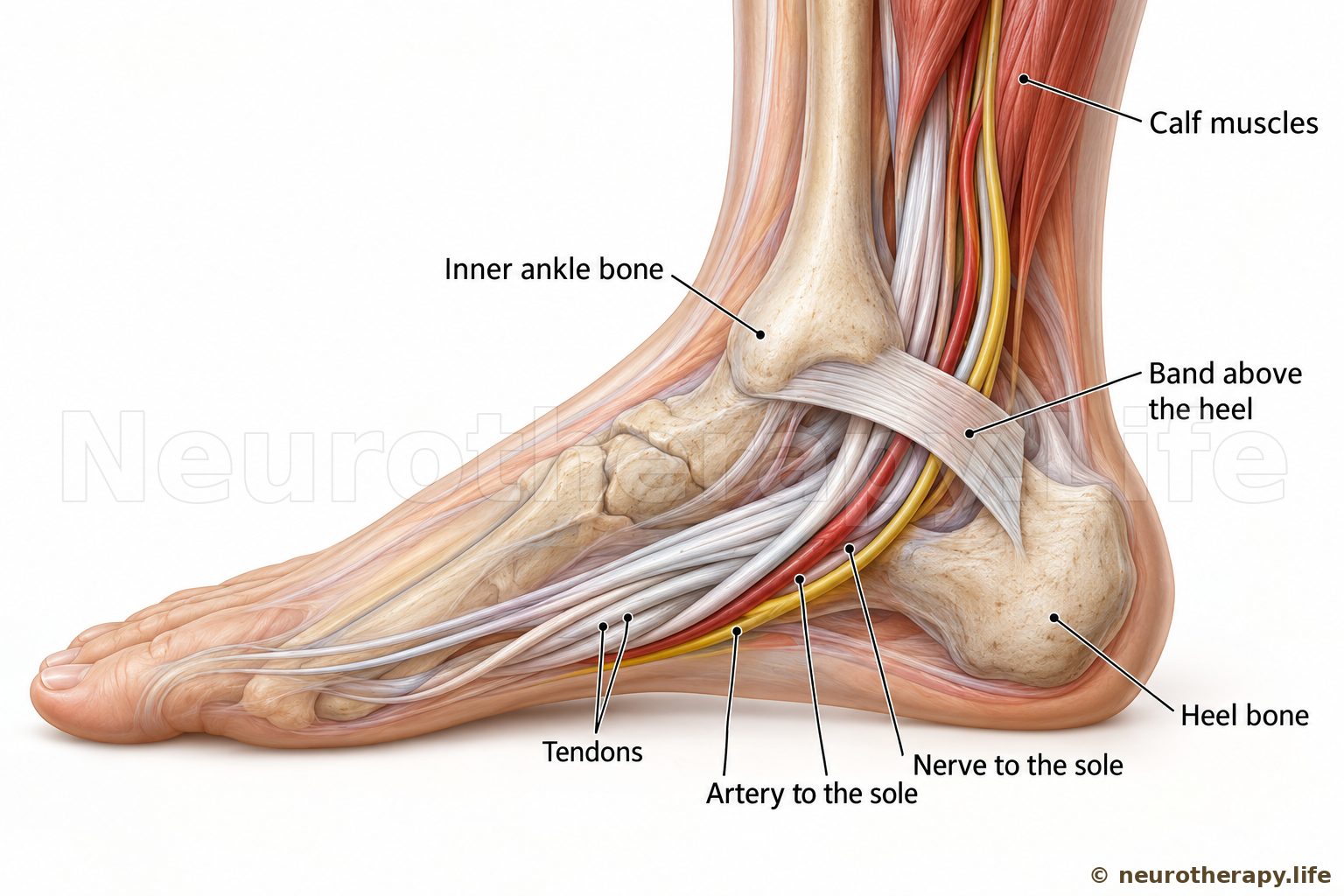
Just above and behind the heel, on the inner side of the ankle, there is a band of tough tissue. Through it pass the blood vessels of the feet and toes, the nerves that control movement, and the tendons — the strong cords that tie muscle to bone. Everything that reaches the sole travels through this one gate.
Guruji's teaching explains BOF this way: when we strike something, bend to lift a heavy weight or make a sudden movement, tendons, nerves and vessels coming down from the knee or waist can be pulled and slip down; some cannot go back and get caught inside that band, causing severe pain in the heel or around a toe. BOF presses these from below upward and brings them back to their place.
It is called excellent for numbness, pain, burning or any kind of trouble from the toes, soles and heel up to the calves.
Everything that reaches the sole passes under one band above the heel — the region BOF works from.
Where it is given
Where and in which positions is it given?
PositionLying face down
Body areaThe sole and the back of the lower leg from the heel end upward — outer side, inner side and centre; lying face down with a pillow under the ankles; right leg first
In the demonstration video you lie face down with a pillow under the head and a pillow under the front of the ankles so the feet rest at an angle; the knee must not press the ground. The work always starts with the right leg.
The area runs from the heel end upward along the sole and lower leg, always from below upward, on three sides — outer, inner (the face turned the other way), and centre. After a sprain a fourth side, the front, is added, written as BOF – all 4 sides.
How it is given
How is it given?
How this point is given — the tool, the pressure, the count and the exact movement — is deliberately not described here. A demonstration video for this point is being prepared; until it is on this page, learn the method hands-on from a trained Neurotherapist before giving it. Please do not give any point from a written description alone: a point given in the wrong place or the wrong way can do harm.
The exact technique is taught hands-on in the Neurotherapy (LMNT) course. See the course →
What it does
What does it do in the body?
The teaching describes BOF as bringing slipped tendons, nerves and vessels back to their correct place from below upward, after which the patient gets relief. Anatomy confirms the crowded band above the heel is real; the slipping-and-returning picture is the therapy's own explanation, built from clinical experience.
Used for numbness, pain or burning in the toes, soles and heels.
Used for severe heel pain or pain around one toe after a strain or sudden movement.
Works the calves from below upward, toward the knee.
Organs it reaches
Muscles — The calf muscles and the tendons of the foot.
Blood vessels — The artery and veins passing to the sole.
Skin — The sole's skin, whose feeling comes through the band above the heel.
A variant of A. Heparin with Adr and Bottom of Feet is written for diabetic feet, to help protect against gangrene.
Safety: when it is held back
Ordinarily BOF is not given on the front (upper) side of the leg — only on the three sides of the calves. The front is added only after a sprain. BOF — all 4 sides
JJ⁺² is not given on the same day as BOF for sole pain — the two pull in opposite directions and undo each other. JJ⁺²
The numb diabetic foot: in long-standing diabetes the feet can lose feeling, so harmful pressure is not felt. Check feeling first; where it is reduced, light hand contact only — never body weight. Any blister, crack, ulcer, red patch or hot swollen foot goes to a doctor the same day; a foot ulcer outranks every point. Diabetes
Never work a calf that is swollen, warm and tender on one side only — it may hide a blood clot. That ends the session and the patient goes to a doctor the same day. Thrombosis (blood clots)
Gangrene is a medical emergency. Neurotherapy (LMNT) is support alongside the doctor's treatment, never in place of it. In the A. Heparin variant, Adr brings its own bars: not in septicaemia, HIV/AIDS or cancer, and not in high blood pressure. Gangrene
Because the calf has separate compartments at the back and on each side. Turning you is the only way the therapist's sole can reach them all; angling the leg mostly turns the foot, not the calf.
I have diabetes and burning feet. Is BOF safe?
Only after your therapist checks that your feet can feel normally and that there are no wounds. If feeling is reduced, only light hand contact is used. Keep your diabetes treatment and foot checks with your doctor.
Is BOF the same as Calf Muscle Ghisai?
No. BOF draws the calf tissue toward the knee; Calf Muscle Ghisai draws it toward the heel. They differ in tool, position, direction and purpose.
I have just sprained my ankle. Will I get BOF?
After a sprain the sprain form, BOF – all 4 sides, may be added. If the ankle is very swollen, cannot bear weight, or might be broken, see a doctor and get an X-ray first.
Surprising facts
1One gate to the sole
Behind the inner ankle bone, under a strap of tough tissue, the tendons that curl the toes, the main artery of the sole and the nerve that gives the whole underside of the foot its feeling run together in one tunnel — the tarsal tunnel.
Source: Standard anatomy: Gray's Anatomy (41st ed.), flexor retinaculum and tarsal tunnel.
2Feet that cannot feel
Long-standing diabetes can damage the nerves of the feet so that injuries are not felt. This is why doctors advise people with diabetes to look at their feet every day.
Source: NIDDK, Diabetic Neuropathy; IWGDF guidelines on the diabetic foot.
3The calf is several rooms
The lower leg is divided by tough sheets into separate compartments — front, outer side, and a shallow and a deep back compartment — each with its own muscles, nerves and vessels.
Source: Standard anatomy: Gray's Anatomy (41st ed.), compartments of the leg.
This page explains what a Neurotherapy (LMNT) treatment is for; it is not a self-treatment guide and does not diagnose. Neurotherapy (LMNT) works alongside your medical care — keep taking the medicines your doctor prescribed.
Ready to begin?
Send COURSE for course details, or your name, age and health issue for a consultation.