1The most-sprained joint
The ankle is the most commonly sprained joint in the body, and most ankle sprains happen when the foot rolls inward, stretching the ligaments on the outer side.
Source: StatPearls, Ankle Sprain.
Also called: the sprain form, मोच वाला रूप, BOF all four sides
BOF – all 4 sides is the sprain form of BOF. To the usual three sides of the calf it adds a fourth — the front of the leg — worked while the patient lies on the back, pushing the tissue from in front of the heel upward toward the knee.
Ordinary BOF (Bottom of Feet) is given only on three sides of the calves: the back, the right side and the left side. The front of the leg is left alone.
When someone has had a sprain, a fourth side is added — the front of the leg. On the card it is then written BOF – all 4 sides. It is given in addition to the three, not instead of them, so the circle around the leg is closed.
A sprain is a stretch or tear of a ligament — the tough bands that hold one bone to the next at a joint. The ankle is the most commonly sprained joint.
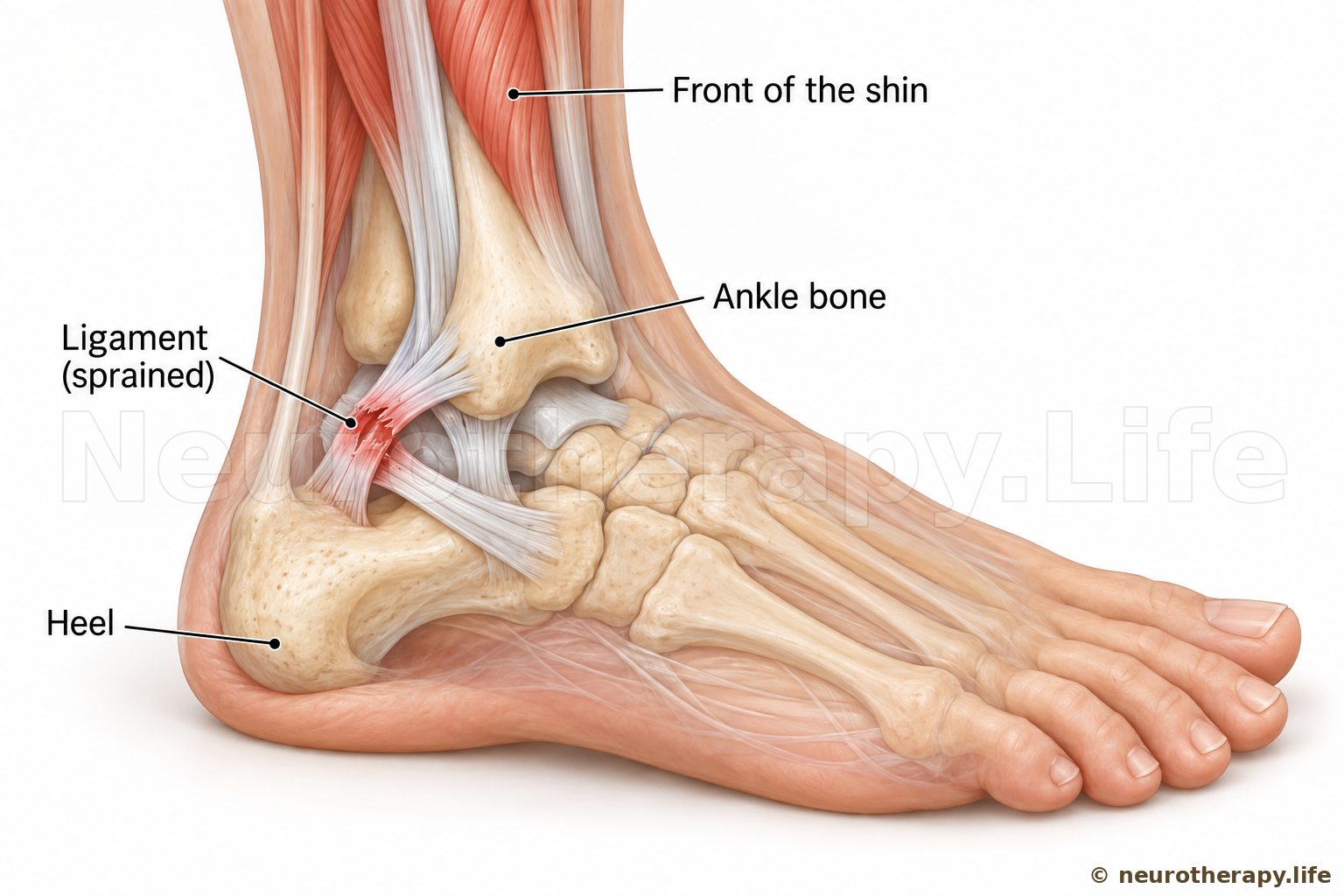
For the fourth side the patient lies straight on the back. The area is the front of the lower leg, starting from in front of the heel — not on the heel itself — and running upward toward the knee.
The other three sides are given as in ordinary BOF: face down, then on the right side and the left side.
How this point is given — the tool, the pressure, the count and the exact movement — is deliberately not described here. A demonstration video for this point is being prepared; until it is on this page, learn the method hands-on from a trained Neurotherapist before giving it. Please do not give any point from a written description alone: a point given in the wrong place or the wrong way can do harm.
The exact technique is taught hands-on in the Neurotherapy (LMNT) course. See the course →
Like BOF, the sprain form carries tissue from below upward. After a sprain the tissue at the front of the ankle is strained too, so the teaching closes the circle by working the front as well.
It is always given with its parent, BOF.
It is chosen for one thing: a sprain.
It is BOF with one side added. The usual three sides are still given, and the front of the leg is added because of the sprain.
Yes, if you cannot put weight on the foot, the bone itself is tender, the ankle looks deformed, or the swelling is severe. A fracture must be ruled out first.
It is a firm press, but it should stay bearable. A freshly sprained ankle is sore, so tell the therapist at once if the pressure is too much.
The ankle is the most commonly sprained joint in the body, and most ankle sprains happen when the foot rolls inward, stretching the ligaments on the outer side.
Source: StatPearls, Ankle Sprain.
Ligaments have a poorer blood supply than muscles, so they heal more slowly — often over several weeks.
Source: Standard physiology of connective tissue healing; StatPearls, Ankle Sprain.
Doctors use simple checks — such as whether the patient can take four steps and whether certain bones are tender — to decide which ankle injuries need an X-ray.
Source: Ottawa Ankle Rules (Stiell IG et al., JAMA 1993).
This page explains what a Neurotherapy (LMNT) treatment is for; it is not a self-treatment guide and does not diagnose. Neurotherapy (LMNT) works alongside your medical care — keep taking the medicines your doctor prescribed.
Send COURSE for course details, or your name, age and health issue for a consultation.