JJ Groin and JJ Back: for one leftover point of knee pain
When the knee treatments have done what they can and pain remains at one single spot, the side of the knee decides what comes next: inner side, JJ Groin; outer side, JJ Back.
Overview
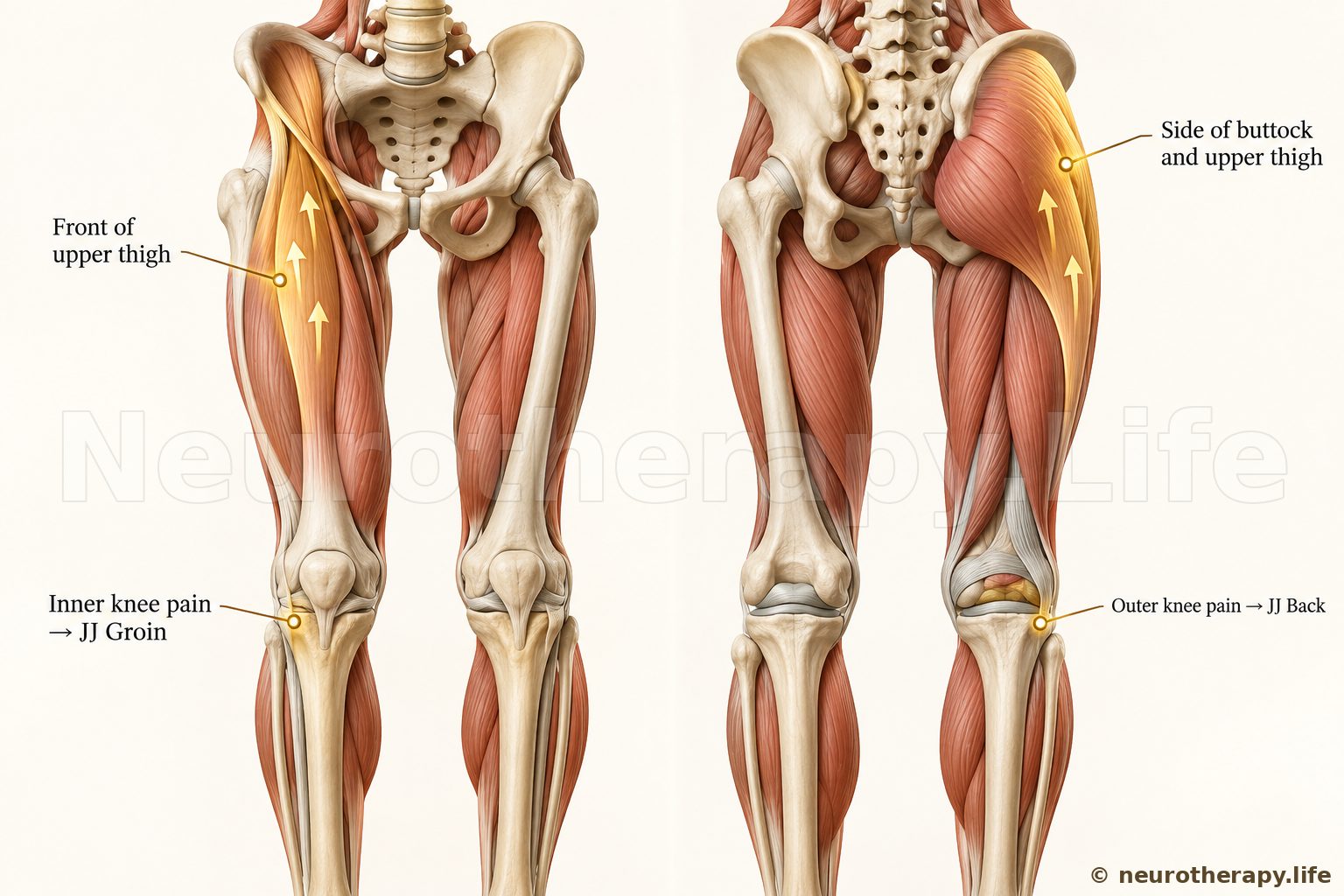
These two are late treatments. They are for someone who, even after the other knee treatments, still has pain at one single point that can be covered with a fingertip. They are not for a knee that aches all over, and they do not open a course of knee work.
Pain on the inner side of the knee calls for JJ Groin, given lying on the back only. It works the upper front of the thigh from below upward, towards the hip. Pain on the outer side calls for JJ Back, given face down, on the troublesome knee only. It works the side of the buttock and the upper outer thigh from below upward. Both use short, firm presses that lift off, with the heel or the palm. Neither touches the knee itself.
They should not be confused with JJ⁺¹ and JJ⁺², which look alike on a treatment card. Those are chosen by the level of the low back and given in graded rounds. JJ Groin and JJ Back are chosen only by which side of the knee hurts.
A teaching case: a farmer whose knee pain had shrunk to one fingertip on the outer side was given JJ Groin by mistake for two sessions, and nothing changed. The treatment record showed the error. Once JJ Back was given, he reported steady relief over the following weeks. The exact method is taught hands-on in the course.
Key points
- JJ Groin and JJ Back are for one leftover point of pain, after the other knee treatments.
- Inner side of the knee means JJ Groin, lying on the back.
- Outer side of the knee means JJ Back, face down, on that knee only.
- Both work the thigh and hip for a pain felt at the knee; neither touches the knee.
- They are a different family from JJ⁺¹ and JJ⁺², which are chosen by spinal level.
Go deeper
JJ Groin
The full point page for JJ Groin
JJ Back
The full point page for JJ Back
JJ⁺¹
JJ⁺¹, a different family chosen by spinal level
JJ⁺²
JJ⁺², its lower-level partner
Knee pain
Knee pain and how it is approached
Knee
How the knee is built
The Record That Shows the Truth: The Patient Card in Neurotherapy (LMNT)
Why the treatment record catches mistakes
Knee, Leg and Foot: Neurotherapy (LMNT) for Knee Pain and the Lower Leg
The full guide to the knee, leg and foot
Read the full guide
This topic is part of: Knee, Leg and Foot: Neurotherapy (LMNT) for Knee Pain and the Lower Leg
Safety: when it is held back
- The top of JJ Groin lies near the groin crease, where the great artery, vein and nerve of the leg and a cluster of lymph nodes sit close to the surface. Presses there are brief and light, and never placed on a pulse that can be felt. Blood vessels
- Stop and send to a doctor, rather than treat, if there is a pulsating lump in the groin, a hard fixed swelling there, a leg that is cold with no pulse at the ankle, or a recent puncture site from a hospital procedure.
- Neurotherapy (LMNT) works alongside your medical care. Do not stop or change any medicine on your own.
This page explains what a Neurotherapy (LMNT) treatment is for; it is not a self-treatment guide and does not diagnose. Neurotherapy (LMNT) works alongside your medical care — keep taking the medicines your doctor prescribed.