1A band from hip to shin
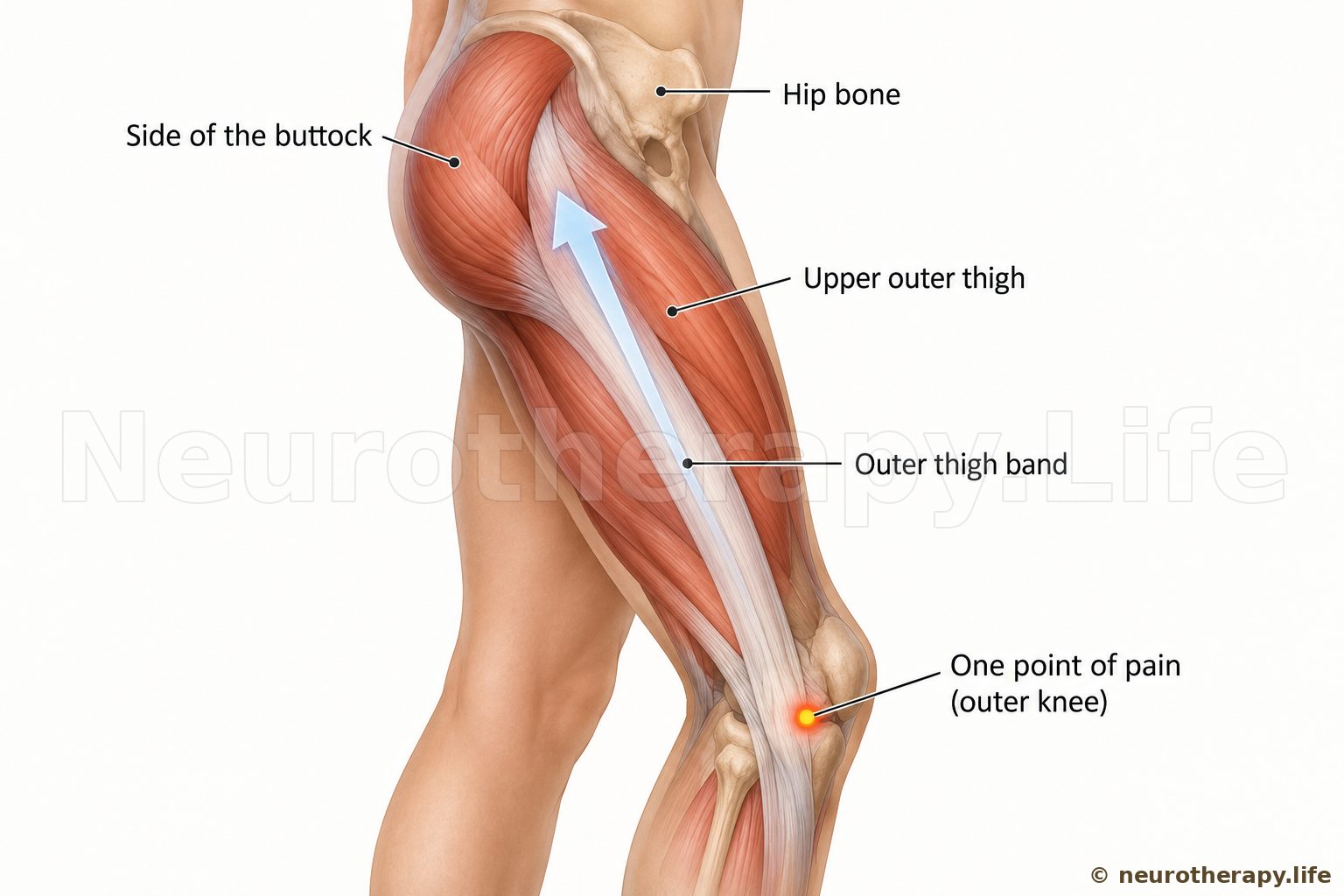
The iliotibial band runs from the outer hip down the thigh and attaches just below the knee on the outer side. Muscles of the hip and buttock pull on it from above.
Source: Gray's Anatomy, 41st ed., iliotibial tract.
Also called: J back, जे जे बैक
JJ Back is a late knee treatment in Neurotherapy (LMNT), given face down at the side of the buttock and the upper outer thigh. It is for a patient who, even after all the other knee treatments, still has pain at one single point on the outer side of the knee.
JJ Back is a physical point, the mirror of JJ Groin. The teaching says that with it the tissue on the outer side of the knee that has descended is pulled upward and brought back to its own place.
It is a finishing treatment. It comes after the knee sequence has done what it can, and it is for one single point of pain that the patient can cover with a fingertip — not for a knee that aches all over.
It shares only a written sign with JJ⁺¹ and JJ⁺², which are chosen by a level of the low back. JJ Back is chosen by where the leftover pain sits: on the outer side of the knee.
You lie face down with one and a half pillows under the chest, as in every face-down treatment.
It is given at the side of the buttock outside the pelvic bone and on the upper part of the thigh bone, starting some way below the hip and working up to the hip bone. Only the troublesome knee's side is treated. The knee itself is not touched.
How this point is given — the tool, the pressure, the count and the exact movement — is deliberately not described here. A demonstration video for this point is being prepared; until it is on this page, learn the method hands-on from a trained Neurotherapist before giving it. Please do not give any point from a written description alone: a point given in the wrong place or the wrong way can do harm.
The exact technique is taught hands-on in the Neurotherapy (LMNT) course. See the course →
The teaching says the muscles and tissues at the side of the buttock, outside the pelvic bone and over the upper thigh bone have descended, and JJ Back carries them back upward. Body science agrees that the outer-hip muscles feed into the long outer thigh band, which runs down to just below the knee and is a common source of outer-knee pain.
Inner side → JJ Groin, on the back. Outer side → JJ Back, face down. Two words decide, and they cannot be swapped.
It has one narrow use, written into its own entry.
A teaching case, put together from several patients: a farmer in his forties had months of knee pain, already partly treated, and was left with pain he could cover with one fingertip on the outer side of the knee. His knee-cap moved freely and his calves were cool, but the outer thigh and side of the buttock felt tight. JJ Back was given on that side only, alongside the earlier knee work, and the fingertip pain faded over the following sessions.
A composite case written to teach the reasoning — not one patient’s file.Because JJ Back works at the side of the buttock and the back of the upper outer thigh, which is easiest to reach face down. The knee itself is not touched.
No. Only the knee that is troublesome is treated.
No. They share a written sign only. JJ⁺² is chosen by a low-back level and walked down the calf; JJ Back is for one leftover point on the outer knee.
The iliotibial band runs from the outer hip down the thigh and attaches just below the knee on the outer side. Muscles of the hip and buttock pull on it from above.
Source: Gray's Anatomy, 41st ed., iliotibial tract.
Pain where the outer thigh band rubs over the outer knee is one of the commonest overuse injuries in runners and cyclists.
Source: Standard sports-medicine texts on iliotibial band syndrome.
The gluteus maximus of the buttock is the largest muscle in the human body, and part of it pulls into the outer thigh band.
Source: Gray's Anatomy, 41st ed., gluteal region.
This page explains what a Neurotherapy (LMNT) treatment is for; it is not a self-treatment guide and does not diagnose. Neurotherapy (LMNT) works alongside your medical care — keep taking the medicines your doctor prescribed.
Send COURSE for course details, or your name, age and health issue for a consultation.