1A bone that grew inside a tendon
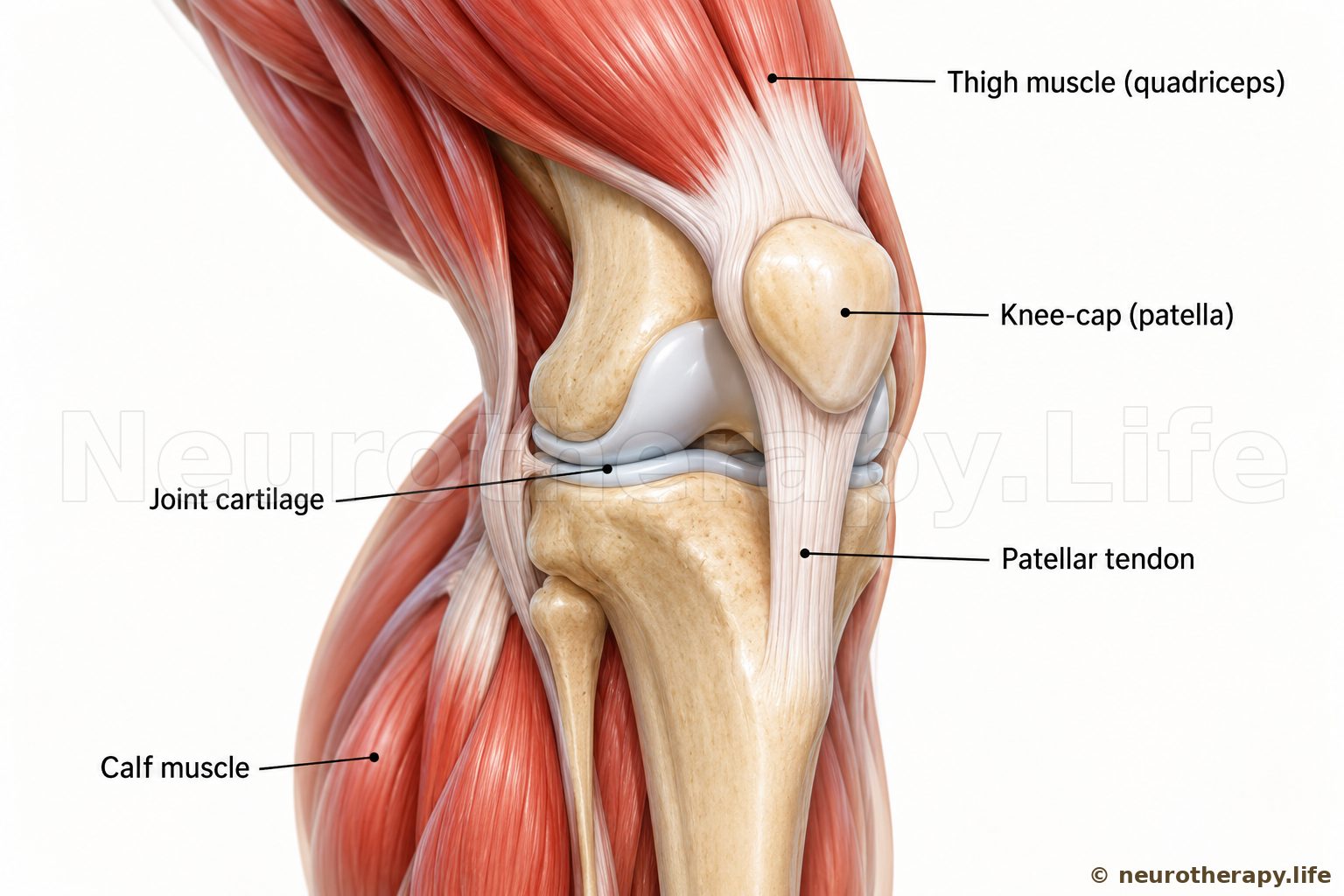
The knee-cap is a sesamoid bone: it forms inside the tendon of the big front thigh muscle and acts like a pulley, giving that muscle more leverage.
Source: Gray's Anatomy, 41st edition, the patella and knee joint.
Also called: Pradip treatment, Pradip trt., प्रदीप ट्रीटमेंट
Pradeep is a physical Neurotherapy (LMNT) treatment for the knee, given lying on your back with the knee resting bent on an angled pillow. It works the muscles above and below the knee from the therapist's position between the legs, and it comes late in the knee sequence — after the chemical points and after the gentler knee treatments.
Pradeep is not a gland point. It is one of the physical treatments for knee pain — treatments that work on where tissue is sitting, rather than on the body's chemistry.
The knee group of Neurotherapy (LMNT) follows one order. First come the chemical points, to improve the inner environment of the cells. After that come the physical points, chosen so that the tissues above and below the knee-cap — which get pulled during work and become caught at the knee-cap — are brought back to their own place.
In that sequence, Back of Knees softens what is behind, Knee Cap Free frees the cap, Giriraj and the calf work carry tissue back upward — and Pradeep works the region from both sides of the joint, ending with a steady load through the front of the knee.
You lie on your back. A pillow is placed under the knee at an angle, so that both the thigh and the lower leg are carried and the knee rests in a small bend, turned a little inward. The pillow is part of the treatment, not bedding: it sets the knee in the position of most room and least strain.
The therapist stands between your legs, facing the knee — not beside you, as for most treatments. The work covers the thigh above the knee, the leg below it and the front of the knee. The left knee is treated first, then the right.
How this point is given — the tool, the pressure, the count and the exact movement — is deliberately not described here. A demonstration video for this point is being prepared; until it is on this page, learn the method hands-on from a trained Neurotherapist before giving it. Please do not give any point from a written description alone: a point given in the wrong place or the wrong way can do harm.
The exact technique is taught hands-on in the Neurotherapy (LMNT) course. See the course →
Pradeep belongs to the 'putting-back' half of knee care. Its aim is to restore movement to tissue around the knee that has lost its glide.
Pradeep is one step of a knee sequence. Each step is its own treatment, and each can be given or withheld on its own.
Pradeep is for the painful, stiff knee — but only after the knees that must not enter the sequence have been ruled out.
Because the knee teaching starts with the chemical points: a knee in a body that is not digesting well has little raw material for repair. The physical treatments like Pradeep come after.
Not its forceful parts — no impulse and no body weight on a replaced knee, ever. Tell your therapist about any knee surgery, however old.
No. It is used to restore movement and ease pain; it does not put cartilage back. Keep your doctor in the picture, especially before any decision about surgery.
Because the work runs up the thigh and down the leg from the knee, and only from there can one therapist reach both directions safely, with their weight held on the chairs.
The knee-cap is a sesamoid bone: it forms inside the tendon of the big front thigh muscle and acts like a pulley, giving that muscle more leverage.
Source: Gray's Anatomy, 41st edition, the patella and knee joint.
The knee is the largest joint in the body, and it carries several times body weight on stairs.
Source: Gray's Anatomy, 41st edition, the knee joint.
Studies find that many knees showing wear on X-ray do not hurt, and some painful knees look nearly normal — which is why the knee in front of the therapist matters more than the picture.
Source: Bedson J, Croft PR. The discordance between clinical and radiographic knee osteoarthritis. BMC Musculoskeletal Disorders 2008;9:116.
This page explains what a Neurotherapy (LMNT) treatment is for; it is not a self-treatment guide and does not diagnose. Neurotherapy (LMNT) works alongside your medical care — keep taking the medicines your doctor prescribed.
Send COURSE for course details, or your name, age and health issue for a consultation.