1Your shoulder is the most mobile joint
The shoulder can move through a wider range than any other joint in the body — the price is that it is also the joint most easily dislocated.
Source: Gray's Anatomy, 41st ed. — the glenohumeral joint.
Also called: All-joints ghisai, Sab jodon ki ghisai, सब जोड़ों की घिसाई
All Joints Ghisai is a very, very light rubbing with the palms over every joint of the arm, from the fingers up to the shoulder, with a rest between one joint and the next. It is added after the New Star Modified formula, never in place of it, and patients often say the pain leaves the joints one by one.
'Ghisai' means rubbing — a gliding stroke, not a press. All Joints Ghisai is that rubbing given, very lightly, to every joint of the arm in turn: the finger joints, the wrist, the elbow and the shoulder.
It belongs to the Star line of joint-pain formulas as a companion. LMNT teaching calls it a mark of long practice: it is given after the New Star Modified formula is complete, as an addition, and never to replace any part of it.
Its lightness is the instruction, not a courtesy. It is the least pressure used anywhere in Neurotherapy (LMNT), and the rest between joints is part of the treatment, not a pause.
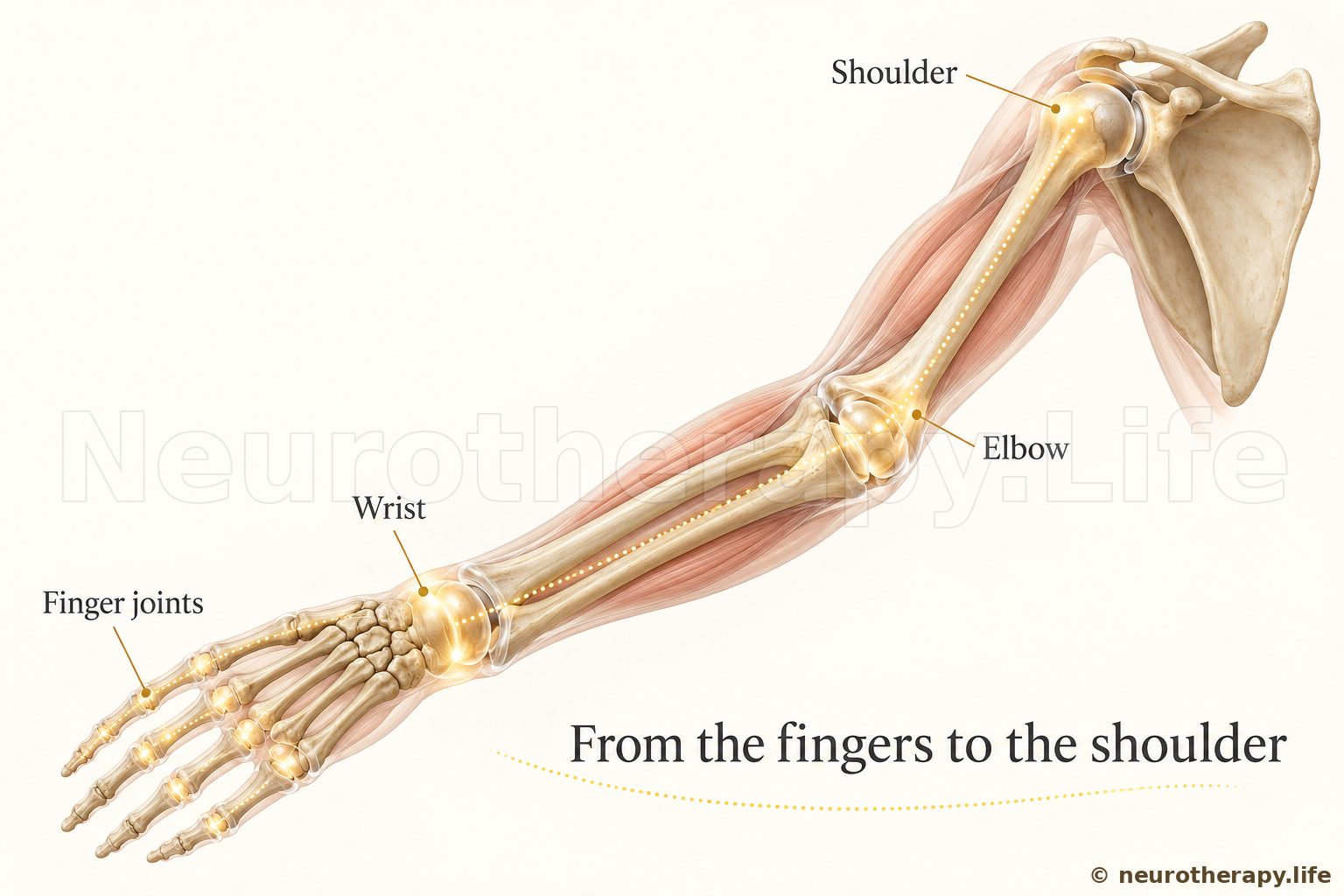
All Joints Ghisai is not built from named points. It works at the joints themselves, every one from the fingers to the shoulder. It follows the formulas and points listed below. The exact method is taught hands-on in the Neurotherapy (LMNT) course. This page lists the points of the formula and what each one contributes; it does not describe how any point is given. For the method, watch the demonstration video of each point on its own page and learn hands-on from a trained Neurotherapist. Please do not give a formula from a written description alone.
The Round Arrow along the spine, which closes the New Star Modified formula just before the joint rubbing begins.
(4) Medulla clockwise with T1/T2, which opens the full joint-pain protocol at the neck — the road the arm's nerves travel.
Position: Seated, with the arm relaxed and supported.
The exact technique is taught hands-on in the Neurotherapy (LMNT) course. See the course →
The therapist uses their own palms with a very, very light gliding stroke on one joint, then takes the hands off completely and rests before moving to the next joint. The work travels from the fingers up to the shoulder, joint by joint, in order.
LMNT teaching gives a reason for the rest. A working joint makes carbon dioxide, which leaves the body through the breath. The rest gives the patient time to breathe it out; without it, the full benefit of the rubbing is not had. The length of the rest is fixed and is taught hands-on.
All Joints Ghisai is the companion of the Star line and closes the full joint-pain protocol.
It is given after the Star formula in patients with joint pain in the arms and hands.
No. LMNT teaching is clear that the lightness is the instruction. It is the least pressure used anywhere in the therapy.
The rest is part of the treatment. It gives time for carbon dioxide to leave through the breath; without it, the full benefit is not had.
It is taught as an addition after New Star Modified, not as a treatment on its own.
LMNT teaching records that the pain comes out of the joints one by one, so plainly that patients call it magic. Results vary from person to person.
The shoulder can move through a wider range than any other joint in the body — the price is that it is also the joint most easily dislocated.
Source: Gray's Anatomy, 41st ed. — the glenohumeral joint.
Most joints of the arm are synovial joints, lined by a thin membrane that makes a slippery fluid. It oils the joint and feeds the cartilage, which has no blood vessels of its own.
Source: Gray's Anatomy, 41st ed. — synovial joints.
Most of the carbon dioxide your tissues make travels in the blood as bicarbonate, and is turned back into gas in the lungs to be breathed out.
Source: Guyton & Hall, Medical Physiology, 14th ed. — transport of carbon dioxide in the blood.
This page explains what a Neurotherapy (LMNT) treatment is for; it is not a self-treatment guide and does not diagnose. Neurotherapy (LMNT) works alongside your medical care — keep taking the medicines your doctor prescribed.
Send COURSE for course details, or your name, age and health issue for a consultation.