1A toe has two or three bones
The big toe has only two small bones; each of the other toes has three. Each foot has 26 bones and more than 30 joints.
Source: Gray's Anatomy, 41st ed. (foot and ankle).
Also called: New Nabhi Set, New Navel Set, न्यू नाभि सेट
NNS, the New Nabhi Set, is a Neurotherapy (LMNT) treatment that sets the navel from the toes. Given at the toe joints while you lie on your back, it is the fine-tuning navel set: where the Old Nabhi Set settles the whole abdomen at once, NNS can set right one particular organ, or several one after another.
Nabhi is the Hindi word for the navel. Neurotherapy (LMNT) began with the folk skill of setting the navel, and over the years it built a family of navel treatments. The first was ONS, the Old Nabhi Set, which lifts both legs. NNS, the New Nabhi Set, came later and works only at the joints of the toes.
The two do different jobs. ONS sets all the organs of the abdomen at one and the same time — enough when the navel is only slightly upset from travel. NNS sets right whichever organ has gone wrong, in a fine way. When both are written, ONS is given first and NNS after; that gives more benefit.
Why the toes? In the Neurotherapy (LMNT) map every toe carries an organ code — Gas, Gas 'I', Pan, Gal, Spl, Liv, Mu and the ovary points — and each toe is joined to its own place around the navel. A card may name a single toe, and then only that toe is treated.
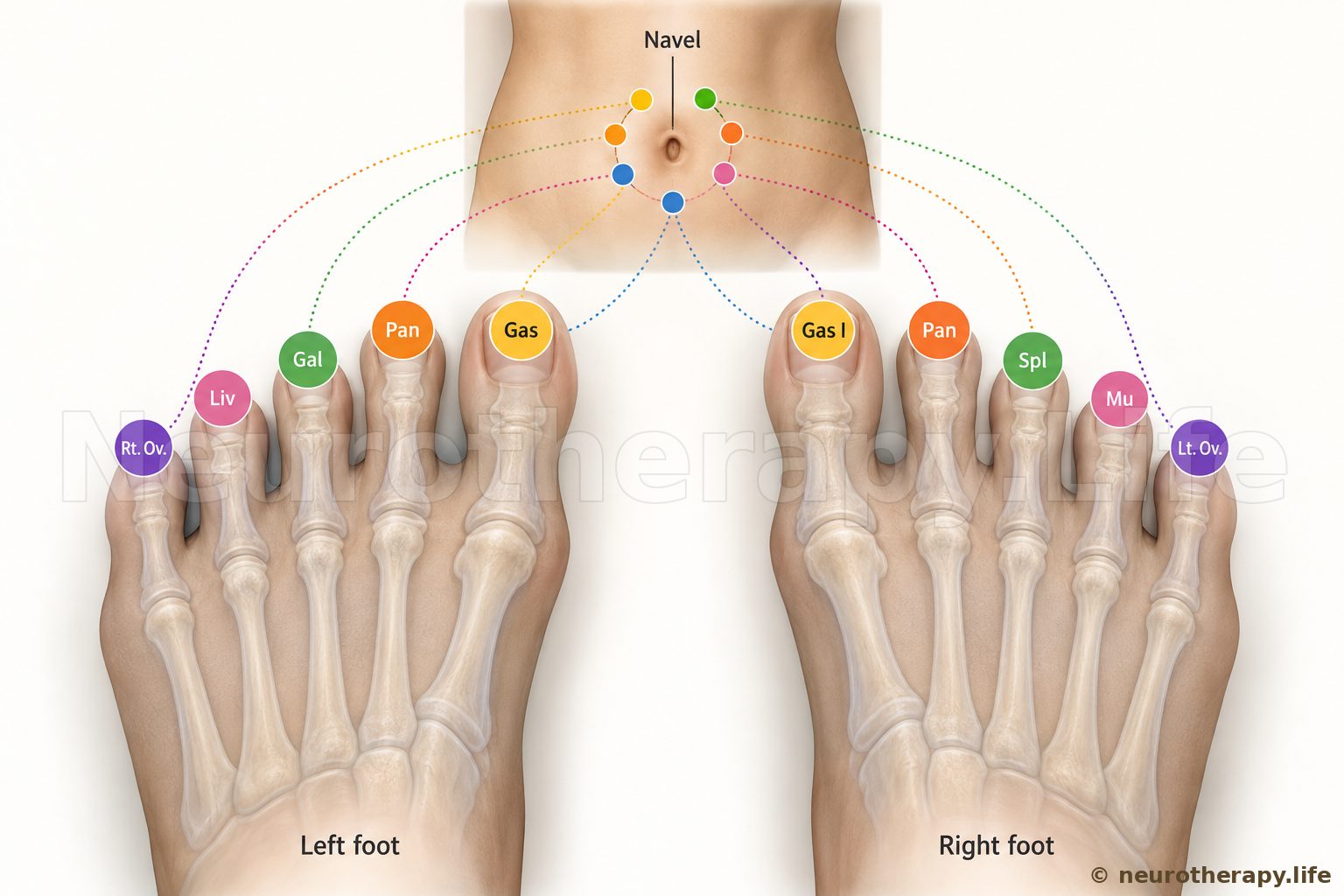
You lie flat on your back and the therapist sits at the foot end, facing the soles of your feet. If your feet hurt, a pillow may go under the foot, placed so that the heel stays off the pillow and on the mat.
NNS is given at the joints of the toes, beginning where each toe leaves the foot — it does not start higher up on the foot as CNNS does. Unless the card names particular toes, all the toes of both feet are treated.
How this point is given — the tool, the pressure, the count and the exact movement — is deliberately not described here. A demonstration video for this point is being prepared; until it is on this page, learn the method hands-on from a trained Neurotherapist before giving it. Please do not give any point from a written description alone: a point given in the wrong place or the wrong way can do harm.
The exact technique is taught hands-on in the Neurotherapy (LMNT) course. See the course →
In the teaching, NNS sets the organs around the navel one by one, through the toe that carries each organ's code. The link between a toe and a place at the navel is the therapy's own map, built from clinical experience; it is not a finding of anatomy.
The navel sets are separate treatments with separate names; a card always says which one is meant.
NNS is chosen from what the therapist finds around the navel and at the toes, and from the formula on the card.
Three navel-setting steps — ONS, TF and NNS — placed in front of the New Star, for the patient whose navel was never set; very useful in RA.
The Star formula for the patient whose joint pain comes from the alkali side.
The twelve-part treatment for breathing and hormones; NNS is given with Folded Legs and TF.
The single running order that TF and NNS share across the ten toes.
In the Neurotherapy (LMNT) map each toe carries the code of one organ around the navel. The toe is the switch; the navel is where the result is looked for.
ONS settles all the abdominal organs at once, like shaking a packed bag; NNS tunes one organ at a time, like a TV remote. When both are written, ONS comes first.
A named toe narrows the treatment to that organ. 'Gal' is the middle toe of the left foot, so only that toe is treated.
Not this way. If your feet have lost feeling, firm pressure on the toes is stopped, because your feet cannot warn you of harm. Tell your therapist about any numbness.
The big toe has only two small bones; each of the other toes has three. Each foot has 26 bones and more than 30 joints.
Source: Gray's Anatomy, 41st ed. (foot and ankle).
Across North India the belief that the navel can shift and be put back by practised hands is ordinary; families call it nābhi ṭalnā or dharan girnā, and the elder's hands often go to the toes first.
Source: Traditional North Indian practice, as described in the Neurotherapy (LMNT) teaching.
Nerve damage from diabetes affects up to about half of people who have had diabetes for many years. A foot that cannot feel pain cannot warn you — which is why such feet are not pressed.
Source: Pop-Busui R et al., Diabetic Neuropathy: A Position Statement by the American Diabetes Association, Diabetes Care 2017;40:136–154.
This page explains what a Neurotherapy (LMNT) treatment is for; it is not a self-treatment guide and does not diagnose. Neurotherapy (LMNT) works alongside your medical care — keep taking the medicines your doctor prescribed.
Send COURSE for course details, or your name, age and health issue for a consultation.