Also called: TF / NNS running order, Toe Finger and New Nabhi Set order, TF NNS standard order
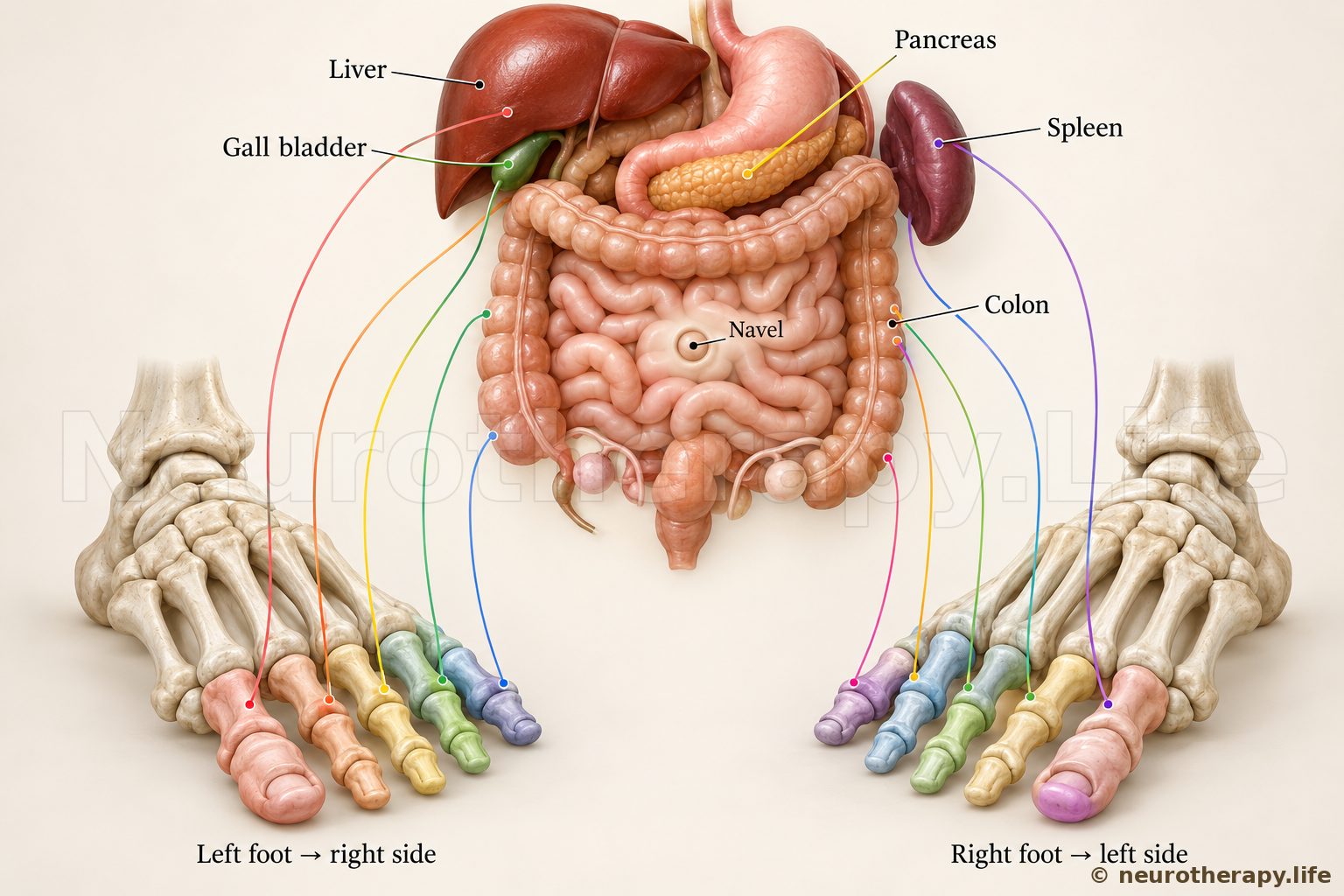
TF (Toe Fingers) and NNS (New Nabhi Set) are the Neurotherapy (LMNT) treatments that set the organs around the navel through the ten toes. Each toe stands for one abdominal organ station, so the two feet act as one keyboard for the whole abdomen. A standard order covers all ten toes, and two altered forms are used for mild constipation and for digestion.
Overview
What is the TF / NNS toe map?
TF and NNS are two navel-setting treatments given at the joints of the toes, with the patient lying on the back. In Neurotherapy (LMNT) the navel is the centre of the abdomen's organs, and when it is upset digestion suffers. Given together at the close of a treatment, TF and NNS are taught to set all the organs of the navel.
Nothing new is introduced here. The toes carry the same organ points a student first learns on the thighs and arms — Gas, Gas 'I', Pan, Gal, Liv, Spl, Mu, Rt. Ov. and Lt. Ov. Only the place from which the organs are addressed has changed: the same alphabet, written in a different hand.
The map crosses: the left foot answers the organs on the right side of the navel, and the right foot those on the left. When a card writes TF or NNS without naming a toe, all ten toes are treated. When a toe is named — for example NNS 'Gal' — only that toe is treated.
The ten toes act as one keyboard for the navel's organs, and the map crosses: left foot to the right side, right foot to the left.
What it is for
What is it used for?
To set all the organs around the navel, usually at the close of a treatment, so the stomach and intestines work properly.
In an altered form for mild constipation, which leaves out one toe and gives more attention to the stretch of colon that has to move.
In a second altered form for digestion, which centres on the pancreas, gall bladder, liver and gas stations.
As a named single toe, when only one organ needs to be reached.
Points it works through
Which stations does it work through?
Gas : Gas 'I' : Pan (left) : Pan (right) : Gal : Liv : Rt. Ov. ; Spl : Mu : Lt. Ov.
Ten toe stations, each standing for an abdominal organ point. They are listed here as a set, with the foot and the organ each one stands for. The running order and the exact method are taught hands-on in the Neurotherapy (LMNT) course. This page lists the points of the formula and what each one contributes; it does not describe how any point is given. For the method, watch the demonstration video of each point on its own page and learn hands-on from a trained Neurotherapist. Please do not give a formula from a written description alone.
NNS, the New Nabhi Set — the second toe treatment, using the same map.
Position:Lying on the back (supine), with the therapist sitting at the foot end, facing the soles.
The exact technique is taught hands-on in the Neurotherapy (LMNT) course. See the course →
How it works
How is the order organised?
The standard order is organised by organ logic, not by the convenience of the therapist's hands. It begins with the two gas stations, then the two halves of the pancreas, and only then settles into one foot and then the other — the gall bladder and liver group, then the spleen and the left colon, with the two gonad stations at the end of each foot's run.
In mild constipation the Rt. Ov. toe is left out, because the teaching says it would reduce alkali and raise acid, and the stations of the left colon are given more attention instead. An omission here is an instruction, not a shortcut. In the digestion form, the gonad, spleen and Mu stations are left out and the pancreas, gall bladder and liver stations carry the work.
Its family
Which treatments are related?
The toe map is shared by the navel-setting group, and the same organ points appear in the abdominal formulas.
Abdominal painTender places around the navel, set through the matching toes
The bowel
ConstipationMild constipation, in the altered form that leaves out the Rt. Ov. toe
Safety: when it is held back
Feet without feeling — as in long-standing diabetes — are not treated with firm or repeated pressure. Look at the feet first; never rub so hard that the skin breaks. Diabetes
Any ulcer, blister, new redness, swelling or change of shape in the foot is shown to a doctor the same day. Gangrene
In cancer, Neurotherapy (LMNT) never gives Rt.Ov/Lt.Ov, (10) Pan, Thymus, Pit, Lu+Sh or (30) Medulla — so the ovary stations are left out. Cancer care: Neurotherapy (LMNT) support
Constipation that starts after the age of fifty, or comes with blood or weight loss, needs a doctor before any formula. How to tell a patient to see a doctor
Why would my toes be worked for a stomach problem?
In Neurotherapy (LMNT) each toe carries the code of an abdominal organ, so the toes are another way of reaching the same organs as the points on the thighs and arms.
Why does the left foot link to the right side?
That is how the map is taught: the left foot answers the organs on the right of the navel — gall bladder, liver, appendix region — and the right foot those on the left.
Is it painful?
It is meant to rouse the nerves under the skin, not to hurt. Tell your therapist if any toe is very tender — that tenderness is itself a finding.
Surprising facts
1Your feet are packed with nerve endings
The sole of the foot is one of the most densely innervated areas of skin, rich in touch and pressure receptors that help you balance.
Source: Kennedy PM, Inglis JT. Distribution and behaviour of glabrous cutaneous receptors in the human foot sole. J Physiol. 2002;538(Pt 3):995–1002.
2The colon is about a metre and a half long
The large intestine runs up the right side, across, and down the left side of the abdomen — the route the toe map follows from one foot to the other.
Source: Gray's Anatomy, 41st ed. — large intestine.
3The pancreas has a head and a tail
The head of the pancreas sits in the curve of the duodenum on the right, and its tail reaches across to the spleen on the left.
This page explains what a Neurotherapy (LMNT) treatment is for; it is not a self-treatment guide and does not diagnose. Neurotherapy (LMNT) works alongside your medical care — keep taking the medicines your doctor prescribed.
Ready to begin?
Send COURSE for course details, or your name, age and health issue for a consultation.