Your navel is the scar left by the cord that fed you before birth — and the natural centre of your belly. For Neurotherapy (LMNT) it is where the whole therapy began, and where every examination starts.
Overview
What is the navel?
The navel, or belly button (umbilicus), is a small scar in the middle of your belly. Before birth, the umbilical cord joined you there to the placenta, bringing oxygen and food from your mother and carrying waste away. After birth the cord is clamped and cut, the stump dries and falls off, and the navel is what remains.
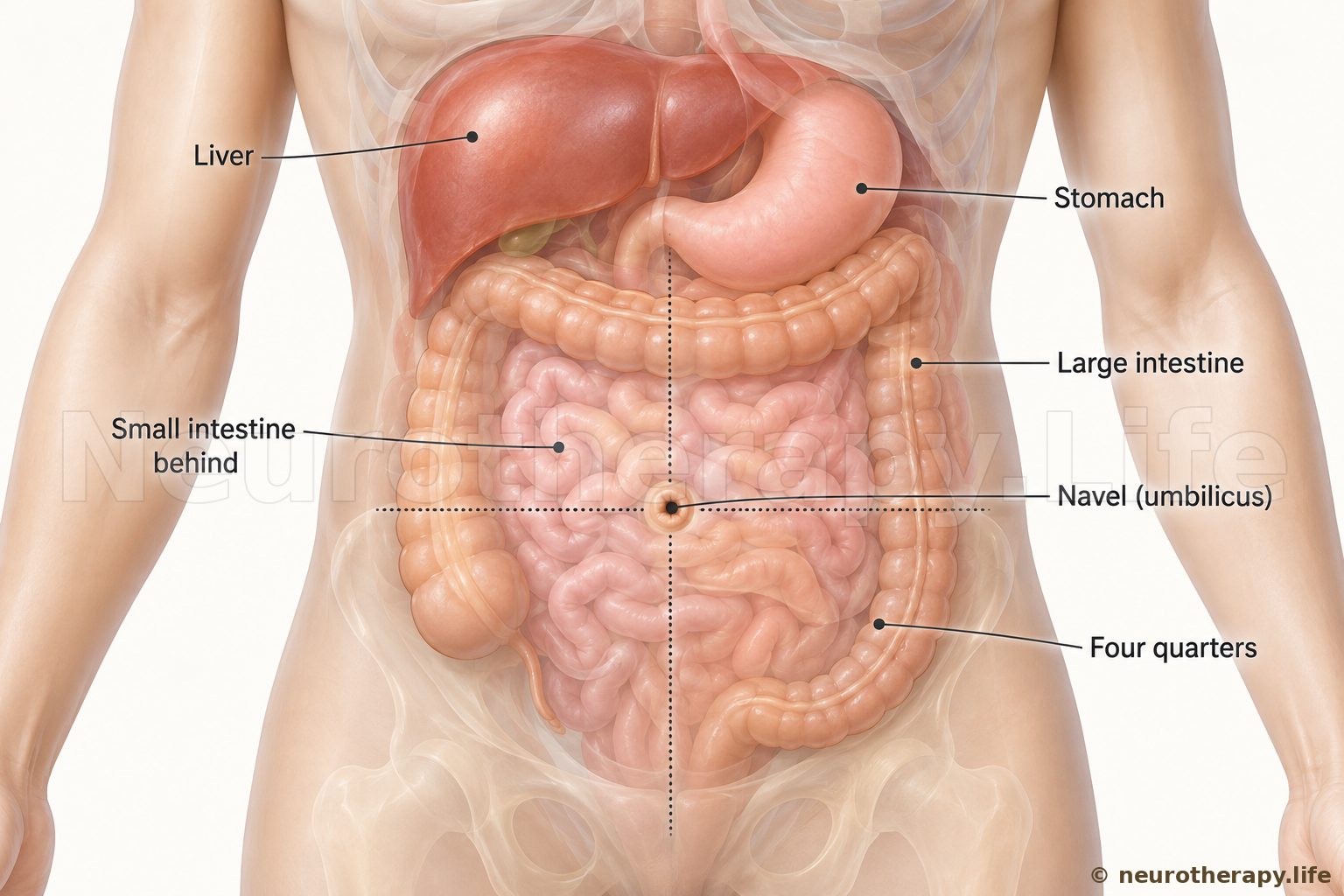
Although it no longer does any work, the navel stays a useful landmark. Doctors divide the belly into quarters around it, and several organs and body levels are found in relation to it.
In Indian homes a 'slipped navel' (nābhi khisaknā) is a familiar complaint, and setting the navel is an old folk skill. Neurotherapy (LMNT) began there: Guruji's own long stomach ache as a boy was eased when an old man set his navel. Today every LMNT examination begins by pressing gently at fixed points around the navel.
The navel: a small scar, and the centre point around which the belly is mapped.
Function
What does the navel do?
Before birth, the place where the navel will be is a lifeline. After birth it becomes a scar — and a map-maker's centre point.
Before birth: carries oxygen and food in through one vein, and waste out through two arteries, in the umbilical cord.
At birth: once the cord is cut, its vessels close; the stump dries and falls off, usually within one to three weeks.
After birth: the closed vessels remain inside as thin cords (ligaments) running to the liver and the bladder.
A landmark for doctors: the belly is divided into quarters and regions around it, and it lies roughly level with the third and fourth lumbar vertebrae.
A hidden doorway: surgeons often enter through the navel for keyhole surgery, so the scar hides in its folds.
In LMNT: the centre of the examination — pain or hardness at points around it is read as a sign of disturbed blood flow to the organs of that region.
How is the navel connected to other organs?
Heart, blood and circulation — Before birth, the cord's two arteries and one vein linked the baby's circulation to the placenta.
Liver — The old umbilical vein becomes the round ligament of the liver, a thin cord running up to it.
Bladder — A thin cord, the remnant of an early tube called the urachus, runs from the navel down to the top of the bladder.
Intestines — The coils of the small intestine lie around and behind the navel; in the embryo they even grew for a while inside the cord.
Spine — The navel lies roughly in front of the L3–L4 level of the low back; LMNT uses it to find the L3 vertebra from behind.
Kidneys — LMNT names the kidneys after the points beside the navel: Liv°, the right kidney, lies behind Liv; Mu°, the left kidney, behind Mu.
Anatomy
What are the parts of the navel?
What you see is only a small dip in the skin. Behind it lies a ring in the belly wall and the remains of the cord's vessels.
The navel itself
Umbilicus — The scar where the cord was attached — a dip or a small knob of skin.
Umbilical ring — A small, tough ring in the belly wall under the skin, where the cord passed through. If it stays weak, a hernia can push through.
Linea alba — The tough white band down the middle of the belly, from the breastbone to the pubic bone; the navel sits in it.
Remains of the umbilical cord inside
The cord had three vessels — two arteries and one vein. After birth they close into thin cords.
Round ligament of the liver — What the umbilical vein becomes; it runs up from the navel to the liver.
Medial umbilical ligaments — What the two umbilical arteries become; they run down beside the bladder.
Median umbilical ligament — The remnant of the urachus, an early tube that once joined the bladder to the cord.
The map around the navel
Doctors and LMNT therapists both read the belly in relation to the navel, in different ways.
Four quarters and nine regions — A line down and a line across through the navel make four quarters; doctors also use nine regions, with the navel in the central 'umbilical region'.
LMNT's three rings — In eight directions around the navel the same point recurs at three distances: 3 closest to the navel, 2 in a middle ring, 1 furthest out. The nearer the navel the pain, the further down the limb the treatment is given.
LMNT's front points — Gas 'I' immediately around the navel; Liv to its right and Mu to its left; Gas above it; WD below it; Const and Dys in the upper quarters; Rt. Ov. and Lt. Ov. in the lower quarters.
Where is the navel located?
The navel sits on the midline of the belly, roughly level with the disc between the third and fourth lumbar vertebrae of the low back, though its height varies with body shape and weight. The skin around it is supplied by the tenth thoracic spinal nerve.
Behind it lie coils of the small intestine and, deeper still, the aorta, which divides into the two leg arteries just below the navel's level. LMNT teaching uses a simple rule: the L3 vertebra lies straight behind the navel, so the navel is noted before a patient is turned face down.
Most navels are 'innies' — a small hollow — and a smaller number are 'outies', where a little knob of scar sticks out. The shape depends on how the skin and scar healed, and it can change with weight gain or pregnancy.
In a newborn the cord stump starts moist and bluish-white, then dries, shrinks and darkens before it falls off.
How big is the navel and the cord?
The navel itself is small — usually one to two centimetres across — but at birth the cord that led to it is about 50–60 cm long and one to two centimetres thick.
LMNT's examination field around it is much larger: eighteen named points around the navel and the hips, from the pit of the stomach down to the groins.
Conditions and disorders
What conditions affect the navel and the area around it?
The navel itself can have a few problems of its own — a hernia, or an infection. Far more often, pain around the navel comes from the organs behind it.
At the navel itself
Hernia (groin, navel and hiatus)An umbilical hernia: a soft bulge at the navel that grows when coughing or crying. Common in babies, and most close on their own.
Pain around the navel
Abdominal painBelly pain has many causes; where it sits around the navel helps point to the organ.
AppendicitisOften starts as a dull pain around the navel, then moves to the lower right — an emergency.
AcidosisRead in LMNT from the two flanks, which are examined first.
AlkalosisThe other of the two directions read from the flanks.
Linked in LMNT teaching
Rheumatoid arthritis (RA) and rheumatismThe New Star Modified formula puts three navel-setting steps first, for patients whose navel 'was never set'; it has been found most useful in RA.
Low back pain(6) L3, 4, 5 starts at the L3 vertebra, found straight behind the navel.
Pain around the navel that moves to the lower right, with fever or vomiting
A bulge at the navel that becomes hard, painful, discoloured or cannot be pushed back
Redness, swelling, pus or a bad smell from the navel
In a newborn: bleeding from the stump, redness spreading onto the belly, fever or poor feeding
A moist, pink lump or leaking fluid at a baby's navel after the stump has fallen off
A belly that is rigid, very tender, or has a pulsing lump — see a doctor today
How are navel problems checked?
Physical examination — A doctor looks, feels for a bulge while you cough, and presses gently around the belly.
Ultrasound — Shows a hernia, a collection of fluid, or the appendix and nearby organs.
Swab test — A sample from a discharging navel finds the germ or fungus causing an infection.
Blood tests and CT scan — Used when appendicitis or another inside cause of pain is suspected.
LMNT examination — A therapist presses gently inward with the fingertips at fixed points around the navel and hips, flanks first, and writes down each tender point and its grade.
How are navel problems treated?
Keep it clean and dry — Most smells and mild irritations settle with gentle washing and careful drying.
Creams or antibiotics — For a fungal or bacterial infection, as a doctor advises.
Care for a baby's navel — A small moist lump (granuloma) is often treated by a doctor with a simple application; an infected stump needs prompt medical care.
Hernia repair — Babies' umbilical hernias are usually watched; adults' hernias, or ones that do not close, may need a small operation.
Treating the cause behind the pain — Pain around the navel is treated according to its source — for example surgery for appendicitis, or care of the bowel.
Neurotherapy (LMNT)
Neurotherapy (LMNT) began at the navel. In 1943, at the age of eleven, Guruji had a stomach ache that lasted many months and that the best medical help of the time could not ease. An old man laid him face down, drew his hands and feet in a particular way, and set his navel; the pain went almost at once and did not return. Three things in that scene became the therapy: the patient's position is part of the treatment; the correction is made at the limbs, not at the painful spot; and it is done gently. From decades of practice came the central observation: specific points around the navel and hips show pain or hardness, the same points are tender in people who share a group of symptoms, and pain at a place signals disturbed blood flow to the organs there — so when the pain is relieved, the supply has been restored. The examination therefore starts at the belly: the two flanks first (Liv° and Mu°), then from the outer ring inward, leaving the sensitive ground right around the navel till late. The treatment follows a crossing map — legs for pain above the navel, arms for pain below it, the left limbs for the right side and the right limbs for the left — and the three rings tell how far down the limb to go. For the navel itself there are gentle 'navel-setting' treatments given at the feet: ONS, TF and NNS.
Points
ONS — Old Nabhi Set: both big toes held, both feet raised slowly to the therapist's hand height, held six seconds and lowered very slowly — three times. The patient stays completely passive.
TF — Toe Fingers: the three sides of every toe joint rubbed a set number of times, from the left big toe; reversed in children with ordinary loose motions.
NNS — New Nabhi Set: the thumb at each toe joint bends the toe gently towards the sole for six seconds.
CNNS — Complete New Nabhi Set: the nerves drawn from ankle to toe, then each toe pressed down. In LMNT teaching each toe is joined to a particular place at the navel.
Gas 'I' — Immediately around the navel — the small intestine; the most sensitive ground, examined late.
Liv — To the right of the navel, level with it, in the middle ring.
Mu — To the left of the navel, level with it — named for the mucous lining of the whole gut.
Liv° — The right kidney, named after Liv because it lies straight behind it; checked in the right flank.
Mu° — The left kidney, named after Mu; checked in the left flank. The two flanks are examined first.
WD — On the midline below the navel; answered on both forearms, near the elbow or near the wrist depending on the ring.
Organ Clearance — Given face down over the back; its name comes from clearing the arteries to the organs, by which the pain of the organs beside the navel goes.
(6) L3, 4, 5 — Starts at the L3 vertebra, straight behind the navel, sweeping the back muscles outward; for low back problems.
“Whenever there is an obstruction or blockage in the blood circulation of any part of the body, then pain or numbness is felt in that part.”
— Dr. Lajpatrai Mehra
“This matter is to be publicised as widely as possible: that the cord should not be cut until the child itself has cried properly for some time.”
— Dr. Lajpatrai Mehra
“Every person, from a one-day-old infant up to the age of a hundred years, can take this treatment.”
— Dr. Lajpatrai Mehra
Never do this
Never press hard on a belly that is rigid, very tender to the lightest touch, has a pulsing lump, or has sudden severe pain. That is a doctor's problem today, not a session.
Do not examine over a fresh scar, a stoma, a known swelling, a pregnancy or a rigid belly — write down that it was not examined, and why. Examine only with the patient's consent, covered, and with a chaperone where needed.
ONS is a passive lift of both straight legs: not given with acute low back pain running below the knee, a disc under treatment, or thin, brittle bones. Lift only to the therapist's own hand height; the patient must not help. ONS
Folded Legs is not given when there is inflammation in the abdomen. In the New Star Modified formula, (½) Ku is not given during menstruation or with low blood pressure. New Star Modified
Guruji's cord teaching is about not hurrying to cut the cord. It is never a reason to wait with a newborn who is not breathing: such a baby needs help to breathe within the first minute of life.
See a doctor for a navel that is red, swollen, discharging or smells, and at once for a newborn's stump that bleeds or has spreading redness or fever, or for a bulge at the navel that turns hard, painful and cannot be pushed back (call 108/112).
Keep taking prescribed medicines. Neurotherapy (LMNT) works alongside your doctor's care, not in place of it.
Care
How do I look after my navel?
A navel needs very little — just keeping it clean, dry and treated gently.
Wash and dry it
Clean it gently with soap and water when you bathe, and dry it well — especially a deep navel, where sweat and skin cells collect.
Care for a newborn's stump
Keep it clean and dry, fold the nappy below it, put nothing on it unless your nurse or doctor advises, and let it fall off by itself.
Don't let anyone yank at a 'slipped navel'
The old teaching treats the navel as delicate. Guruji's own navel was set gently, from the hands and feet. Rough pressing or pulling on the belly can do harm.
Lift with care
Households link a 'slipped navel' with heavy lifting, jumping and sudden twists. Bend the knees and keep loads close when you lift.
Keep a healthy weight
Extra belly fat stretches the belly wall and raises the risk of an umbilical hernia in adults.
Care for a piercing
A navel piercing takes months to heal; keep it clean and see a doctor if it becomes hot, red or discharges.
Notice pain around it
Mention pain or hardness around the navel to your therapist; pain that moves to the lower right or comes with fever needs a doctor.
Common questions
Can the navel really 'slip'?
In standard anatomy the navel is a scar fixed in the belly wall, so it cannot move. But the household words 'nābhi khisaknā' describe a real, familiar group of complaints — cramping around the navel, loose or blocked motions, no appetite, a dragging feeling — often after lifting or a jerk. LMNT reads this group as disturbed blood flow among the packed organs around the navel, and treats it gently from the feet.
Why does my belly button smell?
A navel is a warm, shaded fold where sweat, dead skin and bacteria collect. Gentle daily washing and drying usually solves it. Redness, pain, discharge or a lump need a doctor.
Is pain around the navel serious?
Most often it comes from gas, constipation, loose motions or an upset gut. But appendicitis often starts as pain around the navel before moving to the lower right, so pain that moves, gets worse, or comes with fever or vomiting needs a doctor the same day.
Why does an LMNT therapist press around my navel first?
Because in LMNT teaching the tender points around the navel and hips are the map of which organs are short of blood supply that day. The therapist presses gently at fixed points, grades each one, and chooses the treatment from what is found — and checks again after treatment to see which pains have gone.
My baby's navel sticks out when he cries. Is that dangerous?
That is usually an umbilical hernia, which is common in babies and most often closes on its own in the first few years. Show it to your doctor. Go at once if the bulge becomes hard, painful, discoloured, or the baby vomits.
When should the cord be cut after birth?
Guruji taught that the cord should not be cut in a hurry, and modern guidance agrees: for a healthy baby, the World Health Organization advises waiting at least one minute, which lets extra blood flow into the baby. But a baby who is not breathing is helped to breathe first — always follow the birth team.
What should I ask my doctor or therapist?
Is this bulge at my navel a hernia, and does it need repair?
Is my baby's navel healing normally, and what should I put on it, if anything?
Which organ could be causing the pain around my navel, and do I need a scan?
Which warning signs mean I should come back at once?
For my therapist: which points around my navel were tender today, and which were better than last time?
For my therapist: do I need the navel-setting treatments, and is ONS safe for my back?
Surprising facts
1Your navel is a jungle of bacteria
Scientists swabbed the navels of 60 volunteers and found more than 2,000 different kinds of bacteria between them. Each person carried a different mix, though a handful of common kinds turned up in most navels.
Source: Hulcr J et al. A jungle in there: bacteria in belly buttons are highly diverse, but predictable. PLoS ONE 2012;7(11):e47712 (2,368 bacterial types across 60 navels)
2Your intestines once grew inside the cord
Around the sixth week of life in the womb, the growing intestines run out of room in the tiny belly and loop out into the base of the umbilical cord. By about the tenth week they return inside and settle around what will become the navel.
Source: Moore KL, Persaud TVN, Torchia MG. The Developing Human, 'Physiological herniation of the midgut' (about weeks 6–10)
3Cutting the cord does not hurt
The umbilical cord has two arteries and one vein wrapped in a soft jelly — but no nerves. That is why neither mother nor baby feels it being cut.
Source: Moore & Persaud, The Developing Human; Gray's Anatomy — the umbilical cord contains two arteries, one vein and Wharton's jelly, and no nerves
4Waiting a minute to cut the cord gives the baby extra blood
If the cord is clamped a little later rather than at once, more of the baby's own blood flows back from the placenta. A large review found healthy babies had higher haemoglobin soon after birth and better iron stores months later. The World Health Organization advises waiting at least one minute — much in the spirit of Guruji's call not to hurry the cord.
Source: McDonald SJ et al. Effect of timing of umbilical cord clamping of term infants on maternal and neonatal outcomes. Cochrane Database Syst Rev 2013;(7):CD004074; WHO guideline on delayed umbilical cord clamping, 2014 (not earlier than 1 minute)
5Early appendicitis often starts at the navel
The appendix is in the lower right, but its early pain is often felt as a dull ache around the navel, because it shares nerve pathways with the skin there. Only later, as the lining next to it becomes inflamed, does the pain move to the lower right.
Source: Guyton & Hall (referred visceral pain); StatPearls, 'Appendicitis' — periumbilical pain migrating to the right lower quadrant
6The navel has long been called the centre of the body
About two thousand years ago the Roman architect Vitruvius wrote that if a person lies with arms and legs stretched out, a circle drawn around the navel will touch the fingers and toes. Leonardo da Vinci drew this idea as his famous 'Vitruvian Man'.
Source: Vitruvius, De Architectura III.1; Leonardo da Vinci, Vitruvian Man (c. 1490, Gallerie dell'Accademia, Venice)
7Navel and nave are cousins
The Sanskrit nābhi means both the navel and the hub of a wheel. English shows the same old link: 'navel' and 'nave' (the hub of a wheel) grew from one ancient root. For LMNT this is exactly how the navel is treated — the centre everything else is arranged around.
Source: Monier-Williams, Sanskrit–English Dictionary (nābhi: navel; nave of a wheel); Oxford English Dictionary, etymology of 'navel' and 'nave'
Your navel in numbers
3vessels in the cord: 2 arteries, 1 vein
~50–60 cmthe length of the cord at birth
1–3 weeksfor the stump to fall off, usually
≥ 1 minWHO's advised wait before clamping a healthy baby's cord
18LMNT examination points around the navel and hips
3 × 8LMNT's rings and directions around the navel
Yoga
Makarāsana — the crocodile pose Makarāsana
Benefits
Rests the belly on the floor — the same face-down position in which Guruji's navel was set.
With each breath the belly presses gently against the floor, encouraging slow belly breathing.
A deep rest pose that eases the low back.
How to do it
Lie face down with legs a little apart, heels in and toes out.
Fold the arms in front of you and rest the forehead on them.
Close the eyes and breathe slowly, feeling the belly press into the floor.
Stay 2–5 minutes, then turn onto your side before getting up.
Take care
Not in pregnancy or soon after belly surgery. If lying flat on the belly hurts the low back, put a thin pillow under the belly. Not straight after meals.
Uttānapādāsana — the raised-legs pose (one leg at a time) Uttānapādāsana
Benefits
Works the muscles of the belly wall around the navel.
In many Indian homes it is taught for a 'slipped navel'; no study has tested that, but it is a simple belly-strengthening pose.
The one-leg form protects the low back.
How to do it
Lie on your back, arms by your sides, palms down.
Bend one knee and keep that foot flat on the floor.
Breathing in, slowly raise the other straight leg to about a hand's height or 30°; keep the low back flat.
Hold for a few breaths, lower slowly while breathing out, and change legs. Repeat 3 times each side.
Take care
Avoid with a slipped disc or low back pain that runs down the leg, a hernia, recent belly surgery, pregnancy, or uncontrolled high blood pressure. Never lift both legs if the back arches. Not straight after meals.
Bhujaṅgāsana — the gentle cobra Bhujaṅgāsana
Benefits
Gently stretches the front of the belly around the navel.
Strengthens the back muscles, which balance the belly wall.
Opens the chest and eases stiffness from long sitting.
How to do it
Lie face down, legs together, hands under the shoulders.
Breathing in, lift the head and chest a little, using the back more than the arms.
Keep the navel and hips on the mat and the elbows bent.
Hold for 3–5 breaths, come down slowly, and repeat 3 times.
Take care
Avoid in pregnancy, with a hernia, after recent belly surgery, or with a peptic ulcer. With back pain, lift only a little and stop if pain goes down the leg.
Watch
LMNT Neurotherapy Diagnostic Pain Points
An overview of LMNT's diagnostic pain points — the places around the navel that the therapist presses to read the body before choosing a treatment.
LMNT Mu Zero (Mu°) Point Practical Demo | Diagnosis & Treatment by Dr. Diwakar Shukla | For Students
Dr. Diwakar Shukla shows students where the Mu° point lies and how it is pressed, both to examine the body and as part of treatment.
LMNT Liv Zero (Liv°) Point को कैसे समझें? | Clinical Guide by Dr. Diwakar Shukla | Practical Demo
Dr. Diwakar Shukla explains and demonstrates the Liv° point — where it lies on the right side and how it is pressed to examine the body.
ORGAN CLEARANCE
A short Hindi demonstration of Organ Clearance: the patient lies face down on two pillows, and the therapist's open hands work over the whole back in overlapping strokes — first up and down, then side to side — twice each, leaving no area out.
Test yourself
Research
Strong evidence
A review of trials found that waiting a little before clamping a healthy baby's cord raised the baby's haemoglobin soon after birth and improved iron stores months later.
Swabs from 60 navels found over 2,000 kinds of bacteria, most of them rare, but a few common kinds were found in most people — the belly button is a small, busy ecosystem.
This page explains how the body works; it does not diagnose. Neurotherapy (LMNT) works alongside your medical care — keep taking the medicines your doctor prescribed, and see a doctor for any new or severe symptom.
Ready to begin?
Send COURSE for course details, or your name, age and health issue for a consultation.