The silent finding: the tender spot you never knew you had, and why ‘no pain’ also counts
In a Neurotherapy (LMNT) examination the most useful findings are often places the patient never knew were tender — and the points that stay quiet. Both guide the treatment more than the complaint the patient came with.
Overview
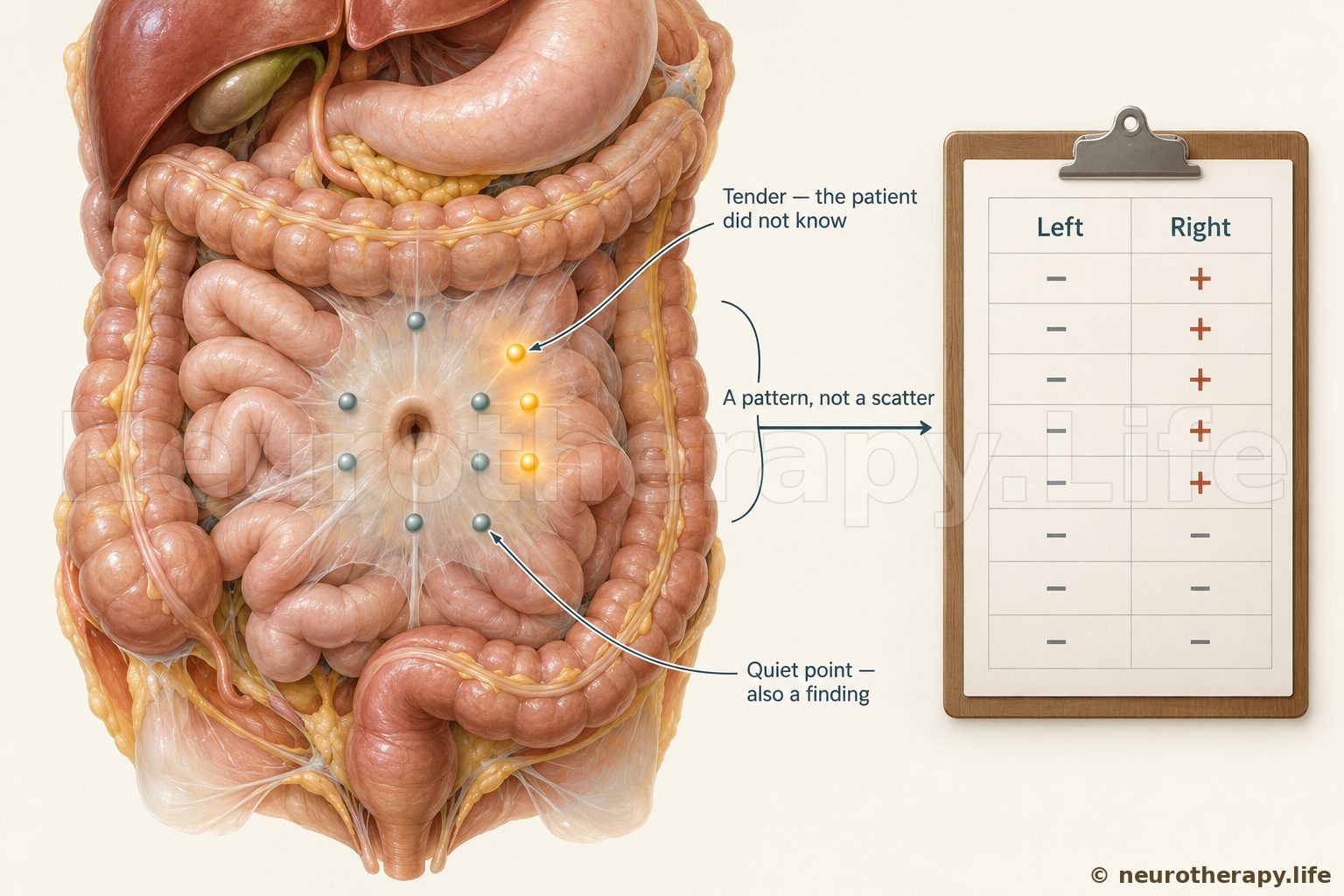
A patient comes because something hurts — a knee, a head, a back. She already knows that pain. What she does not know is what the therapist's fingers are about to find. Very often, the tender spot found around the navel is one the patient never knew was there. ‘Why is there pain here? There has never been pain here!’ is the ordinary sound of a first Neurotherapy (LMNT) examination.
What is discovered often matters more than what the patient came complaining about. The complaint shows where the trouble is felt; the findings show where it is coming from, and the treatment follows the second. So a patient who came about her knees may be told on the first day that her digestion will be worked on, and why.
A minus — a point soft like butter with no reaction — is not a blank. It is a finding. It rules things out. It shows the therapist's hand was gentle enough, because a card with pluses everywhere usually means the hand pressed too hard. And it gives a baseline: when a point that was three plus at the first visit reads one plus a few weeks later, the body has shown what no conversation can.
Tenderness can also be manufactured by mistake: by pressing too hard, holding too long, pressing on bone or an artery instead of soft tissue, or asking a leading question like ‘That hurts, doesn't it?’ A careful therapist guards against all four.
Key points
- The tender spot found is often one the patient never knew she had.
- The complaint shows where trouble is felt; the findings show where it comes from.
- A minus is a real finding, and a good examination almost always has some.
- Too hard, too long, the wrong spot and a leading question can all create a false tenderness.
Go deeper
The Educated Hand: How the Pain Points Are Felt
Guide: The Educated Hand
The Record That Shows the Truth: The Patient Card in Neurotherapy (LMNT)
Guide: The Record That Shows the Truth
Navel
The navel, the centre of the examination
Const
Const — the constipation point
Headache and migraine
Headache and migraine
Constipation
Constipation
Read the full guide
This topic is part of: The Educated Hand: How the Pain Points Are Felt
Safety: when it is held back
- A tender point never means an organ is damaged. The right words are: ‘There is a tender place here. In our system it is connected with how this organ is working, and we will work on it. It does not mean there is damage.’
- A region under caution — a fresh scar, a stoma, a known swelling, a pregnancy or a rigid belly — is not examined, and the card says so and why. When the Hand Must Stop: Blocked Points and Safety in Neurotherapy (LMNT)
- If the trouble increases after any point or formula, the chief therapist is consulted at once, and it is written clearly on the card so that the point is not given again, or is given with proper caution. Reactions after treatment
Watch

An overview of LMNT's diagnostic pain points — the places around the navel that the therapist presses to read the body before choosing a treatment.
This page explains what a Neurotherapy (LMNT) treatment is for; it is not a self-treatment guide and does not diagnose. Neurotherapy (LMNT) works alongside your medical care — keep taking the medicines your doctor prescribed.