The Educated Hand: How the Pain Points Are Felt
Knowing where the pain points are is easy; pressing them so that you find what is really there is a skill. This guide explains how a Neurotherapist examines with soft fingers, grades each finding from minus to four plus, compares the two sides and writes it down.
Overview
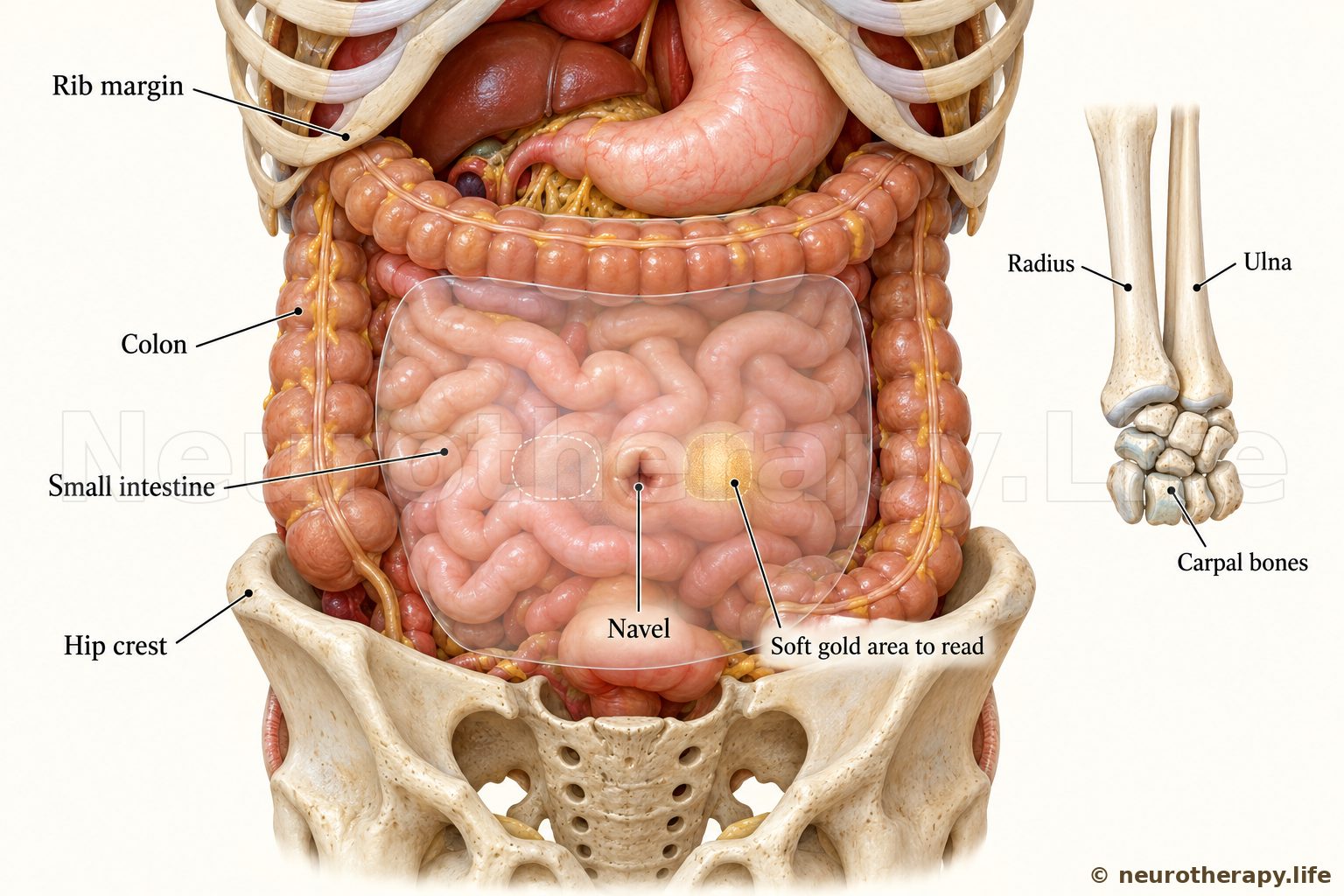
Knowing where the pain points are is easy; pressing them so that you find what is really there is a skill. This guide explains how a Neurotherapist examines with soft fingers, grades each finding from minus to four plus, compares the two sides and writes it down.
The student whose every patient was four plus
This is a teaching case, drawn from what happens in the third week of many teaching batches. A bright student learned the whole chart in a fortnight. When the class began examining one another, every belly he touched was tender — on a room full of healthy young men. His teacher asked him to press the same way on his own healthy forearm. "That hurts," said the student. "Yes," said the teacher. "You did not find these pain points. You made them."
Why the hand has to be taught
The instruction sounds simple: with the tips of the fingers, press inwards, with soft pressure, at certain fixed places. But the word "press" hides four things — how hard, how fast, how deep and how long. A beginner usually gets all four wrong in the same direction, because effort feels like care. A hard press does find more: it finds tenderness in everyone. A test that is positive in everyone tells you nothing.
What the finger really measures is how far it could travel into the body before something pushed back — and, separately, what the patient's face did on the way. A healthy wall lets the finger sink through skin, fat and muscle without objection; the therapy calls this "soft like butter". Where something is wrong, the finger meets a floor early. How early is the finding. The old Indian physicians examined by seeing, touching and asking, and gave the three equal weight; this touch is one third of the examination, never the whole of it.
How an examining press is given
Hands are warm and nails short. A cold hand makes the belly wall tighten, and that tightness reads as hardness that will vanish once the hand warms. The contact is made through the soft pads of the fingers held together — never the thumb, never one finger boring in, never a knuckle. The therapist kneels level with the patient's hip so the forearm comes in flat, and the pressure comes from gently leaning the body's weight through a soft arm, not from squeezing with the fingers. A finger working hard cannot feel.
The patient is told first what will be done. The press goes in slowly, on an out-breath, the eyes on the patient's face rather than the hand, and the fingers lift clear before moving on rather than sliding. A steady press also stops being felt: touch nerves fire when something changes and fall quiet when it does not, so holding longer reveals less, not more. The exact way of pressing is taught hands-on in the course, under a teacher's correction.
The plus-and-minus scale
Every finding is written as plus (pain or stiffness) or minus (none), graded on five steps. The grade is the depth at which the going stops being easy — a ruler laid on its side. Two therapists will never agree whether a patient is "quite tender", but both can answer: at what depth did resistance begin?
- Four plus (++++): the patient cries out at the very lightest touch.
- Three plus (+++): stiffness or pain once the finger has gone a little way in.
- Two plus (++): the surface is soft, but stiffness is felt somewhat deeper.
- One plus (+): soft quite deep down, and only then a mild stiffness.
- Minus (−): soft like butter all the way and no reaction — the blood circulation below is entirely correct.
Left against right
Almost every point has a mirror on the other side: Gal and Spl, Liv and Mu, Dys and Const, Rt.Ov and Lt.Ov, Fluid and Acid, and at the low back Liv° and Mu°. The two are always pressed one after the other, the same way, within a minute. Everything you cannot control — build, muscle, the thickness of the wall, what the patient ate — is shared by both sides and cancels out. Three plus on one side and minus on the other is a finding. Three plus on both is usually a hand pressing too hard.
A useful habit is a fixed route: the two flanks first, because their comparison sorts patients into two great families; then away from the complaint, so the patient does not brace; and from the outer points inward, because the area right around the navel is the most sensitive of all.
The silent finding, and the made-up one
Often the most useful tenderness is one the patient never knew she had. A teaching case: a woman came about migraines; her flanks and front points showed a clear left-sided pattern, and only on exact questions did she admit hard motions every second or third day. Nothing was aimed at her head — the treatment went where the findings pointed, and her headaches eased as her bowel improved.
A minus is not a blank. It rules things out, it proves the hand is not pressing too hard — a card with no minuses is a confession, not a diagnosis — and it is the baseline that lets a later change be seen. Tenderness can also be manufactured in four ways: pressing too hard, pressing too long, pressing over the wrong structure, and leading the patient with the question. Ask "which of these two is worse?", never "does this hurt?" — a kind patient says yes to be helpful.
Grade, write, move
A grade fades from memory in about a minute, and by the end of an examination only the loudest finding, the first and the expected one remain. So each point is graded, written on the card at once, and only then is the next one pressed — minuses included. The card is what lets today be compared with last week; without it the therapist can only feel that things are going well.
A hand is trained on well people: family and fellow students, whose cards should come back mostly minuses. Two therapists examining the same patient, each writing without seeing the other's card, quickly show where a hand has drifted.
Key points
- The finger measures how deep it goes before resistance — not how loudly the patient reacts.
- Press with warm hands and soft finger pads, slowly and gently — never the thumb or a knuckle.
- Every finding is graded from minus to four plus by the depth at which stiffness begins.
- The two sides are always compared; the difference is the finding.
- A minus is a real finding, and a card with no minuses means the hand pressed too hard.
- Ask which side is worse, not whether it hurts.
- Grade, write, move — every point, every time.
Topics in this guide
Go deeper
The Navel Speaks First: The Map of the Pain Points
The map of the pain points
The Two Kingdoms: Acidic and Alkaline Bodies
What the two flanks say: acid and alkali
Before You Touch Anyone: Room, Conduct and Consent
Room, conduct and consent before any touch
The Record That Shows the Truth: The Patient Card in Neurotherapy (LMNT)
How the card keeps the truth of the treatment
Taking a Patient's Story: The History That Cannot Mislead
Asking what the hands cannot feel
The Timed Press: Why Time, Angle and Order Are Fixed
Why treatment time is fixed — and kept out of examination
What goes on a patient's treatment card
How findings are written on the card
Feather Touch: the gentlest treatment, for patients who can bear nothing else
The lightest touch in the therapy
Safety: when it is held back
- Small children, very weak persons and anyone with osteoporosis are examined and treated with the hand only, with the lightest pressure; in frail elders keep off the rib margins and hip crest. Osteoporosis
- In long-standing diabetes, feeling can be dulled and the patient may not warn you of pain — reduce the pressure, not the attention. Diabetes
- A beating cord a little above and left of the navel is the body's great artery, not a pain point. A pulsating swelling that expands under the hand means no abdominal pressure at all and a doctor the same day. How to tell a patient to see a doctor
- The therapist is not feeling for lumps; if one is ever felt, the patient is told plainly and sent to a doctor. Reading the Reports: Which Tests Change the Treatment
- If trouble increases after any point or formula, the chief therapist is asked at once and it is written clearly on the card. The Record That Shows the Truth: The Patient Card in Neurotherapy (LMNT)
Guruji says
“Only they know the pain; you do not.”
Common questions
How do you know where to press? Are you feeling for a lump?
No. These are fixed places, the same on everybody. Each is pressed gently to notice how easily the finger goes in and how your face reacts. Every point is written down, including those where nothing is found.
Will you press hard?
No. Firm enough to feel something, soft enough not to create it. Pressing hard would find pain in everyone and tell the therapist nothing. Say at once if anything is uncomfortable.
Nothing hurt anywhere. Does that mean you cannot help me?
It means several parts of your abdomen are working freely, which is good news. Findings change from day to day, so they are checked again next time. What the hands find is only one part of the picture; what you say and what can be seen are the other two.
My doctor examined my stomach and said it was normal. So why is this sore?
Both can be true. The doctor felt for particular things — an enlarged organ, a swelling — and did not find them, which is worth knowing. Here, set places are pressed to see how freely the wall gives, which speaks of blood flow in a region. Two different questions asked of the same belly.
Watch

An overview of LMNT's diagnostic pain points — the places around the navel that the therapist presses to read the body before choosing a treatment.
Test yourself
Explore more
Organs
Body systems
Diseases
Points
Topics
Read more
This page explains what a Neurotherapy (LMNT) treatment is for; it is not a self-treatment guide and does not diagnose. Neurotherapy (LMNT) works alongside your medical care — keep taking the medicines your doctor prescribed.