Feather Touch: the gentlest treatment, for patients who can bear nothing else
Feather Touch is a very soft stroke with the fingertips, as light as a peacock's feather. It can be given in any position and is used for paralysis, stiffness, pain and diseases of the brain.
Overview
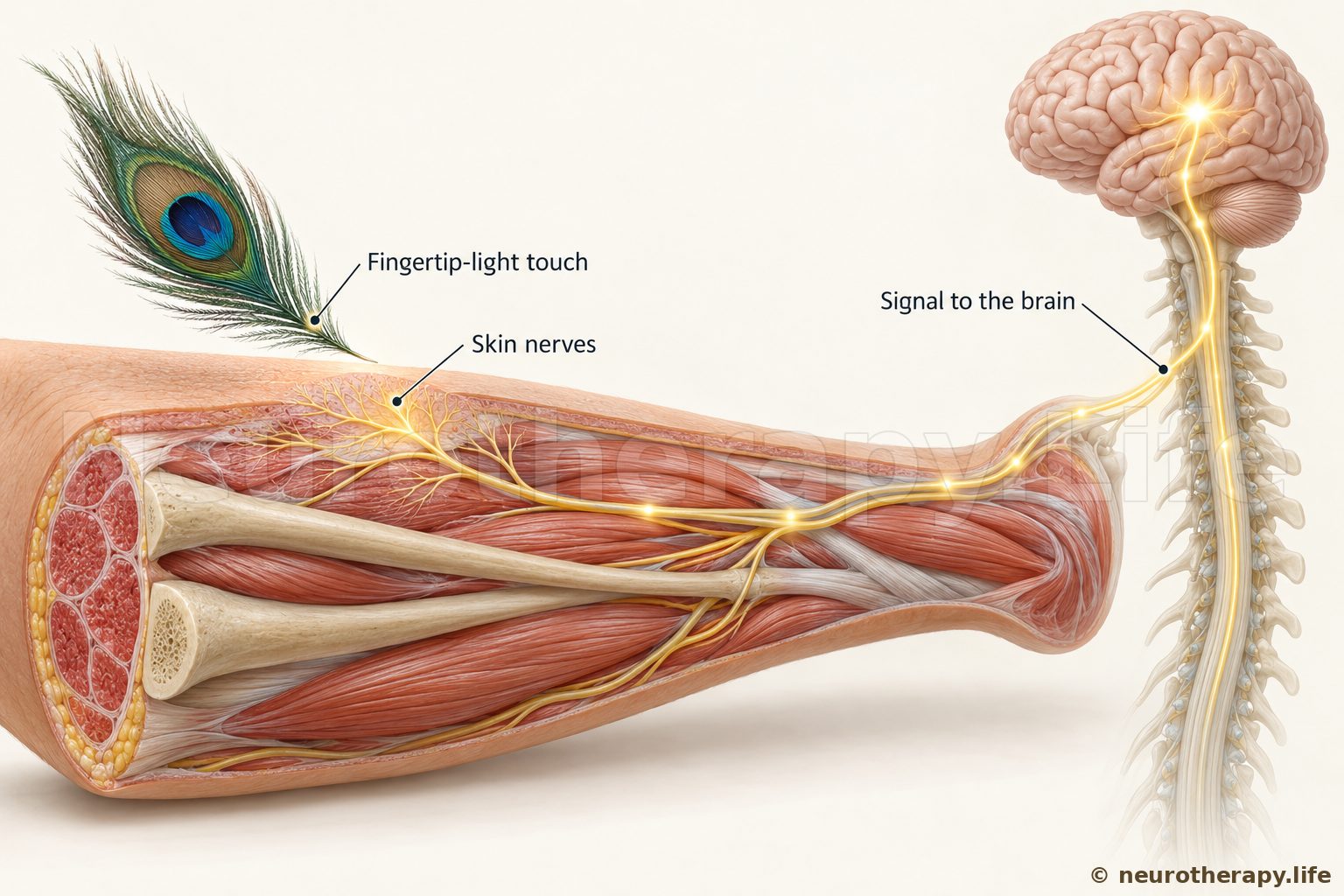
Feather Touch is the softest treatment in Neurotherapy (LMNT). The therapist strokes the needed part of the body with the tips of the fingers, as lightly as a peacock's feather would. There is no weight, no jerk and no position the patient has to hold.
It is given to send impulses, or nerve signals, through the whole body. The source describes it as very helpful in paralysis, stiffness, pain and all diseases of the brain. The patient may lie, sit or be held in any position.
This makes it the treatment of last resort. A newborn, a woman late in pregnancy, a person whose bones break easily, someone in the first days after a stroke, a child who will not be handled, or a patient in too much pain to bear a palm can still receive it when every other treatment is closed.
Guruji taught that the therapist's own state of mind travels with the hand. Calm attention, a wish for the patient's recovery and no ill feeling towards anyone are part of how it is given. Hurry and irritation travel down the arm too.
Body science supports the idea that light touch is a real signal. Skin carries special slow nerve fibres that respond best to slow, gentle stroking, and gentle touch tends to calm the body. The exact way of giving Feather Touch is taught hands-on in the Neurotherapy (LMNT) course.
Key points
- Feather Touch is a fingertip stroke as light as a peacock's feather.
- It can be given in any position, with no weight and no jerk.
- It is used in paralysis, stiffness, pain and diseases of the brain.
- It stays open for patients who can receive nothing else.
- A calm, kind state of mind is part of how it is given.
Go deeper
Paralysis and stroke
Paralysis and stroke: how Neurotherapy (LMNT) supports recovery
Spasticity (stiff, tight muscles)
Stiff, tight muscles and why gentleness matters
Paralysis Clockwise
The limb treatment often given alongside it
Opposite Point
Treating the opposite limb when one cannot be touched
Frail and elderly patients (gentle care)
Gentle care for frail and elderly patients
Nervous system and brain
The nerves that carry touch to the brain
Uncommon Problems: Neurotherapy (LMNT) Points Found One Patient at a Time
The guide to points for uncommon problems
Read the full guide
This topic is part of: Uncommon Problems: Neurotherapy (LMNT) Points Found One Patient at a Time
Safety: when it is held back
- Sudden weakness, a drooping face or slurred speech is an emergency. Call 108/112 at once; Feather Touch is support afterwards, never instead of hospital care. Paralysis and stroke
- Children and frail patients are always given light treatment. Frail and elderly patients (gentle care)
- Neurotherapy (LMNT) works alongside your medical care. Do not stop or change any medicine on your own; ask the doctor who prescribed it.
Guruji says
“Just as, from the mere smell of a bhajiyā — or merely on hearing its name — water comes into the mouth, that is, the body begins to do its own work … This is the very logic of the Feather touch treatment.”
This page explains what a Neurotherapy (LMNT) treatment is for; it is not a self-treatment guide and does not diagnose. Neurotherapy (LMNT) works alongside your medical care — keep taking the medicines your doctor prescribed.